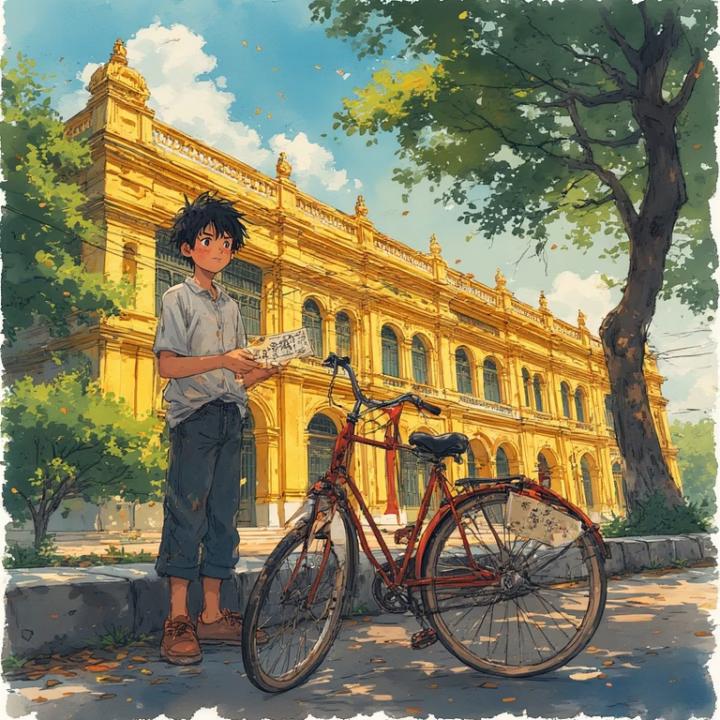
The Saigon Central Post Office is not just a building; it is a giant, yellow dinosaur that breathes dust and old paper. Inside, the ceiling curves like the belly of a whale, and the air smells like sticky glue and the sweet cà phê sữa the guards drink near the entrance.
Thanh wiped sweat from his forehead. He was twelve, and according to his mother, he was “too energetic for his own good.” That was why he’d been sent to help his Auntie Linh at the post office during the summer holidays.
“Thanh! Don’t just stand there looking at the ceiling,” Auntie Linh called out. She was a sharp woman with a bun so tight it seemed to pull her eyebrows up. “Move these crates. The tourists are coming, and we need the floors clear.”
“Aiya, Auntie, it’s so hot,” Thanh complained, but he moved.
He dragged a heavy wooden crate from a dark corner behind the long wooden counters. It snagged on a loose floorboard. CRACK. The bottom of the crate gave way, and a mountain of yellowed envelopes spilled out like dry leaves.
“Oops,” Thanh whispered.
He started scooping them up until his fingers touched something different. It wasn’t a standard envelope. It was thick, wrapped in a piece of faded blue silk, and tucked into a crack in the crate’s wood. He pulled it out. The paper was brittle, the color of a toasted cracker.
The date stamped on the corner made his heart skip: April 28, 1975.
“Two days before the end of the war,” Thanh whispered.
The address was written in beautiful, swirling ink: To Minh, The Girl with the Red Ribbon. 42 Flower Street, District 1.
The Ghost of the Past
Thanh knew he should give it to Auntie Linh, but he also knew she’d just put it in a “Lost and Found” box where it would sit for another fifty years. He slipped the letter into his pocket.
That evening, over a bowl of steaming phở at his grandmother’s house, Thanh brought it up.
“Bà Nội,” he said to his grandmother, who was busy picking herbs. “Where is Flower Street?”
Bà Nội paused, her eyes turning misty. “That name is gone, little bird. After the war, many streets were renamed. Why do you ask?”
Thanh showed her the blue silk bundle. His grandmother’s hands shook as she touched it. “This ink… it’s the style of the old scholars. And that address… Flower Street is now Dong Khoi Street. But the houses there… many are gone.”
“I have to deliver it,” Thanh said firmly.
“It has been nearly fifty years, Thanh,” she sighed. “People move. People disappear like smoke.”
“But what if she’s waiting?”
The Search Begins
The next morning, Thanh didn’t go straight to the post office. He took his bicycle—a creaky old thing he called “The Rusty Dragon”—and pedaled toward District 1.
Saigon was a chaos of motorbikes, bánh mì carts, and shouting vendors. “Hey, watch it, kid!” a delivery driver yelled as Thanh swerved.
“Sorry, uncle!” Thanh shouted back, dodging a basket of durians.
He found the spot where #42 should have been. Instead of an old house, there was a gleaming glass skyscraper selling expensive watches. His heart sank. He felt like a fool. How could a letter from the past find a home in a future made of glass?
He sat on the curb, feeling xui (unlucky). He took the letter out.
“Can I help you, grandson?”
An old man sitting on a plastic stool nearby was sharpening scissors. He wore a faded green cap and had skin like a dried plum.
“I’m looking for ‘The Girl with the Red Ribbon,'” Thanh said, showing the envelope. “She lived here in 1975.”
The old man squinted at the name. “Minh? There were many Minhs. But the one with the red ribbon… she was the daughter of the tailor. When the helicopters came and the city changed, that family moved to the riverside. Near the old canal in District 4.”
“Is she still there?”
The man shrugged. “Who knows? In Saigon, if you want to find someone, you follow the smell of the cooking or the sound of the mahjong tiles.”
The Bridge to the Other Side
Thanh pedaled over the bridge into District 4. This part of the city was different. The buildings were smaller, crowded together like teeth. The air smelled of salt and grilled pork.
He asked the lady selling chè (sweet soup). He asked the man fixing punctures. Everyone shook their heads.
“Don’t waste your time, boy,” a grumpy uncle told him. “Go play video games.”
Thanh was about to give up when he saw a small, crooked house near the water. On the porch sat an old woman. She wasn’t wearing a red ribbon, but she was sewing a dress. A pile of red silk scraps lay at her feet.
Thanh walked up, his knees shaking. “Excuse me, Bà… are you Minh?”
The woman looked up. Her eyes were sharp and clear. “Who is asking?”
“I work at the Post Office,” Thanh said, trying to sound official. “I found this. It’s… a bit late.”
He handed her the blue silk bundle.
The neighborhood went quiet. Even the stray dogs seemed to stop barking. The woman’s fingers traced the ink. She didn’t open it immediately. She held it to her chest and closed her eyes.
“He said he would write,” she whispered. “My Khoa. He was a messenger. He disappeared the day the city fell. I waited at the post office every day for ten years. Then I stopped going.”
“He didn’t forget you,” Thanh said softly. “The letter was stuck in a crack in the wood. It was hiding.”
With trembling hands, she opened the letter. Inside was a dried jasmine flower, now turned to brown dust, and a simple note:
Minh, the gates are closing, but my heart is open. Meet me at the Iron Post at noon. If we are parted, look for the moon; I will be looking at it too. Yours, Khoa.
The Echo of the Letter
The old woman started to cry, but she was smiling. “All this time,” she said. “I thought he ran away. I thought he didn’t care.”
“He was there,” Thanh said. “The letter proves it.”
The woman looked at Thanh and reached into her sewing basket. She pulled out a small, faded red ribbon and tied it to his bicycle handle. “You are a good messenger, little bird. Better than the ones with the big trucks.”
When Thanh returned to the Post Office, Auntie Linh was waiting, hands on her hips. “Where have you been? You missed the afternoon rush!”
“I was delivering mail, Auntie,” Thanh said, leaning his bike against the yellow wall.
“What mail? You don’t have a badge!”
Thanh just smiled and looked up at the grand clock inside the hall. The Post Office felt different now. It wasn’t just a building of dust and paper. It was a place where thousands of hearts were folded into envelopes, waiting for someone to find them.
He realized then that Saigon wasn’t just made of roads and buildings. It was made of stories. And as long as someone was willing to listen, those stories would never truly be lost.
“Auntie,” Thanh said, grabbing a broom. “Are there any more old crates in the back?”
Auntie Linh blinked, surprised. “Well… maybe a few. Why?”
“I think I’m going to like working here,” Thanh laughed, the red ribbon on his bike fluttering in the humid breeze like a tiny, beating heart.
Share this story, Spread the joy or reading
Other Interesting Stories:
Shadows of the Shogun’s Nightingale In the heart of Edo-period Kyoto, a young floor-builder's apprentice named Jiro discovers that his grandfather’s "Nightingale Floors"—designed to sing when stepped upon—are the ultimate defense against intruders. When Jiro…
The Mystery of the Missing Dinosaur The sun hung low in the sky, casting elongated shadows across the sprawling grounds of the Central Valley Dinosaur Park. Children laughed and ran, their squeals echoing as they chased…
The Floating Market of Pangkor This slice-of-life story follows Kai, a 9-year-old boy, as he spends his school holidays helping his family run their food stall at a traditional floating market on Pangkor Island. Through…
The Last Boat to Kukup Fishing Village "The Last Boat to Kukup Fishing Village" follows Mei-Mei, a city girl initially resistant to spending her summer with relatives in a unique stilted fishing village. Through daily chores, traditional…
The Vanishing Trail of the Taiping Lake Gardens During a family holiday in the scenic Taiping Lake Gardens, young Eddy, an aspiring detective, embarks on a mission to find his cousin Bell's lost gerbil, Fluffy. The search quickly…
The Beast and the Firecracker: How the World Turned Red The Beast and the Firecracker is a vibrant reimagining of the Chinese New Year legend, centered on a spunky boy named Eddy and his clever friend Belly. Tired of their…
This mode enables people with epilepsy to use the website safely by eliminating the risk of seizures that result from flashing or blinking animations and risky color combinations.
Visually Impaired Mode
Improves website's visuals
This mode adjusts the website for the convenience of users with visual impairments such as Degrading Eyesight, Tunnel Vision, Cataract, Glaucoma, and others.
Cognitive Disability Mode
Helps to focus on specific content
This mode provides different assistive options to help users with cognitive impairments such as Dyslexia, Autism, CVA, and others, to focus on the essential elements of the website more easily.
ADHD Friendly Mode
Reduces distractions and improve focus
This mode helps users with ADHD and Neurodevelopmental disorders to read, browse, and focus on the main website elements more easily while significantly reducing distractions.
Blindness Mode
Allows using the site with your screen-reader
This mode configures the website to be compatible with screen-readers such as JAWS, NVDA, VoiceOver, and TalkBack. A screen-reader is software for blind users that is installed on a computer and smartphone, and websites must be compatible with it.