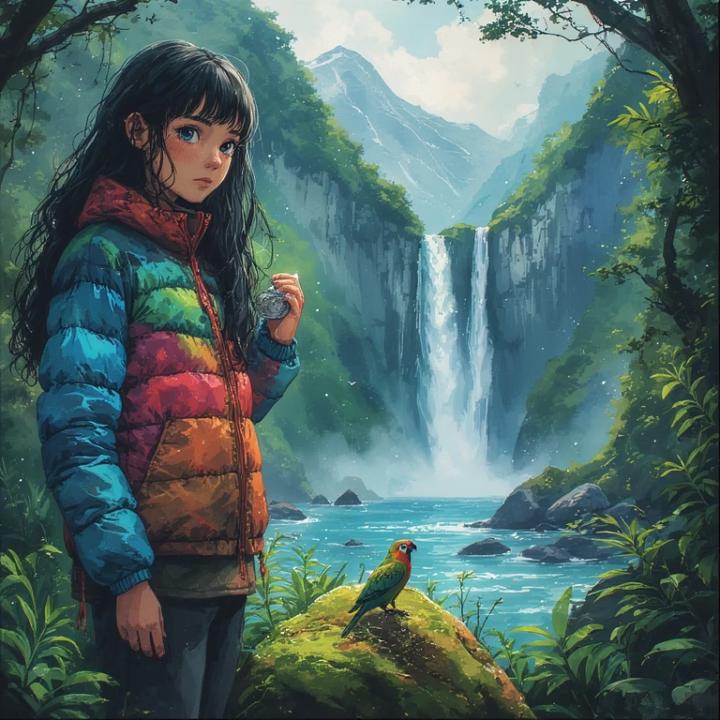
The mist over Piopiotahi—that’s what the locals call Milford Sound—didn’t just sit on the water; it breathed. It crawled up the sheer granite cliffs like a ghostly gecko, hiding the mountain tops from the world.
Twelve-year-old Maia Chen sat on the edge of the school boat’s bench, her puffer jacket zipped up to her chin. Around her, the rest of the Year 8 class from Queenstown were acting like total choice mates—shouting, pointing at seals, and trying to catch raindrops on their tongues. But Maia was quiet. She had her sketchbook open, trying to capture the way the waterfalls looked like silver threads stitched into the dark green bush.
“Maia! Look at that one!” her best friend, Jun-Ho, yelled over the roar of the engine. He pointed toward Stirling Falls. The boat was getting close—the captain was doing the ‘glacial facial,’ driving the bow right under the spray.
“It’s huge!” Maia shouted back, laughing as the freezing mist hit her face.
As the boat nudged toward the rocks near the base of the falls, something caught the light. It wasn’t the white foam of the water. It was a sharp, metallic glint, snagged in a punga fern hanging precariously over a ledge.
“Jun, look,” Maia whispered.
While the other kids were busy getting soaked and screaming, Maia leaned over the railing. The boat’s fender bumped softly against the rock for just a second. In that heartbeat, Maia reached out. Her fingers brushed the wet fronds and closed around something cold and hard.
“What you got there, sis?” Jun asked as she pulled back, her hand dripping.
Maia opened her palm. Resting there was a tarnished silver locket, shaped like a kina shell. It felt heavy, like it was full of secrets.
The Secret Inside
Back on the bus to the lodge, Maia and Jun-Ho huddled in the back seat. Maia used the hem of her hoodie to scrub the grime off the metal.
“Probably just some tourist’s junk,” Jun said, though his eyes were wide. “Or maybe… cursed treasure?”
“Don’t be a egg, Jun,” Maia joked, though her heart was racing.
She found a tiny notch on the side and flicked it with her fingernail. The locket clicked open. There was no photo inside. Instead, a small piece of yellowed, waterproof paper was tucked behind a glass pane. On it, written in faded black ink, were three sets of numbers:
44.6716° S, 167.9258° E44.6750° S, 167.9220° E44.6801° S, 167.9150° E
Below them, a single name: Suki.
“Those are coordinates,” Maia whispered. “And look at the date on the back of the shell.”
Jun squinted. “1924? That’s ancient! That’s like… a hundred years ago.”
Maia looked out the window at the dense, towering beech forest passing by. “My Great-Auntie Suki used to talk about this place. She lived in the Sound when she was a little girl. Her dad worked on the tracks. She told me she lost something precious here before they moved back to the city.”
“You reckon it’s hers?” Jun asked.
“I reckon we’re going for a walk,” Maia replied.
The Hidden Valley
The next morning, the class had ‘exploration time’ near the mouth of the Cleddau River. Their teacher, Mr. Hira, was busy showing a group of students how to identify lichen.
“Stay within earshot!” he called out. “And watch out for the sandflies—they’re hungrier than a pack of wolves today!”
Maia and Jun slipped away toward the first set of coordinates. Maia had downloaded a topographical map on her phone before they lost reception.
“The first spot is just past that big kahikatea tree,” Maia said, pointing toward a wall of green.
The bush was thick and ‘choice’—full of the smell of damp earth and rotting leaves. They scrambled over mossy logs that felt like giant sleeping caterpillars. Finally, they reached a small clearing where an old stone chimney stood, reclaimed by vines.
“This must have been a surveyor’s hut,” Jun said, kicking a rusted tin can.
Maia looked at her phone. “We’re right on top of the first coordinate.”
She looked around. Nestled in a hollow at the base of the chimney was a small, flat stone with a carved symbol—a circle with a line through it. Underneath it was a tiny glass jar. Inside was another note: ‘Where the shadows meet the stone, the history of the Sound is grown.’
“It’s a geocache!” Jun exclaimed. “But an old one. Like, a ‘pre-internet’ one.”
“No,” Maia said, feeling the weight of the locket in her pocket. “It’s a trail. Suki’s dad was a surveyor. He didn’t just map the land; he left stories in it.”
The Sound of the Past
The second coordinate led them higher up a deer track. The air got colder, and the sound of the waterfalls turned into a constant, low thrum that you felt in your bones.
“I’m knackered,” Jun panted, wiping sweat from his forehead. “How much further?”
“Just to that overhang,” Maia said.
They reached a rocky ledge that looked out over the entire Sound. From here, the giant cruise ships looked like bathtub toys. Tucked into a crevice in the rock was an old wooden box, nearly rotten away.
Inside was a diary, wrapped in oilcloth. Maia carefully opened it. The pages were filled with sketches of the Sound—not the tourist version, but the real one. Sketches of Chinese miners who had come searching for greenstone (pounamu), workers building the first tracks, and a little girl playing with a pet weka.
“Look,” Maia pointed to an entry dated October 1924.
‘The mountains are tall, but my heart is taller. I leave my silver kina here, in the heart of the mist. If you find it, you find the soul of the valley. To the one who follows the path: look after the land.’
Suddenly, a loud screech echoed through the trees. A kea—the world’s only alpine parrot—landed on a branch nearby. It cocked its head, its orange underwings flashing like fire.
“Hey there, cheeky fella,” Jun muttered.
The kea hopped down and began tugging at Maia’s shoelaces.
“Wait,” Maia said, watching the bird. It wasn’t just being a nuisance. It was hopping toward the final coordinate path—a narrow, hidden track behind a waterfall that didn’t even have a name.
The Heart of the Sound
The final coordinate took them to a place that felt like the beginning of time. It was a hidden cove, accessible only by a narrow squeeze through the rocks. Inside, the water was perfectly still, reflecting the mountains like a giant mirror.
In the center of the cove was a small memorial cairn—a pile of stones. On top sat a weathered piece of pounamu, smooth and green.
Maia stepped forward. She felt a strange sense of peace, like she was finally meeting the person she was named after. She realized the locket wasn’t just a piece of jewelry. It was a bridge.
She took the locket and placed it in a small hollow in the cairn.
“You’re not keeping it?” Jun asked softly.
“It belongs here,” Maia said. “Suki didn’t lose it by accident. She left it for the Sound. It’s a gift back to the place that gave her so many stories.”
As she spoke, the mist began to swirl around them. For a second, Maia thought she saw the reflection of a young girl in the water, wearing the same puffer jacket she was, but with eyes that had seen the world a century ago. The girl smiled and waved.
“Let’s get back,” Maia said, feeling a warmth in her chest that had nothing to do with the weather. “Mr. Hira’s gonna have a cow if we’re late for the bus.”
The Journey Home
They made it back just as the bus driver was honking the horn.
“Where have you two been?” Mr. Hira asked, though he didn’t look too cross. “You’re covered in mud and looking like you’ve been through the ringer.”
“Just exploring, sir,” Jun-Ho said with a wink at Maia. “Finding some local history.”
As the bus pulled away, winding through the Homer Tunnel and away from the misty peaks, Maia opened her sketchbook. She didn’t draw the waterfalls this time. She drew a silver locket, shaped like a kina, resting on a bed of green stone.
She realized that you didn’t need to own something to keep it. The mystery of the Sound wasn’t in the silver—it was in the way the mountains whispered to those who were quiet enough to listen.
“Sweet as,” she whispered to herself, looking out at the fading peaks. “Sweet as.”
In New Zealand, the phrase “Sweet as” is a quintessential piece of Kiwi slang used to express that something is excellent, “cool,” or perfectly fine. While it sounds like the start of a comparison, the second half is left off, using the “as” simply to intensify the feeling—meaning “as sweet as can be.” Whether a person is agreeing to a plan, accepting an apology, or admiring a beautiful view like the one at Milford Sound, “Sweet as” serves as a versatile, laid-back way to say that everything is great and there are no worries.
Share this story, Spread the joy or reading
Other Interesting Stories:
The Secret of the Silvered Leaf A group of friends – Mika, Siti, Raj, and Mei Lin – on a nature camp in the Selangor forest, discover a mysterious encoded message hidden within the unique "Crown…
The Boulders of Moeraki Sophie, a girl struggling with her family's move from Auckland to rural Otago, visits the mysterious Moeraki Boulders. She discovers the spherical stones hold ancient memories and stories from Māori…
The Shimmering Surprise of Seabrook In the secluded town of Seaside Pines, there lived a quirky old sailor named Chen "Chili Peppers" Wu. Chen was a retired fishing captain known for his love of green…
Sticky Rice and Second Chances In the heart of Penang, when the struggling Youth Dragon Boat team faces disbandment due to lack of funds, determined rowers Eddy and Anna refuse to give up—instead launching a…
The Pocketful of Tomorrow A young girl relocates to a new place carrying seeds from her old home, struggling to adapt while clinging to memories of where she came from. As she learns to…
When the Screens Went Asleep When every digital screen in Kampung Seri Paya mysteriously falls asleep at the same time, a curious boy and his friends uncover a hidden magical grove where old technology rests…
This mode enables people with epilepsy to use the website safely by eliminating the risk of seizures that result from flashing or blinking animations and risky color combinations.
Visually Impaired Mode
Improves website's visuals
This mode adjusts the website for the convenience of users with visual impairments such as Degrading Eyesight, Tunnel Vision, Cataract, Glaucoma, and others.
Cognitive Disability Mode
Helps to focus on specific content
This mode provides different assistive options to help users with cognitive impairments such as Dyslexia, Autism, CVA, and others, to focus on the essential elements of the website more easily.
ADHD Friendly Mode
Reduces distractions and improve focus
This mode helps users with ADHD and Neurodevelopmental disorders to read, browse, and focus on the main website elements more easily while significantly reducing distractions.
Blindness Mode
Allows using the site with your screen-reader
This mode configures the website to be compatible with screen-readers such as JAWS, NVDA, VoiceOver, and TalkBack. A screen-reader is software for blind users that is installed on a computer and smartphone, and websites must be compatible with it.