When the school bell rang on the last day before the holidays, Arif already knew where he would be spending most of his time. Not the beach. Not the mall with his cousins. Not even at home gaming until his eyes went square.
He would be with Tok Aki and the trishaw.
“Eh, boy, tomorrow you come early ah,” Tok Aki had said the night before, sipping kopi from a chipped mug. “Morning air got good mood. City also still waking up.”
Arif nodded, even though part of him felt lazy just thinking about waking up before sunrise. He was twelve already, after all. Holidays were meant for sleeping late. But when Tok Aki spoke like that—slow, steady, like each word mattered—it was hard to say no.
Tok Aki was his grandfather, but everyone else in George Town just called him Uncle Aki. Some tourists called him Sir, some called him Boss, and some didn’t call him anything at all. They just pointed at the trishaw, eyes wide, cameras ready.
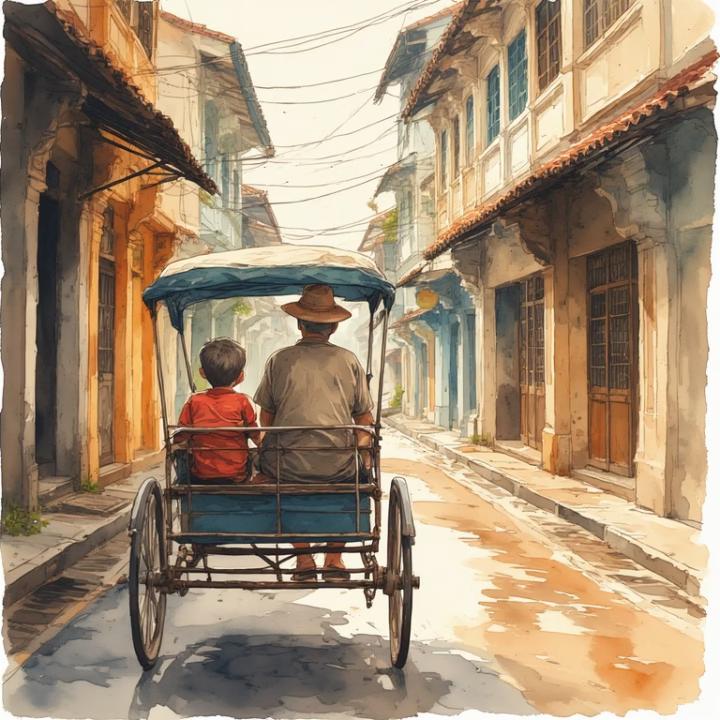
The trishaw stood under the mango tree beside their shophouse, old but proud. The red paint had faded into something closer to pink. The bell on the handlebar gave a soft kring instead of a loud ring. The seat cushion had been patched so many times it looked like a quilt.
“Last one already,” Tok Aki always said, patting the handle. “Last trishaw in this part of town.”
Arif wasn’t sure if that was true, but it felt true.
The next morning, Arif woke to the sound of pigeons fluttering on the roof and Tok Aki humming an old tune. The air smelled like wet stone and leftover rain. George Town always smelled different in the morning—cool, salty, with a hint of kopi and frying dough from somewhere far away.
They pushed the trishaw out together, its wheels groaning softly.
“Careful, don’t knock the wall,” Tok Aki said.
“I know lah,” Arif replied, steering gently. The streets were narrow, lined with old buildings that leaned slightly forward, like they were trying to listen.
They rode slowly through Lorong Pintal Tali, past closed shops with metal shutters painted in bright colours. A stray cat stretched and yawned, watching them pass.
“Why you still do this, Tok?” Arif asked suddenly. “You can rest already. Uncle Rahman say trishaw no future.”
Tok Aki chuckled. “Future always come whether you like it or not. But heartbeat? That one you must listen.”
Arif frowned. “City got heartbeat meh?”
Tok Aki smiled but didn’t answer. He pedalled on.
By mid-morning, the sun had climbed higher, and the streets were alive. Tourists appeared like colourful birds—hats, backpacks, water bottles swinging. The trishaw bell rang softly as Tok Aki navigated the crowd.
“Slow, slow,” Tok Aki muttered. “City don’t like to be rushed.”
A couple from somewhere far away waved them down. The woman had freckles and the man carried a big camera.
“Can you take us around?” the man asked.
Tok Aki nodded. “Short ride or long ride?”
“Long,” the woman said. “We want to see the real town.”
Tok Aki grinned. “Then you choose the right trishaw.”
Arif climbed onto the back footrest, holding onto the frame. As they rolled along, Tok Aki pointed things out—not with his finger, but with stories.
“This road last time got rickshaw jam,” he said. “People argue until ayam also stop crossing.”
The tourists laughed.
“That shophouse there, used to sell paper fans. During hot season, whole street sound like fwap fwap.”
Arif listened, surprised. He’d walked these streets many times, but he’d never really heard them like this.
They passed a mural half-hidden by a parked motorcycle. A street vendor stirred a pot, the spoon clinking rhythmically. Somewhere above, someone practiced violin, the notes floating down like thin threads.
The tourists tipped generously when they got off.
“Thank you for the stories,” the woman said.
Tok Aki bowed slightly. “Stories belong to the city. I just borrow.”
During lunch, they sat by the jetty, sharing nasi lemak wrapped in brown paper.
“Tok,” Arif said, mouth full, “how you remember so many things?”
Tok Aki chewed slowly. “Because I move slow. When you rush, memory cannot catch up.”
Arif thought about his friends, always rushing—rushing to grow taller, to get better phones, to be older. He wondered what memories they were leaving behind.
After lunch, the sky darkened slightly. Clouds gathered, thick and heavy.
“Rain coming,” Tok Aki said. “Good time.”
“Good time for what?”
“For listening.”
The rain began as a soft tapping, then grew louder. They sheltered under a five-foot way, the trishaw parked beside them. The city changed its sound—rain drumming on tin awnings, water rushing along drains, laughter echoing louder in the quiet spaces.
Arif closed his eyes.
He heard footsteps splashing. A radio playing an old song. The rain softened everything, like the city was breathing out.
“Tok,” Arif said softly, “is this the heartbeat?”
Tok Aki looked at him, eyes shining. “One of them.”
Later that afternoon, they rode past a group of boys on bicycles. One of them shouted, “Eh, trishaw still exist ah!”
Arif felt a pinch of anger, but Tok Aki just laughed.
“Exist because still needed,” he said.
“But who need slow?” Arif asked. “Everyone want fast.”
Tok Aki stopped the trishaw and rested his feet on the ground.
“You see that uncle there?” He nodded toward an old man sitting outside a shop, feeding birds. “If you rush past him, he just background. If you slow down, you see his hands shaking, his smile gentle. You see life.”
Arif followed his gaze. The old man looked up and waved.
Arif waved back.
Something warm settled in his chest.
On the last day of the holidays, Arif woke up early without being asked. The mango tree leaves rustled softly. The trishaw waited.
They rode together one more time through the narrow streets. Tok Aki pedalled, Arif rang the bell—kring, soft and clear.
People turned. Some smiled. Some stared. Some didn’t notice at all.
But Arif noticed everything.
The cracks in the road. The smell of morning bread. The way the city hummed, steady and alive.
When they returned home, Tok Aki wiped the trishaw carefully.
“One day,” he said, “this trishaw maybe cannot move already.”
Arif swallowed. “Then what?”
Tok Aki smiled. “Then you carry the listening. City heartbeat don’t belong to trishaw. It belong to people who slow down.”
Arif nodded.
That night, as he lay in bed, he realized something had changed. He didn’t feel like rushing anymore.
Because sometimes, the slowest way was the only way to hear what really mattered.
And George Town was still beating.
Share this story, Spread the joy or reading
Other Interesting Stories:
When the Screens Went Asleep When every digital screen in Kampung Seri Paya mysteriously falls asleep at the same time, a curious boy and his friends uncover a hidden magical grove where old technology rests…
The Last Boat to Kukup Fishing Village "The Last Boat to Kukup Fishing Village" follows Mei-Mei, a city girl initially resistant to spending her summer with relatives in a unique stilted fishing village. Through daily chores, traditional…
The Vanishing Trail of the Taiping Lake Gardens During a family holiday in the scenic Taiping Lake Gardens, young Eddy, an aspiring detective, embarks on a mission to find his cousin Bell's lost gerbil, Fluffy. The search quickly…
The Floating Market of Pangkor This slice-of-life story follows Kai, a 9-year-old boy, as he spends his school holidays helping his family run their food stall at a traditional floating market on Pangkor Island. Through…
A Journey on the Melaka River Cruise This slice-of-life story follows Jali, a young boy working on the Melaka River Cruise during his school holidays. Through his interactions with diverse passengers like the wise Uncle Tan and…
The Owl Who Was Scared of the Dark Aru, an owl who prefers daylight and fears the dark, is unexpectedly chosen to guide a forest festival during a stormy night. Struggling with his fear, he learns to rely…
This mode enables people with epilepsy to use the website safely by eliminating the risk of seizures that result from flashing or blinking animations and risky color combinations.
Visually Impaired Mode
Improves website's visuals
This mode adjusts the website for the convenience of users with visual impairments such as Degrading Eyesight, Tunnel Vision, Cataract, Glaucoma, and others.
Cognitive Disability Mode
Helps to focus on specific content
This mode provides different assistive options to help users with cognitive impairments such as Dyslexia, Autism, CVA, and others, to focus on the essential elements of the website more easily.
ADHD Friendly Mode
Reduces distractions and improve focus
This mode helps users with ADHD and Neurodevelopmental disorders to read, browse, and focus on the main website elements more easily while significantly reducing distractions.
Blindness Mode
Allows using the site with your screen-reader
This mode configures the website to be compatible with screen-readers such as JAWS, NVDA, VoiceOver, and TalkBack. A screen-reader is software for blind users that is installed on a computer and smartphone, and websites must be compatible with it.