In the heart of Kuching, where the Sarawak River winds like a sleeping crocodile, lived a boy named Zafri. At twelve years old, Zafri wasn’t interested in mobile games or football. Instead, he spent his afternoons helping his grandmother, Nenek Rohaya, at her small wooden food stall tucked between an old temple and a towering rain tree.
Nenek’s stall didn’t have a fancy neon sign. It only had a handwritten board that said: Laksa Sarawak Power.
“Zafri! Go wash the beansprouts! Don’t just stand there daydreaming about the clouds,” Nenek called out, her voice raspy but kind.
“Coming, Nek!” Zafri chirped. He loved the smell of the stall—the pungent, earthy scent of shrimp paste, the zing of lime, and the creamy richness of coconut milk. To Zafri, Sarawak Laksa wasn’t just breakfast; it was the soul of the city in a bowl.
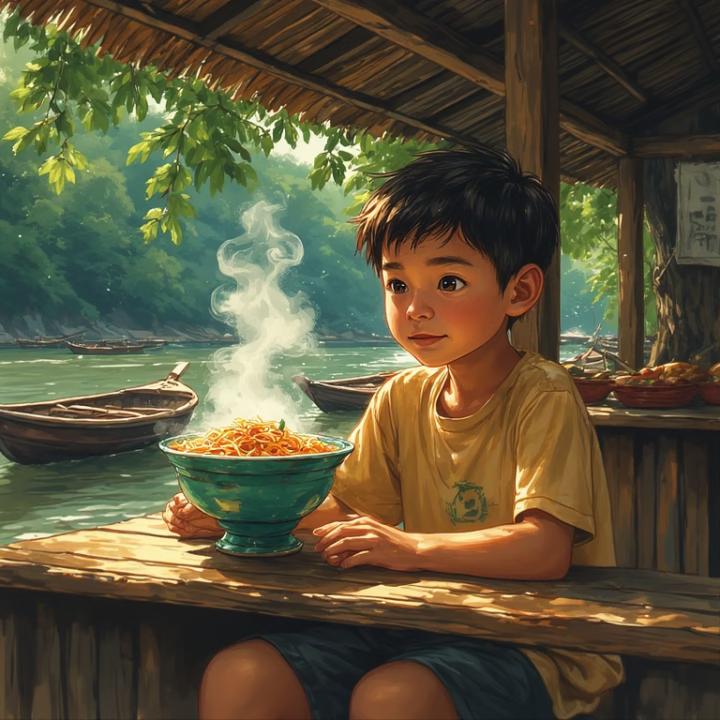
One rainy Tuesday, while scrubbing the floor near the riverbank, Zafri’s brush hit something hard buried in the mud. He reached down and pulled out a bowl. It wasn’t plastic or cheap ceramic. It was heavy, made of thick, sea-green stoneware with hand-painted swirls that looked like waves.
“Eh, what is this?” Zafri muttered. He washed it in the river. As the mud cleared, the bowl seemed to glow with a soft, pearly light. It was beautiful.
“Nenek, look what I found!”
Nenek Rohaya put on her spectacles and squinted. Her eyes widened. “Aiyoo, Zafri. This looks like the old ‘Weather-Maker’s Ware.’ My own grandmother told stories about these. People say they were fired in a kiln fueled by lightning.”
Zafri laughed. “Nenek, you and your ghost stories! Can I use it for my lunch?”
Nenek shrugged. “It’s just a bowl, lah. But wash it with salt first, just in case.”
Zafri scrubbed the bowl until it shined. For lunch, he ladled a generous portion of Nenek’s spicy broth over rice vermicelli, topped it with shredded chicken, omelet strips, and fresh prawns. He squeezed a lime over it, the citrus scent cutting through the spice.
As the hot steam rose from the sea-green bowl, something strange happened. The steam didn’t just vanish into the air. It began to swirl and thicken, forming shapes right above the noodles.
Zafri froze, his spoon halfway to his mouth. Inside the steam, he saw a miniature version of the Kuching Waterfront. He saw the brightly colored sampans (boats) crossing the river. Suddenly, in the steam-vision, a massive dark cloud rolled in, and a bolt of purple lightning struck the water.
“Wah! What is this?” Zafri gasped.
“What’s wrong, boy? Is it too spicy?” Nenek asked, busy frying keropok.
“Nek! Look at the steam! It’s showing a storm!”
But when Nenek looked, she only saw steam. “It’s just heat, Zafri. Eat your food before it gets cold. Jangan main-main (Don’t play around).”
Zafri ate the laksa. It tasted better than usual—deeper, warmer, with a hint of something like ozone. Half an hour later, the sky over Kuching, which had been perfectly clear, suddenly turned charcoal black. A violent thunderstorm cracked across the sky, exactly like the one in the steam.
Zafri’s heart raced. The bowl told me, he thought.
Over the next week, Zafri tested his theory. Every morning, he ate a small portion of laksa from the green bowl.
On Wednesday, the steam showed a light drizzle and a beautiful double rainbow. By 2:00 PM, the rainbow appeared over the State Assembly building.
On Thursday, the steam stayed perfectly flat and thin. Not a single drop of rain fell all day, even though the radio weather-man said it would pour.
Zafri became the “Weather Boy” of the neighborhood. He started telling the local fisherman, Uncle Mutu, when to tie up his boat and warning the aunties when to bring in their laundry.
“Oi, Zafri! Should I dry my salted fish today?” Uncle Mutu would shout.
“Wait until tomorrow, Uncle! The bowl says big wind is coming!” Zafri would yell back.
People started calling him Budak Magik (Magic Boy). Zafri loved the attention. He felt important. He felt like he finally had a superpower. But Nenek Rohaya looked worried.
“Zafri,” she said one evening as they closed the stall. “The bowl is a gift, but don’t get too arrogant (sombong). The weather belongs to the sky, not to a bowl of noodles.”
“I’m just helping people, Nek!” Zafri argued.
“Just remember,” she warned. “Some things are meant to be a surprise.”
The biggest event of the year was approaching: the Sarawak River Regatta. It was a massive boat race that brought thousands of tourists to the city. Zafri’s older cousin, Arif, was the captain of the local village team. They had practiced for months.
The night before the race, the whole town was buzzing. But the official weather reports were grim. They predicted a massive monsoon surge that would cancel the festival.
“If it cancels, we lose all the prize money, Zafri,” Arif said, looking defeated. “The village needs that money to fix the community hall.”
“Let me check,” Zafri said confidently.
He prepared the laksa. He sat in the quiet of the stall and watched the steam. This time, the vision was different. He saw the river, calm as a mirror. He saw the sun shining so brightly the water looked like liquid gold.
“The sun will shine!” Zafri announced. “The weather-man is wrong. The bowl says it will be the clearest day of the year!”
The news spread like wildfire. Based on Zafri’s word, the organizers decided to proceed. The food vendors bought thousands of ringgit worth of ingredients. The boat teams traveled from far-away districts. Everyone was counting on Zafri’s bowl.
But that night, Zafri couldn’t sleep. He looked at the bowl sitting on his bedside table. For the first time, the sea-green swirls looked agitated, like trapped spirits.
The morning of the Regatta arrived. The sky was blue. The sun was hot. Zafri felt like a king. “See, Nenek? I told you!”
The races began. The drumbeats echoed across the water—boom, boom, boom!—as the longboats sliced through the river. Thousands of people lined the banks, cheering and eating grilled meat on sticks.
But at noon, Zafri felt a sudden chill. The air became heavy and “sticky.” He ran to the stall and quickly poured some hot broth into the bowl. He didn’t even add noodles; he just needed the steam.
The steam rose, but it wasn’t showing the weather anymore. It showed a face. It was an old, watery face with eyes like deep pools. The face looked sad. Then, the steam exploded outward, hitting Zafri in the face with a blast of cold air.
Suddenly, the sky didn’t just turn dark; it turned purple.
A “Sumatra” storm—a sudden, violent squall—hit the river with terrifying force. The wind roared like a tiger. The calm river turned into a washing machine of white-capped waves.
“Get out of the water!” Nenek screamed.
Chaos erupted. The racing boats, thin and long, were not built for these waves. Zafri watched in horror as his cousin Arif’s boat flipped over. Men were screaming, struggling in the murky water. The tents on the riverbank were being ripped away by the wind.
“Arif!” Zafri cried. He realized his mistake. He had been so proud of his “power” that he hadn’t noticed the bowl was trying to warn him that the weather was changing because of the heat. Or perhaps, the bowl was showing him what he wanted to see because he had used it for fame, not for safety.
Zafri grabbed the bowl and ran to the edge of the river. The wind almost knocked him over.
“I’m sorry!” he yelled into the storm. “I don’t want to know the future! I just want everyone to be safe!”
He remembered what Nenek said: The weather belongs to the sky.
In a moment of desperation, Zafri threw the bowl. It soared through the air, a flash of sea-green against the purple clouds, and splashed into the center of the river.
As soon as the bowl sank, the wind died down. The rain didn’t stop, but the violent waves flattened instantly. The current slowed, allowing the rescue boats to reach Arif and the other paddlers.
Everyone was soaked and shivering, but they were alive.
The festival was ruined, but the people were safe. Zafri spent the rest of the day helping Nenek give out free hot soup to the rescued paddlers. He didn’t use a magic bowl; he used the old plastic ones they had used for years.
“I lost it, Nek,” Zafri whispered, looking at the river. “The bowl is gone.”
Nenek wrapped a dry towel around his shoulders. “Maybe it went back to where it belongs. You were trying to control the wind, Zafri. Even the kings of old couldn’t do 그게 (that).”
“I just wanted to be special,” Zafri admitted.
Nenek smiled and handed him a spoon. “You make the best laksa in Kuching, even without a magic bowl. That is special enough.”
A few weeks later, Zafri was walking by the river. The water was calm. He looked down and saw a flash of sea-green deep in the silt. He paused, thinking about reaching for it. Then, he looked up at the clouds. They were grey and puffy, drifting slowly toward the mountains.
He didn’t know if it would rain in an hour, and for the first time in a long time, he realized he didn’t need to know. He felt the wind on his face, smiled, and walked back to the stall to help Nenek prep the lime and sambal.
The sky would do what the sky would do. And Zafri would just make the laksa.
Share this story, Spread the joy or reading
Other Interesting Stories:
The Pocketful of Tomorrow A young girl relocates to a new place carrying seeds from her old home, struggling to adapt while clinging to memories of where she came from. As she learns to…
The Taste of Grandma's Asam Laksa "The Taste of Grandma's Asam Laksa" is a heartwarming children's story about Lily and Eddy, who embark on an adventurous quest through the vibrant streets of Penang to find the…
The Penang Sentral Food Court’s Friendship Feast In the lively heart of George Town, Penang, a bustling food court becomes the backdrop for an extraordinary journey of connection as children from diverse cultural backgrounds—Malay, Chinese, Indian, Korean,…
Letters from the Banana Leaf In the bustling morning market of Kuala Lumpur, twelve-year-old Lina discovers a fragile letter from 1957 hidden within a bundle of banana leaves—written by a girl named Siti to her…
When the Screens Went Asleep When every digital screen in Kampung Seri Paya mysteriously falls asleep at the same time, a curious boy and his friends uncover a hidden magical grove where old technology rests…
The Girl Who Talked to Rain Trees In the heart of a changing Malaysian neighborhood, twelve-year-old Maya copes with her father’s absence by confiding in an old rain tree outside her flat in Taman TAR. When developers…
This mode enables people with epilepsy to use the website safely by eliminating the risk of seizures that result from flashing or blinking animations and risky color combinations.
Visually Impaired Mode
Improves website's visuals
This mode adjusts the website for the convenience of users with visual impairments such as Degrading Eyesight, Tunnel Vision, Cataract, Glaucoma, and others.
Cognitive Disability Mode
Helps to focus on specific content
This mode provides different assistive options to help users with cognitive impairments such as Dyslexia, Autism, CVA, and others, to focus on the essential elements of the website more easily.
ADHD Friendly Mode
Reduces distractions and improve focus
This mode helps users with ADHD and Neurodevelopmental disorders to read, browse, and focus on the main website elements more easily while significantly reducing distractions.
Blindness Mode
Allows using the site with your screen-reader
This mode configures the website to be compatible with screen-readers such as JAWS, NVDA, VoiceOver, and TalkBack. A screen-reader is software for blind users that is installed on a computer and smartphone, and websites must be compatible with it.