The humidity in Cuc Phuong National Park didn’t just hang in the air; it hugged you like a wet, warm blanket. For twelve-year-old Lam, this was the smell of home—damp earth, rotting leaves, and the sweet, hidden scent of wild orchids.
Lam was a “junior volunteer,” which mostly meant he spent his afternoons scrubbing metal cages and chopping endless piles of papaya. While his friends in the city were busy playing mobile games or hanging out at tea shops, Lam was covered in bear poop and sweat.
“Aiyoo, Lam! Move faster-lah!” Uncle Vinh shouted, wiping his forehead with a stained rag. Uncle Vinh was the head keeper, a man with skin like ancient tree bark and a heart that was probably just a giant lump of gold. “The new guest is arriving. He’s very stressed, very gan cheong. We need his enclosure to be perfect.”
The “new guest” was a sun bear cub rescued from a bile farm. When the truck finally pulled into the rescue center, the atmosphere changed. Usually, the center was full of the sounds of gibbons hooting and birds chirping, but as the small wooden crate was lowered, a heavy silence fell.
Inside was a tiny, ragged ball of black fur. He had the classic golden crescent moon shape on his chest, but his coat was dull, and his eyes were clouded with fear.
“We will call him Kopi,” Uncle Vinh decided. “Because he is small and dark, like a strong cup of coffee.”
But Kopi didn’t act like coffee. He didn’t have any energy. For three days, the cub sat in the corner of his recovery den, staring at the concrete floor. He refused the sweet honey-water. He ignored the ripe bananas. He wouldn’t even look at the high-protein biscuits the vets provided.
“He’s giving up,” whispered Mai, another volunteer. “His spirit is broken. If he doesn’t eat by tomorrow, his organs will start to fail.”
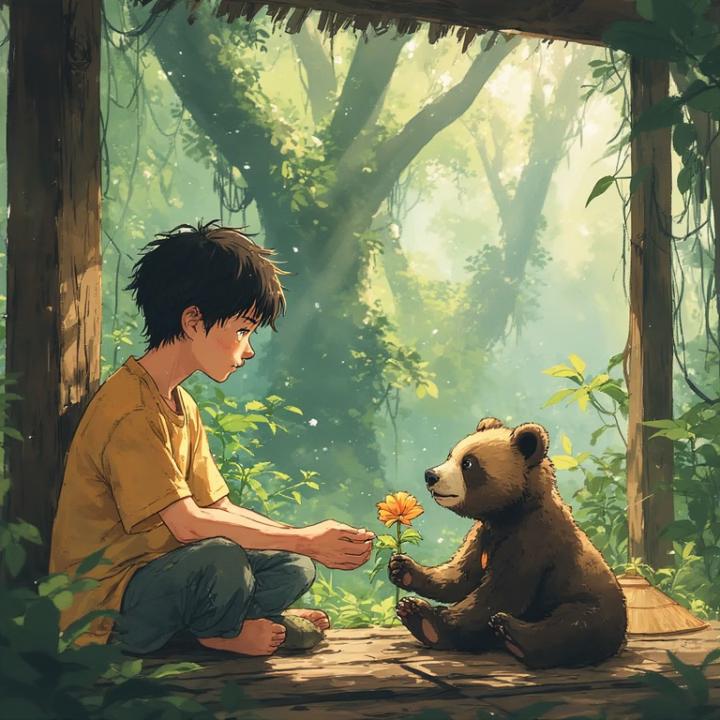
Lam felt a sharp tug in his chest. He stayed late that night, sitting cross-legged outside Kopi’s mesh fence. “Hey, little brother,” Lam whispered. “You’re safe now. No more cages. No more bad people. Why won’t you eat?”
Kopi didn’t move. He just let out a tiny, shaky breath that sounded like a sob.
Lam looked around the sterile rescue center. It was clean and safe, but it was noisy in the wrong way. The hum of the electric fans, the clatter of metal bowls, the distant sound of a motorbike on the main road.
It doesn’t sound like home, Lam realized.
Lam remembered his grandmother’s stories. She used to say that every creature in the forest has a song, and if you forget your song, you forget how to live.
He stood up and grabbed a bamboo basket. “I’ll be back, Kopi. Don’t go anywhere-ah.”
Lam slipped into the dark edges of the primary forest. The elders said you shouldn’t go into the woods at night because of the ma (ghosts), but Lam wasn’t afraid. He listened. He heard the crrr-pock of the forest frogs. He heard the rhythmic woosh-woosh of a hornbill’s wings. He heard the wind whispering through the giant Parashorea trees.
He began to collect things. Not just food, but pieces of the forest. He gathered damp moss that smelled of rain. He found a hollow bamboo stalk. He picked wild ginger flowers and a handful of fallen termite mound earth.
When he returned to the den, Uncle Vinh was there, looking worried. “What are you doing with that rubbish, boy?”
“It’s not rubbish, Uncle. It’s a memory,” Lam said.
Lam stepped into the service area of the enclosure. He didn’t go inside—Kopi was still a wild animal, and a frightened bear can be dangerous—but he placed his “gifts” right against the mesh.
He took the hollow bamboo and blew into it, mimicking the low, booming hoot of a Great Hornbill. Hoo… Hoo…
Then, he began to hum a melody his grandmother used to sing, a slow, swaying tune that mimicked the movement of the canopy in a summer breeze. As he sang, he scratched the damp moss against the wood, creating a soft, rustling sound like a bear mother grooming her cub.
For the first time in days, Kopi’s ears flicked.
Lam didn’t stop. He used a small stick to tap out the rhythm of falling rain on the bamboo. He pushed the wild ginger flowers through the mesh. The spicy, fresh scent filled the small space, cutting through the smell of disinfectant.
Kopi’s nose twitched. Sniff. Sniff-sniff.
The cub slowly, painfully, uncurled himself. He crawled toward the scent of the ginger. Lam’s heart was drumming against his ribs like a frantic moth. Please eat. Please.
Lam picked up a piece of honeycomb he had hidden in his pocket—real forest honey, still waxy and sticky. He placed it on top of a fresh leaf and slid it under the gate.
“Eat, Kopi. This is the taste of the sun.”
Kopi reached out a long, curved claw. He touched the honey. Then, he licked his paw. His black eyes met Lam’s. There was no more “blur” in his gaze. He took a bite, then another. He began to eat with a desperate, messy hunger.
Uncle Vinh, who had been watching from the shadows, let out a long breath he had been holding. “Wah, you really did it, Lam. You brought the forest to him.”
Over the next few weeks, Lam became Kopi’s official “music teacher.” He didn’t use instruments, just his voice and the things he found in the woods. He taught Kopi that the sound of a rustling leaf meant hidden grubs. He taught him that the sound of a distant stream meant a cool bath.
Kopi grew strong. His fur began to shine like polished onyx. He became a “naughty” bear, constantly trying to steal Lam’s sandals or climbing the wooden platforms in his enclosure with surprising speed.
One afternoon, a year later, it was time. Kopi was no longer a cub; he was a sturdy young bear, ready to return to the deep green heart of Cuc Phuong.
The release team trekked deep into the core zone, far away from any human paths. When they opened the door of the transport crate, Kopi didn’t run away immediately. He stepped out onto the soft forest floor, his claws sinking into the familiar moss.
He turned back and looked at Lam.
Lam didn’t say goodbye. Instead, he cupped his hands and made the low, soft hoot of the hornbill—the sound that had first woken Kopi up.
Kopi huffed, a happy, chuffing sound, and then vanished into the emerald shadows. He didn’t need Lam’s songs anymore. He had found his own.
“Don’t be sad-lah,” Uncle Vinh said, patting Lam’s shoulder. “He is home.”
Lam smiled, wiping a stray tear with his grimy sleeve. “I’m not sad, Uncle. I’m just listening. Can you hear that?”
Deep in the trees, a branch snapped, and a bird called out. The forest was singing, and for the first time, Lam knew exactly what it was saying.
Share this story, Spread the joy or reading
Other Interesting Stories:
Between the Pages of Now "Why can't we go outside today?" little BB asked, his voice echoing in the dimly lit room. His grandmother looked up from her rocking chair, the candlelight playing shadows on…
Echoes of a Small Town "Hey, did you hear about the old clock tower?" Yuze asked, his eyes wide with curiosity as he poked a stick into the crackling campfire. "What about it?" Susu replied,…
The Seven Tiers of the National Park Chai, a high-achieving competitive swimmer from Bangkok, approaches a family hike at Erawan National Park like an Olympic race, obsessed with being the first to reach the prestigious seventh tier.…
Eco-Warriors: The Heroes of Tomorrow The sun broke over the horizon, spilling golden light across the patchy grass of Taiping Lake Garden, where a group of children gathered, their faces set with determination. Among them…
The Case of the Missing Manuscript at the National Library 13 years old "Detective Xiao Wei" takes on his biggest challenge yet when local horror author Uncle Robert loses his only physical manuscript at the National Library. Through a series…
The Secret of the Silvered Leaf A group of friends – Mika, Siti, Raj, and Mei Lin – on a nature camp in the Selangor forest, discover a mysterious encoded message hidden within the unique "Crown…
This mode enables people with epilepsy to use the website safely by eliminating the risk of seizures that result from flashing or blinking animations and risky color combinations.
Visually Impaired Mode
Improves website's visuals
This mode adjusts the website for the convenience of users with visual impairments such as Degrading Eyesight, Tunnel Vision, Cataract, Glaucoma, and others.
Cognitive Disability Mode
Helps to focus on specific content
This mode provides different assistive options to help users with cognitive impairments such as Dyslexia, Autism, CVA, and others, to focus on the essential elements of the website more easily.
ADHD Friendly Mode
Reduces distractions and improve focus
This mode helps users with ADHD and Neurodevelopmental disorders to read, browse, and focus on the main website elements more easily while significantly reducing distractions.
Blindness Mode
Allows using the site with your screen-reader
This mode configures the website to be compatible with screen-readers such as JAWS, NVDA, VoiceOver, and TalkBack. A screen-reader is software for blind users that is installed on a computer and smartphone, and websites must be compatible with it.