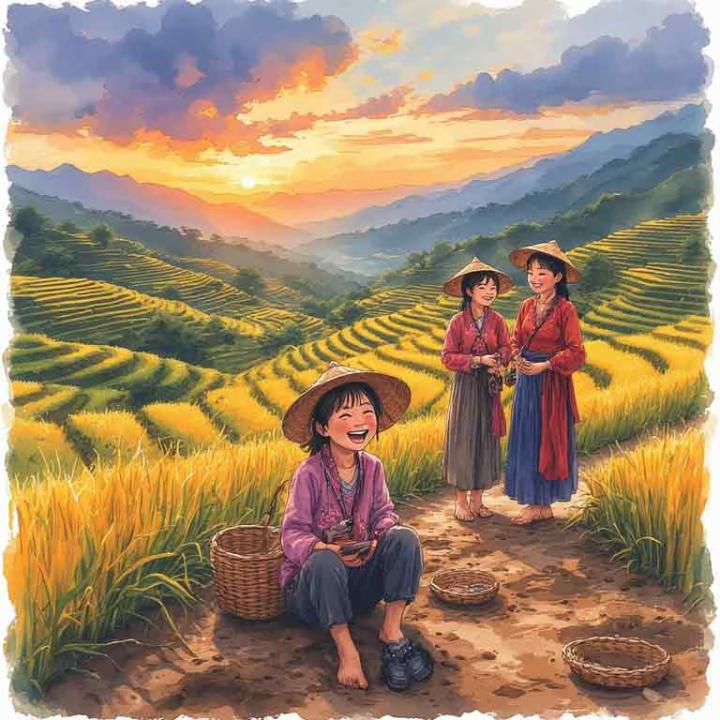
Linh clutched her shiny new “SkyPix” digital camera like it was a sacred relic. Back in the noisy, crowded streets of Hanoi, she was just another middle-schooler with a hobby. But here, standing at the edge of the Mu Cang Chai highlands, she felt like a world-class explorer.
“Careful, Linh-chi! If you fall into the mud, the water buffaloes will think you’re a giant snack,” her cousin, Minh, shouted from a few meters below. He was effortlessly hopping across the narrow stone edges of the rice terraces, balancing a heavy wicker basket on his back.
Linh puffed out her cheeks. “I’m not going to fall, Minh! I just need the perfect angle. The internet says the ‘Golden Hour’ is the only time to get a masterpiece. I have exactly forty-five minutes before the sun hits the ridge.”
Linh’s other cousin, Hanh, who was only ten but had the muscles of a miniature titan, laughed as she sliced through the golden stalks of rice with a curved sickle. “Aiya, you city kids and your ‘angles.’ In the mountains, the only angle that matters is the one that keeps your back from breaking!”
The Quest for Perfection
Linh ignored the teasing. She adjusted her lens, squinting through the viewfinder. The Mu Cang Chai terraces were famous—massive, swirling steps of green and gold carved into the mountains like giant fingerprints. To Linh, they were a backdrop, a beautiful stage set for her to win the National Youth Photography Contest.
She wanted a photo with no people in it. No muddy boots, no sweaty faces, no messy baskets. Just the pure, golden symmetry of the rice against the purple mountains.
“Can you guys move a bit to the left?” Linh called out. “You’re in my frame.”
Minh stopped and wiped sweat from his forehead with a stained sleeve. “Linh, we’re harvesting. If we move to the left, we’re standing on a cliff. If we move to the right, we’re missing the ripe grain.”
“Just for five minutes!” Linh pleaded. “The lighting is becoming so aesthetic right now.”
Hanh sighed, looking at Minh. “Fine, fine. We’ll take a break. My stomach is growling like a grumpy forest spirit anyway.”
The Reality of the Harvest
As the cousins sat on a flat rock to munch on sticky rice wrapped in banana leaves, Linh kept clicking. But something was wrong. The photos looked… empty. They looked like postcards you’d buy at a dusty souvenir shop. They had the color, but they didn’t have the vibe.
“Why do you look so stressed, ba-o?” Minh asked, using the slang for a silly friend. “You’re in the most beautiful place in Vietnam, and you’re scowling at a tiny screen.”
“It’s not perfect yet,” Linh muttered. “There’s a stray hat in the corner of this one. And the dirt over there looks too… brown.”
Hanh snorted, bits of sticky rice nearly flying out of her nose. “Linh-chi, that ‘dirt’ is the soil our Great-Grandpa carved by hand. My Mama says every grain of rice is a drop of sweat. You want to take a picture of the rice, but you don’t like the sweat?”
Linh paused. She looked at her cousins. Their hands were calloused and stained green from the stalks. Their clothes were dusty. But they were smiling—really smiling.
The Lesson in the Mud
Suddenly, a loud splat echoed through the valley.
Linh had stepped backward to catch a wide shot and slipped. Her expensive sneakers skidded on the slick clay, and she landed right on her bottom in a shallow, muddy pool of a harvested terrace.
“My camera!” she shrieked, holding it high above her head like a drowning survivor.
Minh and Hanh erupted into fits of laughter. It wasn’t mean laughter; it was the kind of belly-shaking joy that happens when something truly ridiculous occurs.
“Look at her!” Hanh gasped. “Linh is now part of the landscape! Very aesthetic!”
Linh was ready to cry. Her clean clothes were ruined. But as she looked at her cousins, she saw the way the fading sun caught the gold in their hair and the genuine spark in their eyes. She saw a group of elderly women further up the hill, singing a folk song as they worked in rhythm. She saw the way the community moved together, like a single heartbeat.
She didn’t get up. Instead, sitting in the mud, she leveled her camera—not at the empty hills, but at Minh and Hanh.
Click. She captured Minh mid-laugh, pointing at her, with the golden rice terraces swirling behind him like a sea of honey. She captured Hanh’s mud-streaked face, glowing with the warmth of the setting sun.
The True Golden Hour
“You know,” Linh said, wiping a smudge of dirt off her cheek, “I think I was looking at the wrong thing.”
“Finally,” Minh said, reaching down a hand to haul her up. “The mountains aren’t a painting, Linh. They’re a home. If you only see the colors, you’re missing the story.”
Linh didn’t win the grand prize for “Best Landscape.” Instead, she won the “Human Spirit” award. Her photo wasn’t just of the Mu Cang Chai terraces; it was a photo of a community’s laughter, framed by the hard-earned gold of the harvest.
She realized that the “Golden Hour” wasn’t just about the sun hitting the earth at the right time. It was about the warmth of the people who turned a mountain into a garden.
Share this story, Spread the joy or reading
Other Interesting Stories:
The Seven Tiers of the National Park Chai, a high-achieving competitive swimmer from Bangkok, approaches a family hike at Erawan National Park like an Olympic race, obsessed with being the first to reach the prestigious seventh tier.…
Voices of the Neon Bloom The air hung thick and humid, saturated with the scent of ozone and caramelized sugar. Kai traced the condensation on his chilled synth-ale, the neon glow of the 'Floating Lotus'…
The Secret of the Stone Sentinel Twelve-year-old Minh lives on a tour boat in Vietnam’s Ha Long Bay, surrounded by his grandfather’s "tall tales" about hidden treasures. When he discovers a secret carving on a limestone…
Lost Between the Market Stalls Lost Between the Chatuchak Weekend Market Stalls follows three best friends—Chai, Arun, and Mei—on a high-stakes, comedic race against time when their pet sugar glider, Bento, escapes into the world's…
Journey to the Forgotten Land The forest loomed overhead, a tangle of twisted branches and thick foliage that seemed to swallow the light. Anna paused, brushing a strand of hair from her face, her heart…
The Girl Who Talked to Rain Trees In the heart of a changing Malaysian neighborhood, twelve-year-old Maya copes with her father’s absence by confiding in an old rain tree outside her flat in Taman TAR. When developers…
This mode enables people with epilepsy to use the website safely by eliminating the risk of seizures that result from flashing or blinking animations and risky color combinations.
Visually Impaired Mode
Improves website's visuals
This mode adjusts the website for the convenience of users with visual impairments such as Degrading Eyesight, Tunnel Vision, Cataract, Glaucoma, and others.
Cognitive Disability Mode
Helps to focus on specific content
This mode provides different assistive options to help users with cognitive impairments such as Dyslexia, Autism, CVA, and others, to focus on the essential elements of the website more easily.
ADHD Friendly Mode
Reduces distractions and improve focus
This mode helps users with ADHD and Neurodevelopmental disorders to read, browse, and focus on the main website elements more easily while significantly reducing distractions.
Blindness Mode
Allows using the site with your screen-reader
This mode configures the website to be compatible with screen-readers such as JAWS, NVDA, VoiceOver, and TalkBack. A screen-reader is software for blind users that is installed on a computer and smartphone, and websites must be compatible with it.