The sun hadn’t even poked its head over the horizon when Mei heard the familiar clink-clink of her father’s metal lunchbox.
“Going to the Coathanger, Mei-Mei,” her father, Ba, whispered. He smelled of cold tea and old soot. “Be a good girl for Ma. Don’t go wandering too far near the wharves.”
“Stay safe, Ba,” Mei murmured, pulling her thin woollen blanket up to her chin.
It was 1932, and Sydney was a bit of a mess. Everyone was “on the wallaby track”—looking for work that didn’t exist. Money was as scarce as hens’ teeth, and if you had a job, you held onto it like a lifesaver in a rough sea. Ba was one of the lucky ones, a “rivet cooker” working high up on the massive steel arch they called the Sydney Harbour Bridge.
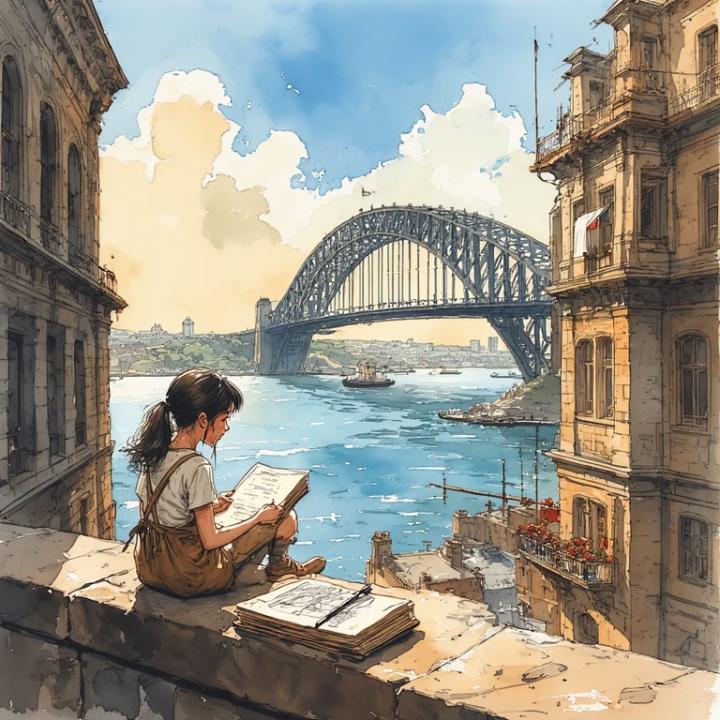
Once Ba left, Mei couldn’t sleep. She grabbed her sketchbook—it was mostly scraps of butcher’s paper tied together with string—and her charcoal stick. She crept out to their small balcony in The Rocks. From there, she could see the giant.
The bridge was nearly finished, two massive steel arms reaching across the blue water of the harbour, trying to shake hands in the middle. To Mei, it looked like a great prehistoric beast waking up.
“Fair dinkum, it’s huge today,” she whispered, sketching the jagged lines of the cranes.
By mid-morning, the Sydney heat was already starting to bite. Ma was busy scrubbing laundry for the posh folks up in Vaucluse.
“Mei! Take this bread to Mrs. Nguyen down the lane,” Ma called out. “And don’t spend all day staring at that heap of iron!”
“I’m just documenting history, Ma!” Mei shouted back, grabbing the loaf.
Walking through The Rocks was like navigating a maze. The cobblestones were uneven, and the air smelled of salt, fish, and woodsmoke. She saw plenty of blokes sitting on crates, looking miserable because they had no “quid” in their pockets.
She found her best friend, Kenji, sitting by the pylon. His family ran a small grocery, but these days, most people just “ticked” their food—buying on credit they’d never be able to pay back.
“Oi, Mei! Look at that!” Kenji pointed up.
High above, tiny specks that were men walked along the narrow steel beams. There were no safety nets. If you slipped, you were “gone for a burton”—straight into the drink or onto the rocks below.
“My Ba is up there,” Mei said, her heart doing a little flip-flop. “He says the wind up there can blow a man’s boots right off his feet.”
“He’s a brave one, your old man,” Kenji said seriously. “My Dad says the bridge is the only thing keeping the city’s heart beating.”
Mei sat down and started to draw. She didn’t just draw the steel; she drew the faces of the people watching it. She drew a “swaggie” with his rolled-up bundle, looking up with hope. She drew a little girl holding her mother’s hand, pointing at the gap in the middle that was closing day by day.
The weeks crawled by. The “Great Depression” felt like a heavy grey cloud over everyone’s head. Meat was a luxury; mostly they ate “underground mutton”—which was just a fancy name for rabbits.
One afternoon, a massive storm rolled in. The sky turned the colour of a bruised plum. Thunder rumbled like heavy drums.
“The bridge!” Mei cried, running to the window.
The wind was howling, a “southerly buster” that shook the windows of their tiny terrace house. Ma looked worried, her hands gripping her apron. “The men will come down. They have to.”
But the storm moved fast. Rain lashed the glass. Mei thought of Ba, hundreds of feet in the air, perched on a beam no wider than a plank of wood.
Hours passed. The rain turned to a drizzle. Finally, the heavy thud of boots sounded on the porch. Ba walked in, soaked to the bone and shivering. His face was pale, but he managed a tired grin.
“Nearly lost me hat,” he joked, though his hands were shaking as he reached for a mug of hot water. “The bridge stayed still, though. She’s solid, Mei-Mei. She’s going to hold us all up.”
March 19th, 1932. Opening Day.
The whole of Sydney was “in a lather” with excitement. Thousands of people lined the streets. The “Coathanger” was finished. No more gap. It stood proud and shimmering under the Australian sun.
Mei wore her best dress—the one Ma had mended three times. She carried her finished sketchbook tucked under her arm.
As the ribbons were cut and the crowds cheered, Mei didn’t look at the politicians or the fancy horses. She looked at the steel. She looked at the rivets her father had heated in the coals.
She realized then that the bridge wasn’t just made of metal. It was made of the grit and hope of people like Ba, Ma, and Kenji. It was a giant “no worries” to the hard times.
She opened her sketchbook to the last page and drew the completed arch. Underneath, she wrote in her neatest cursive: The bridge that brought us together.
“Right-o,” she said to herself, closing the book. “Let’s go home, Ba.”
Watch the shortened video of this story:
Share this story, Spread the joy or reading
Other Interesting Stories:
Lost Between the Market Stalls Lost Between the Chatuchak Weekend Market Stalls follows three best friends—Chai, Arun, and Mei—on a high-stakes, comedic race against time when their pet sugar glider, Bento, escapes into the world's…
The Last Boat to Kukup Fishing Village "The Last Boat to Kukup Fishing Village" follows Mei-Mei, a city girl initially resistant to spending her summer with relatives in a unique stilted fishing village. Through daily chores, traditional…
The Umbrella Mender of China Street In the rain-soaked lanes of Penang’s China Street Ghaut, a solitary old man known only as Mr. Lim mends broken umbrellas with quiet devotion, refusing payment and speaking little—until thirteen-year-old…
The Secret Map of Crispy Woods The sun was just peeking over the horizon, casting a warm glow on the dewy grass of Crispy Woods. Eddy sat cross-legged in his room, surrounded by an ocean of…
The Night Riders of Putrajaya Bridge "The Night Riders of Putrajaya Bridge" follows three teenage friends—Yusof, David, and Maya—as they embark on a secret midnight cycling quest to cross the city's three most iconic bridges. Throughout…
The Bridge of Two Worlds Linh, a hardworking girl from a coastal fishing village, travels to the mountains of Da Nang to meet her long-time pen pal, Minh, a stressed student from the bustling metropolis…
This mode enables people with epilepsy to use the website safely by eliminating the risk of seizures that result from flashing or blinking animations and risky color combinations.
Visually Impaired Mode
Improves website's visuals
This mode adjusts the website for the convenience of users with visual impairments such as Degrading Eyesight, Tunnel Vision, Cataract, Glaucoma, and others.
Cognitive Disability Mode
Helps to focus on specific content
This mode provides different assistive options to help users with cognitive impairments such as Dyslexia, Autism, CVA, and others, to focus on the essential elements of the website more easily.
ADHD Friendly Mode
Reduces distractions and improve focus
This mode helps users with ADHD and Neurodevelopmental disorders to read, browse, and focus on the main website elements more easily while significantly reducing distractions.
Blindness Mode
Allows using the site with your screen-reader
This mode configures the website to be compatible with screen-readers such as JAWS, NVDA, VoiceOver, and TalkBack. A screen-reader is software for blind users that is installed on a computer and smartphone, and websites must be compatible with it.