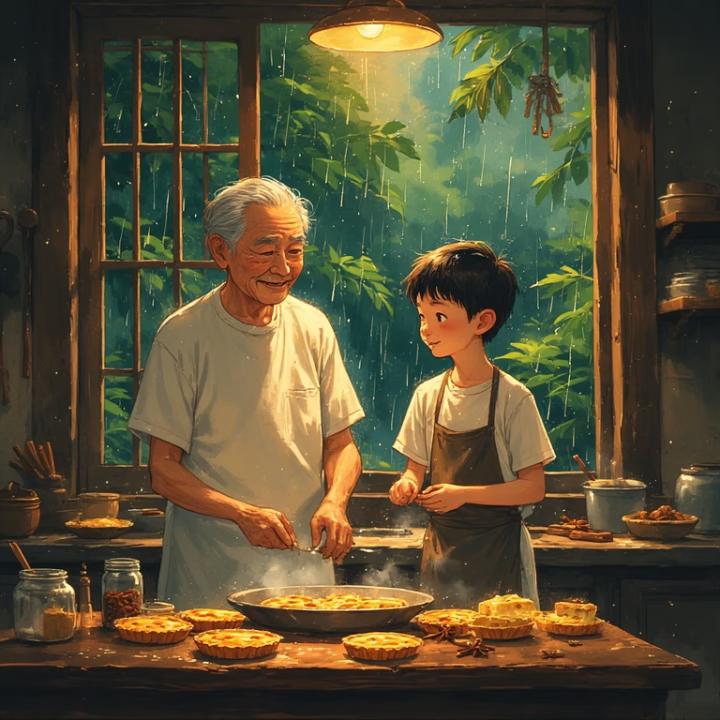
The rain in Singapore doesn’t just fall; it attacks. It drums on the zinc roof of the old terrace house in Katong like a thousand hungry ghosts demanding dinner. Inside, twelve-year-old Ah Boy sat at the kitchen table, his school tie loosened and his homework smelling like damp monsoon air.
“Jun-ah! Don’t just sit there like a blur sotong (clueless person),” a voice rasped from the kitchen. “The butter is melting. If the pastry is oily, your late grandmother will come back and pull your ears.”
Ah Boy looked up. His grandfather, whom everyone called Gong Gong, was standing by the counter. Gong Gong looked like a dried prune—wrinkled, small, but tough. He was wearing his “lucky” singlet, the one with a few yellowed holes near the shoulder, and a pair of faded batik sarong pants.
Today was the start of the “Great Pineapple War.” Every year, two weeks before the Lunar New Year, Gong Gong turned the house into a factory. But this year was different. This year, Gong Gong sometimes forgot where he put his spectacles when they were resting on his forehead. Sometimes, he called Ah Boy by his father’s name, “Ah Huat.”
“Coming, Gong Gong,” Ah Boy sighed, closing his math book.
The Secret Map of Scents
The kitchen was a mess of gold and white. Huge bowls of handmade pineapple jam—slow-cooked for eight hours until they were thick, sticky, and dark—sat waiting.
“Listen carefully,” Gong Gong said, his voice dropping to a whisper as if the neighbors were spying. “The secret is not in the sugar. Anyone can buy sugar. The secret is the rempah (spices). Close your eyes.”
Ah Boy obeyed.
“What do you smell?”
“Pineapple?”
Gong Gong clicked his tongue in disappointment. “Use your nose, not your brain! Smell deeper.”
Ah Boy inhaled. Beneath the sharp, acidic sweetness of the fruit, there was something woody and warm. “Cloves,” Ah Boy said. “And… cinnamon?”
Gong Gong smiled, showing his few remaining teeth. “Correct. My mother told me, and her mother told her: the cloves are like the stars, and the cinnamon is like the earth. If you have both, you will never be lost.”
Gong Gong’s hands, though shaky when he held a spoon, became steady when he touched the dough. He rubbed the cold butter into the flour with his fingertips until it looked like fine breadcrumbs. This was the “rubbing-in” method, a skill passed down through generations of Peranakan bakers.
“Gong Gong, why don’t we use the electric mixer? It’s faster,” Ah Boy asked, reaching for the shiny machine his mom had bought.
“Hah! Machines have no soul,” Gong Gong scoffed. “If you don’t feel the dough, how do you know if it’s happy? You want to eat sad tarts? Go buy from the supermarket lah.”
The Fog in the Mind
As the afternoon went on, the rain got heavier. The sky turned a bruised purple.
Ah Boy was busy rolling the jam into tiny, perfect balls when he noticed Gong Gong had stopped moving. The old man was staring at a bowl of flour, his brow furrowed. He picked up a rolling pin, looked at it, and then looked at the sink.
“Gong Gong? You okay?”
Gong Gong didn’t answer. His eyes looked milky, like he was looking at something very far away. “Where is the… the thing? The yellow thing for the door?”
“The jam, Gong Gong? It’s right here.”
“No, no,” Gong Gong muttered, his voice trembling. “The keys. I need to go to the market. Your grandmother is waiting for the coconut milk. It’s raining… she’ll get wet. I need to find the market.”
Ah Boy felt a cold lump in his throat. Grandmother had been gone for five years. “Gong Gong, Grandma is… she’s not at the market. We are making tarts, remember?”
But Gong Gong started to wander toward the front door, his steps unsteady. “Must find the market. The rain is too loud. I can’t see the road.”
Ah Boy panicked. He tried to grab his grandfather’s arm, but the old man pushed him away with surprising strength. Gong Gong was lost in his own head, a fog thicker than the rain outside. He looked frightened, like a child lost in a mall.
Then, Ah Boy remembered what Gong Gong had said earlier. If you have both, you will never be lost.
Ah Boy ran back to the kitchen. He grabbed the small jar of whole cloves and the sticks of cinnamon. He hurried back to the hallway and held them right under Gong Gong’s nose.
“Gong Gong! Smell!”
The sharp, medicinal scent of the cloves hit the air. Ah Boy broke a cinnamon stick in half, releasing a burst of warm, woody fragrance.
Gong Gong stopped. He blinked. He took a long, deep breath. The scent seemed to cut through the fog in his brain. He looked at the cinnamon in Ah Boy’s hand, then up at Ah Boy’s face.
“Jun-ah?” he whispered. “Why are you holding the spices like a crazy person?”
Ah Boy exhaled a breath he didn’t know he was holding. “You… you got a bit confused, Gong Gong. You wanted to go to the market.”
Gong Gong looked at his bare feet, then at the rain splashing against the windows. A flash of sadness crossed his face—the look of a man who realized his own mind was betraying him.
“Ah… the market,” Gong Gong said softly. “I forgot. Again.”
“It’s okay,” Ah Boy said, gently leading him back to the kitchen. “The kitchen is warm. The tarts are waiting.”
The Golden Treasure
For the next three hours, they worked in silence, broken only by the rhythmic thud-thud of the dough being shaped. They made the “open-faced” style tarts—little golden pedestals of pastry with a crown of pineapple jam, topped with a tiny cross made of dough.
As the first batch went into the oven, the house began to transform. The smell of baking butter and caramelizing sugar rose up, mixing with the scent of the cloves and cinnamon. It was a smell that felt like safety. It felt like home.
“You know, Jun,” Gong Gong said, watching the oven through the glass. “When I was your age, we didn’t have ovens like this. We used charcoal. Very difficult to control the heat. Many burnt bottoms!” He chuckled.
“Was Grandma good at it?”
“She was the best. She could tell if a tart was done just by the sound of the sizzle. She used to say, ‘A good tart is like a good person—sweet on the inside, but strong enough to hold it all together.'”
Ah Boy smiled. He realized that Gong Gong wasn’t just teaching him how to bake. He was giving him the map. One day, Gong Gong wouldn’t be here, and the house might be quiet, but Ah Boy would have the smell of cloves and cinnamon to bring him back to these rainy afternoons.
The Taste of Memory
When the tarts finally came out, they were glowing like little gold coins. Gong Gong picked one up, blowing on it frantically before popping the whole thing into his mouth.
“Aiyoh! Hot, hot, hot!” he yelled, dancing a little jig.
“Gong Gong! Wait for it to cool down!” Ah Boy laughed.
Gong Gong chewed, his eyes closing in bliss. “Perfect. The crust melts like snow, and the jam… the jam has the rempah soul.” He patted Ah Boy’s shoulder. “You did good, boy. You have the ‘hand’ for it.”
The rain outside began to slow down to a drizzle. The “Great Pineapple War” for the day was over. They packed the cooled tarts into red-capped plastic jars, ready for the cousins and aunties who would visit soon.
As Ah Boy helped Gong Gong to his armchair, the old man gripped his hand.
“Jun-ah,” he said, his voice serious. “If one day… if the fog comes back and stays… you just start the oven, okay? You put the cinnamon and the cloves out. I will hear them. I will smell them. I will find my way home to you.”
Ah Boy nodded, his eyes stinging. “I will, Gong Gong. I promise.”
That night, Ah Boy didn’t dream of math problems or school football. He dreamt of golden fields of pineapples and a path made of cinnamon sticks, leading straight to a kitchen where the lights were always on, and the air always smelled like love.
Share this story, Spread the joy or reading
Other Interesting Stories:
The Secret of the Silvered Leaf A group of friends – Mika, Siti, Raj, and Mei Lin – on a nature camp in the Selangor forest, discover a mysterious encoded message hidden within the unique "Crown…
Sticky Rice and Second Chances In the heart of Penang, when the struggling Youth Dragon Boat team faces disbandment due to lack of funds, determined rowers Eddy and Anna refuse to give up—instead launching a…
The Beast and the Firecracker: How the World Turned Red The Beast and the Firecracker is a vibrant reimagining of the Chinese New Year legend, centered on a spunky boy named Eddy and his clever friend Belly. Tired of their…
The Secret of the Sea-Silk Lantern Eddy, a young boy living in the shadow of his family's legendary lantern-making reputation, finds himself struggling to connect with tradition at the bustling Thean Hou Temple. After discovering a…
Ten Thousand Steps to the Top Aki Sato, a talented junior high runner, loses her confidence after a painful ankle injury threatens her racing future. Instead of quitting, she quietly retrains on a long mountain path…
The Last Boat to Kukup Fishing Village "The Last Boat to Kukup Fishing Village" follows Mei-Mei, a city girl initially resistant to spending her summer with relatives in a unique stilted fishing village. Through daily chores, traditional…
This mode enables people with epilepsy to use the website safely by eliminating the risk of seizures that result from flashing or blinking animations and risky color combinations.
Visually Impaired Mode
Improves website's visuals
This mode adjusts the website for the convenience of users with visual impairments such as Degrading Eyesight, Tunnel Vision, Cataract, Glaucoma, and others.
Cognitive Disability Mode
Helps to focus on specific content
This mode provides different assistive options to help users with cognitive impairments such as Dyslexia, Autism, CVA, and others, to focus on the essential elements of the website more easily.
ADHD Friendly Mode
Reduces distractions and improve focus
This mode helps users with ADHD and Neurodevelopmental disorders to read, browse, and focus on the main website elements more easily while significantly reducing distractions.
Blindness Mode
Allows using the site with your screen-reader
This mode configures the website to be compatible with screen-readers such as JAWS, NVDA, VoiceOver, and TalkBack. A screen-reader is software for blind users that is installed on a computer and smartphone, and websites must be compatible with it.