The mist at the top of the mountain didn’t smell like the ocean. That was the first thing Linh noticed. Back home in her small fishing village near Hue, the air always smelled of salt, drying nets, and the pungent, delicious kick of nuoc mam (fish sauce). Up here, in the high hills of Da Nang, the air smelled like cold stones and wet ferns.
Linh smoothed her best floral tunic. She felt like a fish out of water—literally. Her hands were calloused from helping her father untangle nylon lines, and her skin was toasted a deep nut-brown by the East Sea sun.
“Linh! Don’t wander off, con!” her mother called out, adjusting her conical hat. “The crowds are big today. We don’t want to lose you before you find your friend.”
“I know, Ma!” Linh shouted back, her heart doing a nervous little dance in her chest.
Today was the day. After three years of writing letters and sending blurry photos via her cousin’s old smartphone, Linh was finally meeting Minh.
In her mind, Minh was a prince of the city. He lived in Ho Chi Minh City—the “Big City.” From his letters, Linh imagined him living in a world of neon lights, skyscraper apartments, and endless bubble tea. He used cool slang she barely understood and talked about video games that required internet speeds her village couldn’t even dream of.
The Meeting on the Hands
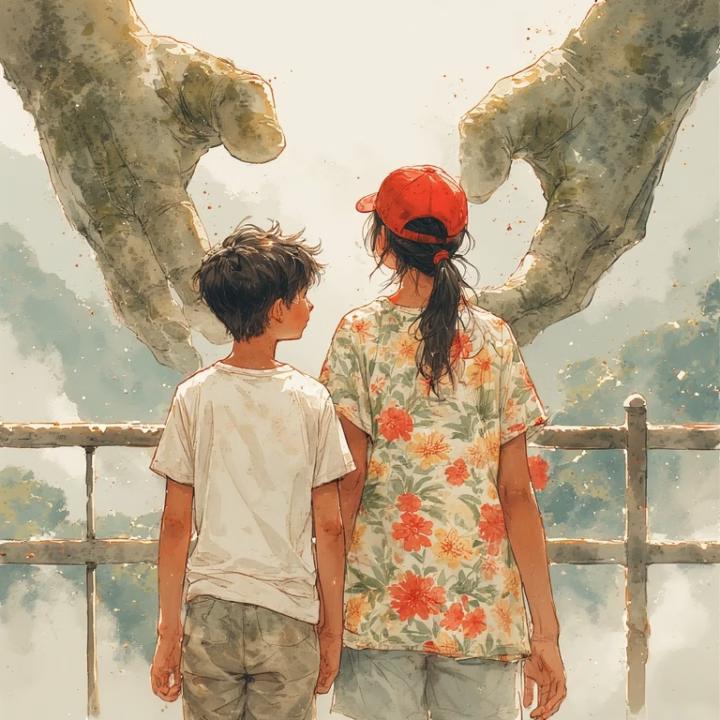
Linh walked toward the famous bridge. When she saw it, she gasped. Two massive, weathered stone hands emerged from the green mountainside, cradling a golden walkway that curved through the clouds. It looked like the hands of a mountain giant reaching out to catch the sky.
“Wah, so beautiful…” Linh whispered.
She reached the midpoint of the bridge, near the thumb of the left hand. She looked for a boy in a red cap—that was their signal.
There he was.
He was leaning against the railing, looking out at the valley. He wore a crisp white T-shirt, expensive-looking sneakers, and a red cap pulled low. He looked exactly like the “city boy” Linh had pictured. Linh felt a sudden pang of shyness. Look at my dusty sandals, she thought. He’s going to think I’m just a silly village girl.
She took a deep breath. “Minh?”
The boy turned around. His eyes widened. “Linh? From the letters?”
“Yes,” she said, giving a small, stiff bow. “Hello. Chao ban.”
Minh grinned, but it wasn’t a cool, confident city grin. It was a bit shaky. “Finally! I thought maybe you got lost. This place is huge, right? Totally khung (crazy)!”
Two Different Worlds?
They walked together along the golden rail. At first, it was awkward. Linh talked about the morning catch and how the monsoon rains had leaky-roofed their kitchen again.
“Must be nice,” Minh said, kicking a small pebble. “No traffic. No noise. Just the sea.”
“Nice?” Linh laughed. “It’s hard work, Minh. If the fish don’t bite, we don’t eat well. And everything is always damp. I bet your life is like a movie. High-speed elevators and fancy malls, right?”
Minh sighed, a sound that seemed too heavy for a thirteen-year-old. “Actually, my apartment is tiny. My parents work all the time at the factory. I spend most of my day in a cram school, staring at a whiteboard until my eyes hurt. It’s just… gray. Everything is gray concrete.”
Linh stopped walking. “But you sent me that picture of the gold-leaf ice cream!”
Minh blushed. “I saved my pocket money for a month to buy that just for the photo. I wanted to look… I don’t know, successful? Like a real city guy.”
Linh looked at him. She saw the dark circles under his eyes. She realized that while she was tired from physical labor, Minh was tired in a different way—the kind of tired that comes from carrying the weight of “getting ahead.”
The Same Reflection
As they stood in the “palm” of the giant stone hand, a thick cloud rolled in, wrapping the bridge in white silence. For a moment, the world below disappeared.
“You know,” Minh said softly. “My dad wants me to be an engineer so we can move out of the slums. I’m scared I won’t be smart enough. Every test feels like a battle.”
Linh nodded. “My Ba wants me to take over the boat. But I want to study plants. I want to know why some crops die in the salt air and others live. But who has money for a scientist daughter in a village of nets?”
They looked at each other. The “City Prince” and the “Sea Girl” weren’t so different after all. Both were trying to please their parents, both were worried about the future, and both felt a little bit trapped by the walls—one made of water, one made of concrete.
“Hey,” Minh said, reaching into his backpack. He pulled out a small, high-tech looking gadget. “It’s a portable fan. It’s hot down in the city, but it works on batteries. Take it. For when you’re fixing nets.”
Linh felt tears prick her eyes. She reached into her woven bag and pulled out a polished tiger-eye stone she had found in a sea cave. “This is for luck. My grandfather says it keeps the storms away.”
Minh took the stone like it was made of gold. “Thanks, Linh. This is way cooler than any video game.”
The Echo on the Mountain
As the sun began to peek through the clouds again, turning the bridge into a glowing ribbon, the two friends stood side by side. They took a “selfie” together—Linh’s windblown hair and Minh’s red cap, framed by the giant stone fingers.
“We’re like this bridge,” Linh said suddenly.
“What do you mean?” Minh asked.
“It connects two sides of a mountain, right? But it’s held up by the same hands. We live in different places, but we’re standing on the same ground.”
Minh smiled, a real one this time. “Deep, Linh. Very deep. You sure you don’t want to be a poet instead of a scientist?”
“Maybe both!” she laughed.
When it was time to leave, they didn’t feel like strangers anymore. Linh headed down toward the coast, and Minh headed toward the airport. The “Bridge of Two Worlds” remained behind them in the clouds, but the connection they had made was tucked safely in their pockets—a stone and a fan, a memory of a day when the gap between the village and the city vanished into thin air.
Share this story, Spread the joy or reading
Other Interesting Stories:
The Secret of the Silvered Leaf A group of friends – Mika, Siti, Raj, and Mei Lin – on a nature camp in the Selangor forest, discover a mysterious encoded message hidden within the unique "Crown…
The Weight of Ordinary In a quaint little village nestled between rolling green hills, there lived a young girl named Lila. Lila was ordinary, or at least that’s what everyone told her. Her hair…
The Penang Botanical Gardens’ Bloom Eleven-year-old Nana, a once-passionate artist now paralyzed by self-doubt, rediscovers her creative spark through quiet afternoons in the Penang Botanical Gardens, where the lush flora and steadfast companionship of her…
The Hidden Waterfall of Bukit Merah Leena, a passionate young conservationist in Bukit Merah, stumbles upon a breathtaking, previously undiscovered waterfall teeming with unique flora and fauna. Her joy turns to alarm when she learns developers…
The Mystery of the Missing Dinosaur The sun hung low in the sky, casting elongated shadows across the sprawling grounds of the Central Valley Dinosaur Park. Children laughed and ran, their squeals echoing as they chased…
The Daring Adventures of Eddy The Spaghetti In the bustling town of Noodleville, where the streets twisted like a well-cooked strand of spaghetti, lived a curious little pasta named Eddy. Eddy wasn’t just any spaghetti; he was…
This mode enables people with epilepsy to use the website safely by eliminating the risk of seizures that result from flashing or blinking animations and risky color combinations.
Visually Impaired Mode
Improves website's visuals
This mode adjusts the website for the convenience of users with visual impairments such as Degrading Eyesight, Tunnel Vision, Cataract, Glaucoma, and others.
Cognitive Disability Mode
Helps to focus on specific content
This mode provides different assistive options to help users with cognitive impairments such as Dyslexia, Autism, CVA, and others, to focus on the essential elements of the website more easily.
ADHD Friendly Mode
Reduces distractions and improve focus
This mode helps users with ADHD and Neurodevelopmental disorders to read, browse, and focus on the main website elements more easily while significantly reducing distractions.
Blindness Mode
Allows using the site with your screen-reader
This mode configures the website to be compatible with screen-readers such as JAWS, NVDA, VoiceOver, and TalkBack. A screen-reader is software for blind users that is installed on a computer and smartphone, and websites must be compatible with it.