The morning sun over Hiroshima didn’t just rise; it shimmered. It caught the ripples of the Motoyasu River and turned the water into a sheet of hammered silver.
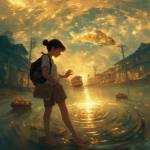
Twelve-year-oldHaruki stood on the bridge, his school bag feeling heavier than usual. He wasn’t a “shining student.” In fact, his teachers often called him bonyari—a daydreamer. While other kids were focused on their high school entrance exams, Haruki was usually staring at the way shadows moved across the concrete.
“Haruki-kun! Wait up!”
Haruki turned to see Sora jogging toward him. Sora was his polar opposite: loud, energetic, and constantly using the latest gyaru slang she picked up from her older sister, even though they were just in middle school.
“You’re moving at a snail’s pace today, maji de (seriously)!” Sora laughed, her bright yellow backpack bouncing. “We’re going to be late for the meeting at the Peace Park.”
“I was just looking at the river,” Haruki said quietly.
“Classic Haruki,” Sora teased. “But today is big. The International Youth Exchange is joining our class project. We have to show them what Japanese spirit is all about!”
The project was simple in theory but daunting in practice: Senbazuru. A thousand origami cranes. Legend said that anyone who folded a thousand cranes would be granted a wish. For the students of Midori Middle School, the wish was for the city’s annual Peace Festival to be a success despite the recent storms that had damaged the local community center.
The Gathering
When they arrived at the Peace Memorial Park, the grass was still dewy. A small group of students had already gathered near the Children’s Peace Monument. Among them were two exchange students: Leo, a tall boy from Brazil with a constant smile, and Hana, a girl from Korea who spoke Japanese with careful, elegant precision.
“Welcome!” cried Yumi, the class representative. She was the iinchou—the bossy but kind-hearted leader of their group. “We have three days until the festival. We have the paper, we have the string, and we have the hands. Let’s get to work!”
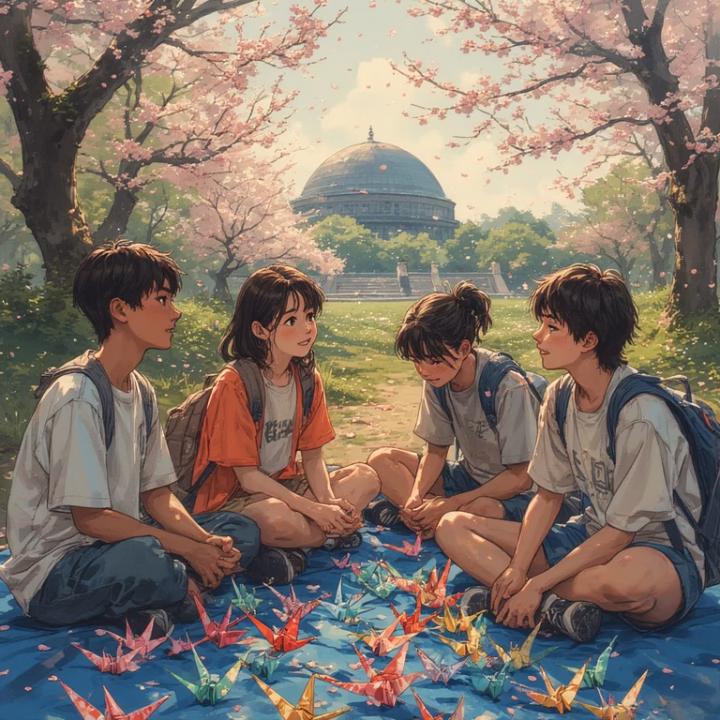
They sat in a circle on a large blue tarp. Yumi handed out square sheets of paper in every color imaginable—neon pink, deep indigo, gold leaf, and soft cherry blossom white.
“Okay,” Leo said, looking at the tiny square of paper in his large hands. “I’ve seen these before, but… how do you start? Is there a ‘Start’ button?”
Sora giggled. “No buttons, Leo-kun! It’s all in the fingers. Look, first you make a shikaku (square) fold, then a sankaku (triangle). Like this!”
The first hour was filled with laughter and the crisp crinkle-snap of paper. But as the sun climbed higher, the mood shifted. Folding one crane was easy. Folding ten was fun. By the fiftieth crane, fingers began to ache.
The Struggle
“My hands feel like they’re turning into stone,” groaned Haruki. He looked at his pile. He had only finished thirty. They were perfect—each beak sharp, each wing symmetrical—but he was too slow.
“You’re being too careful, Haruki,” Yumi urged. “We need volume! Look at Sora.”
Sora was a folding machine. Her cranes were a bit messy—some had slightly crumpled wings—but she had a mountain of them. “Speed is key! Yabai (Craziness), I’m already at eighty!”
“But if they aren’t beautiful, does the wish still count?” Hana asked softly. She was folding her cranes with a different style, smoothing each crease with a small wooden ruler. “In my home, we say that the soul enters the work through the details.”
Leo sighed, looking at his latest attempt. It looked more like a crushed moth than a bird. “I think my soul is just confused,” he joked, but Haruki could see the frustration in his eyes. Leo wanted to contribute, but his hands weren’t used to such delicate movements.
By the end of the first day, they had three hundred cranes. They were tired, and a dark cloud was literally forming on the horizon.
The Storm
That night, a massive summer storm—a yuudachi—ripped through Hiroshima.
When the students returned to the park the next morning, their hearts sank. The temporary gazebo where they had stored their supplies had leaked. The boxes of uncolored paper were soaked, turning into a soggy, grey mush. Even worse, the wind had scattered their finished cranes across the muddy grass.
“No way…” Sora whispered. She picked up a bright yellow crane—one of her own—now stained with brown earth. “Everything is meccha (totally) ruined.”
Yumi looked like she was about to cry. “The festival is tomorrow. We don’t have enough paper left to start over, and we can’t buy more—the shops are closed for the holiday.”
The group sat in silence. The “Great Wave” of cranes they had envisioned felt like a receding tide.
“Wait,” Haruki said. Everyone looked at him. He rarely spoke up first. “Look at the cranes that survived.”
He pointed to the pile Hana and Leo had worked on. Because they had been placed in a plastic container, about a hundred were still dry.
“It’s not enough,” Yumi sighed.
“But we have the old newspapers in the recycling bin,” Haruki said, his eyes brightening with a sudden spark. “And the flyers from the grocery store. And the old maps in the park office.”
“Newspaper cranes?” Sora wrinkled her nose. “Won’t they look… cheap?”
“No,” Hana said, catching Haruki’s vision. “They will look like the city. They will look like us. Not perfect gold, but real.”
The Final Push
The second day became a whirlwind of activity. They didn’t just fold; they hunted. They found discarded colorful magazines, old school worksheets, and even some bright red posters that were no longer needed.
Leo became the “Master of Tearing,” using his strength to rip the large sheets into perfect squares. Sora and Yumi became the “Speed Demons,” folding the basic shapes. Haruki and Hana became the “Finishers,” adding the delicate final folds and blowing air into the bodies of the cranes to make them puff out.
They worked through the lunch break. They worked until their fingertips were stained with black ink from the newspapers.
As they worked, people walking through the park began to stop.
“What are you making?” asked an elderly woman carrying a parasol.
“A thousand cranes for the festival,” Leo explained in his broken Japanese. “We had a problem with the rain, so we are using what we have.”
The woman smiled. She reached into her bag and pulled out a receipt and a candy wrapper. “May I add to your flock?”
She sat down and, with practiced, trembling hands, folded two tiny cranes.
Soon, a businessman on his break contributed a crane made from a memo sheet. A group of tourists added cranes made from brochures. The “Great Wave” wasn’t just a student project anymore; it was becoming a community movement.
The Festival
The day of the Peace Festival arrived with a sky so blue it looked painted.
In the center of the park, near the flame that was never supposed to go out, hung the Senbazuru. A thousand cranes—no, nearly twelve hundred—strung together in long, cascading lines.
It was the most beautiful thing Haruki had ever seen. There were cranes made of comic books, cranes made of grocery coupons, cranes with handwriting on them, and the original gold and silver ones that had survived the storm. When the wind blew, the different papers made a soft, rustling sound, like thousands of tiny heartbeats.
“We did it,” Sora said, her voice unusually quiet. She wasn’t using slang. She was just in awe.
“Look at that one,” Leo pointed to a crane made from a map of the world. “It’s like it’s flying home.”
The mayor of the city stood before the crowd. “This year,” he said, “we see a different kind of peace. Not the peace of perfectly matched colors, but the peace of coming together to fix what is broken. These cranes show us that even when the storm takes our ‘perfect’ plans, we can build something even stronger from the scraps.”
The Wish
As the sun began to set, the students stood together.
“So,” Haruki asked. “We finished the thousand. Does everyone get a wish, or just one for the group?”
“I think,” Hana said, looking at the rustling paper wave, “the wish already came true.”
“What was it?” Sora asked.
“That we wouldn’t be alone,” Hana replied.
Haruki looked at his friends—the bossy leader, the energetic girl, the boy from across the ocean, and the girl from across the sea. He realized he wasn’t a “daydreamer” anymore. He was a part of something.
“Hey guys,” Haruki said, reaching into his pocket. He pulled out one last square of paper—a bright, neon orange scrap he’d saved. “One more? For next year?”
Sora laughed and snatched a corner of the paper. “Maji de! Let’s make it two thousand!”
And under the orange glow of the Hiroshima sunset, the “Great Wave” of paper cranes continued to grow, one fold at a time.
Share this story, Spread the joy or reading
Other Interesting Stories:
The Legend of the Gombak River In a Malaysian village nestled beside the Gombak River, twelve-year-old Aina discovers she can hear the river’s voice—and awaken its long-forgotten guardian, Dayang Bulan, a spirit born from moonlight and…
The Last Firefly of Taman Tasik Perdana In the heart of bustling Kuala Lumpur, 11-year-old Amirah discovers the last fading firefly in Taman Tasik Perdana — a fragile beacon of a forgotten natural magic. Refusing to let…
The Night Riders of Putrajaya Bridge "The Night Riders of Putrajaya Bridge" follows three teenage friends—Yusof, David, and Maya—as they embark on a secret midnight cycling quest to cross the city's three most iconic bridges. Throughout…
Chasing Monsoon Clouds After a sudden monsoon flood traps a litter of kittens in a collapsed storm drain, 12-year-old Eddy and his best friends Bell and Lily embark on a daring rescue mission—guided…
Fish Who Swam Backwards Through Time When 13-year-old Lina touches a mysterious glowing arapaima at KL Sea Adventure Park, she’s flung backwards through time — witnessing Kuala Lumpur in 1957, 1972, and 1998 — and encountering…
A Journey on the Melaka River Cruise This slice-of-life story follows Jali, a young boy working on the Melaka River Cruise during his school holidays. Through his interactions with diverse passengers like the wise Uncle Tan and…
This mode enables people with epilepsy to use the website safely by eliminating the risk of seizures that result from flashing or blinking animations and risky color combinations.
Visually Impaired Mode
Improves website's visuals
This mode adjusts the website for the convenience of users with visual impairments such as Degrading Eyesight, Tunnel Vision, Cataract, Glaucoma, and others.
Cognitive Disability Mode
Helps to focus on specific content
This mode provides different assistive options to help users with cognitive impairments such as Dyslexia, Autism, CVA, and others, to focus on the essential elements of the website more easily.
ADHD Friendly Mode
Reduces distractions and improve focus
This mode helps users with ADHD and Neurodevelopmental disorders to read, browse, and focus on the main website elements more easily while significantly reducing distractions.
Blindness Mode
Allows using the site with your screen-reader
This mode configures the website to be compatible with screen-readers such as JAWS, NVDA, VoiceOver, and TalkBack. A screen-reader is software for blind users that is installed on a computer and smartphone, and websites must be compatible with it.