The horn blared, a grumpy, long BWAAAAAAAAAANNNNGGG, shaking Mei-Mei right down to her flip-flops. Her ears rang. Her backpack felt heavier than a sack of bricks. She gripped her auntie’s hand tight. The air smelled funny here, like salty fish and muddy water, totally different from the clean, air-conditioned malls in the city.
“Come, Mei-Mei!” Auntie Lian pulled her along, a wide smile on her face. “The boat won’t wait for sleepyheads!”
Mei-Mei stumbled onto the wooden jetty, careful not to trip. It swayed a little under her feet. Her eyes darted around. So many people! Aunties with big woven bags, uncles carrying crates of vegetables, kids chasing each other. Everyone was chattering in a mix of languages she barely understood – Hokkien, Malay, a little bit of English. It was a cacophony, a cheerful, noisy mess.
The boat was… well, it was a boat. A bit old, painted a chipped blue and green, with a noisy engine at the back. It already had a bunch of people on it, and what looked like a dozen chickens in cages, clucking nervously. Mei-Mei squeezed between a stack of fishing nets and a woman with a baby strapped to her back.
“Don’t worry, darling,” Auntie Lian patted her head. “Almost there! Just a short ride to Kukup.”
Kukup. The name felt strange on her tongue. All summer. A whole summer away from her phone, her tablet, her best friend Jia-Jia, and the awesome bubble tea shop near her apartment. Her mom and dad had said, “Mei-Mei, you need to experience real life! Go stay with Auntie Lian and Uncle Wei in Kukup. It’ll be good for you.”
Good for her? It felt more like a punishment.
The boat chugged out of the small port, leaving the concrete buildings behind. The water stretched out, brownish-green, dotted with smaller sampans and fishing boats. In the distance, a hazy line appeared, like a long, low cloud on the horizon. As they got closer, Mei-Mei could make out individual structures.
“That’s it, Mei-Mei! Kukup Fishing Village!” Auntie Lian pointed with a flourish.
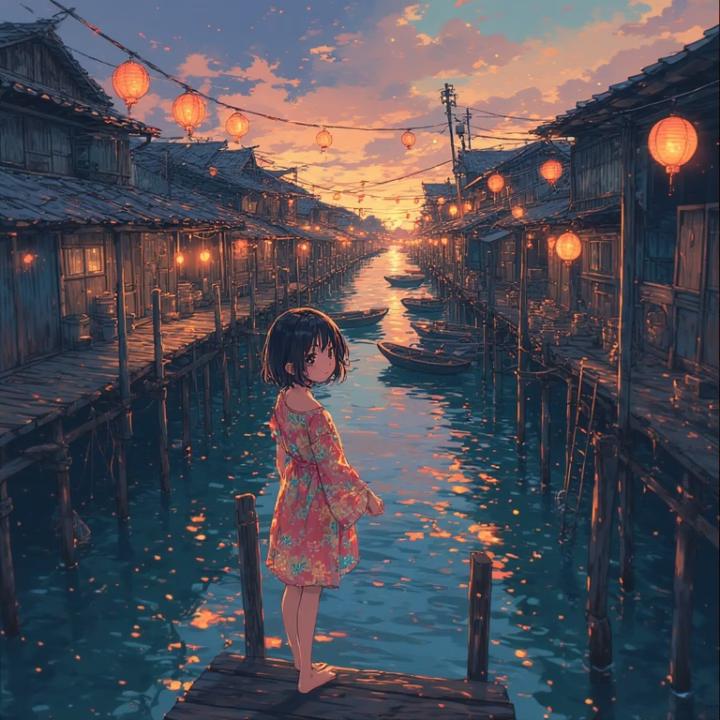
Mei-Mei stared. It wasn’t a village on land at all. It was a village on the water! Hundreds of wooden houses, all built on stilts, connected by narrow, wobbly walkways. It looked like a giant, sprawling raft of houses. Smoke curled from some roofs, and fishing nets hung out to dry from balconies. Small boats bobbed gently beside each other.
“Wow,” Mei-Mei whispered, despite herself. It was… amazing. And a little scary.
The boat bumped against a creaky jetty. Uncle Wei was waiting, a big grin on his face, his skin tanned and leathery from the sun. He wore a simple t-shirt and shorts. He hugged Auntie Lian, then scooped Mei-Mei into a bear hug that smelled faintly of fish and sunshine.
“Welcome, welcome, little city girl!” Uncle Wei boomed, his laugh warm and hearty. “Your room is ready. Come, let’s go home!”
Their house was a small, wooden one, painted a cheerful sky blue. It sat right over the water. Inside, it was simple but cozy. A small living room with a TV that looked ancient, a kitchen with a charcoal stove, and two bedrooms. Mei-Mei’s room had a window that opened right out to the sea. She could hear the gentle lapping of the water, and sometimes, a splash.
That first evening, dinner was an explosion of flavors. Fresh fish, steamed with ginger and soy sauce, stir-fried vegetables, and fluffy white rice. Uncle Wei and Auntie Lian ate with their hands, showing Mei-Mei how to properly scoop rice and fish with her fingers. She felt a bit awkward at first, used to her fork and spoon, but soon she was slurping away just like them.
“This fish,” Mei-Mei said, her mouth full, “it’s so good! Where did you buy it?”
Uncle Wei chuckled. “Buy? Aiya, Mei-Mei! We don’t buy fish here. We catch it! Early morning, before the sun wakes up, I go out with my boat. Fresh catch every day!”
Mei-Mei imagined Uncle Wei on his boat, out on the vast sea. It sounded like an adventure.
The next few days were a blur of new experiences. There was no internet, and her phone signal was patchy at best. No endless scrolling, no online games. She felt a pang of loneliness at first, missing her city life. But then, there was so much else to see and do.
Auntie Lian taught her how to hang laundry over the water, carefully clipping each shirt so it wouldn’t fall into the currents below. She learned to sweep the wooden floors, feeling the vibrations of the house whenever a bigger boat passed by. She even helped Uncle Wei mend a fishing net, her small fingers clumsy with the knots at first, then slowly getting the hang of it.
“You must be patient, Mei-Mei,” Uncle Wei advised, his spectacles perched on his nose as he watched her struggle. “Everything takes time. Like the fish, you wait, you learn their ways.”
Mei-Mei also met the other kids in the village. There was Ah Seng, a boisterous boy with a cheeky grin who loved to tease her about her “city clothes.” There was Li Hua, a quiet girl with long braids who knew all the best spots to find interesting shells and crabs. And there was Gopal, who had a pet parrot that would squawk greetings in three different languages.
They mostly spoke in a mix of Malay and a local dialect, which Mei-Mei slowly started to pick up. They played games she’d never heard of, like catching small crabs in the muddy banks when the tide was low, or racing each other on little makeshift rafts they paddled with their hands.
One afternoon, Mei-Mei was helping Auntie Lian sort dried anchovies on their balcony. The sun was hot, and the air was thick with the smell of the sea. Across the way, she saw a group of kids gathered on a shared walkway, laughing and shouting.
“Auntie,” Mei-Mei asked, “what do they do for fun here, besides fishing?”
Auntie Lian smiled, her eyes crinkling at the corners. “Aiya, so many things! We have our festivals, our storytelling. And every evening, the kids gather to play. Tonight, they will be practicing their kite-flying for the festival next month.”
Mei-Mei’s eyes lit up. Kite-flying! She used to love flying kites when she was little, before screens took over her life.
That evening, after another delicious dinner of steamed prawns and sambal kangkong, Mei-Mei ventured out. The walkways were bustling with activity. Older folks chatted, sipping tea. Younger men mended nets under the dim glow of bare bulbs. And the kids, a dozen of them, were on a wider platform, preparing their kites.
Ah Seng saw her. “Mei-Mei! Come, come! We need more hands!”
He handed her a long string attached to a colorful kite shaped like a fierce dragon. It had shimmering scales and a long, flowing tail. Mei-Mei felt a thrill run through her.
The wind was just right. The boys, with strong arms, held the kites high, then released them with a shout. Mei-Mei held tight to her string, letting it out slowly, feeling the tug as the dragon kite soared higher and higher. It danced in the twilight sky, a splash of vibrant color against the fading orange and purple.
She watched, mesmerized, as the other kites joined hers – a soaring eagle, a graceful butterfly, a powerful phoenix. They spun and dipped, sometimes seeming to chase each other. Laughter filled the air, free and unrestrained.
For the first time since arriving, Mei-Mei didn’t think about her phone, or Jia-Jia, or bubble tea. She was completely in the moment, part of something bigger.
Days turned into weeks. Mei-Mei found a rhythm in Kukup. She woke with the sun, the gentle rocking of the house a constant lullaby. She helped Auntie Lian with chores, learning how to distinguish fresh fish from older ones by their gills, and how to bargain playfully with the few sellers who came by boat. She even learned to steer Uncle Wei’s small sampan, though he always stayed close, just in case.
One afternoon, while exploring with Li Hua, they stumbled upon an old, unused section of the village. Houses here were more run-down, some abandoned, their stilts rotting. Li Hua told her stories about how the village had grown, how families had moved here generations ago to fish.
“This place,” Li Hua said softly, gazing at the weathered wood, “it holds many stories. Our grandfathers, our great-grandfathers, they all built this. It’s our home.”
Mei-Mei looked at Li Hua, her quiet friend. She saw a deep connection to this place, a pride that made Mei-Mei think about her own hurried, disconnected city life. She realized how much she had taken for granted, how much she hadn’t truly seen.
The biggest event of the summer was the annual Water Festival. It was a riot of color and sound. Every house was decorated with lanterns and streamers. Boats were adorned with flowers and flags. There were races between the fastest sampans, and singing competitions. The smell of delicious food wafted from every corner – satay, laksa, fried noodles, sweet cendol.
Mei-Mei, dressed in a pretty batik dress Auntie Lian had given her, helped serve food to the stream of visitors who came by boat from nearby towns. She saw her friends, Ah Seng and Li Hua and Gopal, laughing and playing, their faces glowing in the lantern light.
Later, as fireworks exploded over the water, painting brilliant streaks across the dark sky, Mei-Mei stood on her balcony with Uncle Wei and Auntie Lian. The reflections shimmered on the water, turning the whole village into a magical wonderland.
“You like it here, Mei-Mei?” Auntie Lian asked, her arm around Mei-Mei’s shoulders.
Mei-Mei leaned into her aunt’s embrace. “Yes, Auntie. I really do.”
Uncle Wei nodded. “It’s a simple life, lah. But a good one. We have each other. We have the sea.”
As the summer drew to a close, Mei-Mei felt a strange mix of emotions. She missed her parents, of course, and the familiarity of her city home. But she also felt a tug, a reluctance to leave Kukup. She had learned so much more than just how to mend nets or paddle a boat. She had learned about patience, about community, about the beauty of a life lived close to nature and close to people.
On her last morning, before the boat arrived to take her back to the mainland, Mei-Mei walked along the main walkway. She saw Ah Seng waving from his house, Li Hua collecting shells by the water’s edge, and Gopal feeding his parrot. She stopped by Uncle Wei’s boat, where he was already sorting his morning catch.
“Mei-Mei! Last day!” Uncle Wei called out, a hint of sadness in his voice. “You come back again next year, alright? We’ll teach you how to catch the big ones!”
Mei-Mei smiled, a genuine, heartfelt smile. “I will, Uncle Wei. I promise.”
As the last boat to Kukup chugged away from the village, Mei-Mei looked back. The stilted houses, the vibrant kites in the distance, the endless stretch of water. It wasn’t just a fishing village anymore. It was a place where she had found a piece of herself, a place that would always hold a special spot in her heart. The city would feel different now, less bright, perhaps, but Kukup had given her something precious: a newfound appreciation for the quiet magic of simple living and the unbreakable bonds of family and community. And maybe, just maybe, she wouldn’t miss her phone quite so much after all.
Share this story, Spread the joy or reading
Other Interesting Stories:
Jellyfish Summer at Monkey Beach "Jellyfish Summer at Monkey Beach" is a heartwarming coming-of-age story about Lily, a shy girl whose quiet summer holiday takes an unexpected turn when she experiences a jellyfish sting. Initially…
The Weight of Ordinary In a quaint little village nestled between rolling green hills, there lived a young girl named Lila. Lila was ordinary, or at least that’s what everyone told her. Her hair…
The Enchanted Compass: A Treasure Hunt Beyond Time The sun dipped below the horizon, casting long shadows across the ancient stone courtyard of the old manor house. Ivy clung to the weathered walls, and a chill whispered through…
The Penang Botanical Gardens’ Bloom Eleven-year-old Nana, a once-passionate artist now paralyzed by self-doubt, rediscovers her creative spark through quiet afternoons in the Penang Botanical Gardens, where the lush flora and steadfast companionship of her…
The Girl Who Painted the Zodiac The Girl Who Painted the Zodiac follows Lily, a young girl living in a modern city who feels a deep connection to her grandmother’s traditional stories. When she discovers a…
The Girl Who Talked to Rain Trees In the heart of a changing Malaysian neighborhood, twelve-year-old Maya copes with her father’s absence by confiding in an old rain tree outside her flat in Taman TAR. When developers…
This mode enables people with epilepsy to use the website safely by eliminating the risk of seizures that result from flashing or blinking animations and risky color combinations.
Visually Impaired Mode
Improves website's visuals
This mode adjusts the website for the convenience of users with visual impairments such as Degrading Eyesight, Tunnel Vision, Cataract, Glaucoma, and others.
Cognitive Disability Mode
Helps to focus on specific content
This mode provides different assistive options to help users with cognitive impairments such as Dyslexia, Autism, CVA, and others, to focus on the essential elements of the website more easily.
ADHD Friendly Mode
Reduces distractions and improve focus
This mode helps users with ADHD and Neurodevelopmental disorders to read, browse, and focus on the main website elements more easily while significantly reducing distractions.
Blindness Mode
Allows using the site with your screen-reader
This mode configures the website to be compatible with screen-readers such as JAWS, NVDA, VoiceOver, and TalkBack. A screen-reader is software for blind users that is installed on a computer and smartphone, and websites must be compatible with it.