The humidity in Kuala Lumpur didn’t just sit on you; it hugged you like a sweaty auntie at a Chinese New Year open house. For twelve-year-old Eddy, the only place to escape the heat was the place most people in the city tried to ignore: the river.
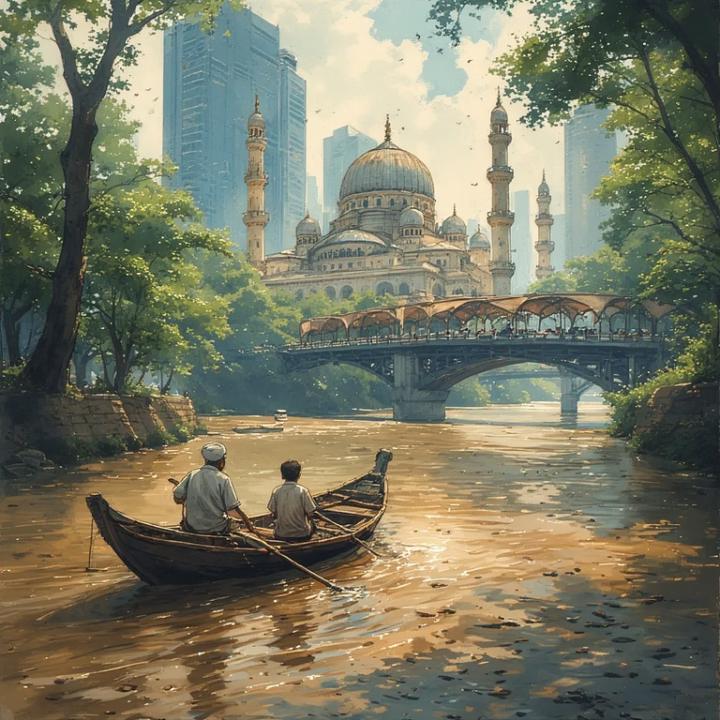
While his schoolmates were busy at the tuition centers or playing mobile games in air-conditioned malls, Eddy was at the muddy banks where the Gombak and Klang rivers met—the Muara. This was the heart of the city, the place where KL got its name, “Muddy Confluence.”
He wasn’t supposed to be there. His mother always said, “Eddy, don’t go near that water! Later you fall in and become fish food, then how?” But Eddy couldn’t help it. The river had secrets.
The Captain of the Muddy Water
Eddy’s best friend wasn’t a kid his age. It was Uncle Mutu, a man with skin the color of dark teak wood and a laugh that sounded like a tractor engine starting up. Uncle Mutu operated one of the small maintenance boats that cleared debris from the river.
“Oi, small boss! You late today! School principal catch you ah?” Mutu shouted over the chug-chug-chug of the engine.
“Mana ada, Uncle!” Eddy grinned, jumping onto the deck with the practiced balance of a cat. “History class was long gila. I thought my brain was going to melt.”
“History is behind us, lah. The river? The river is now. Come, help me with this log. If we don’t move it, the rubbish will pile up until we can walk across the water to Masjid Jamek.”
A Different View of the Concrete Jungle
As the boat drifted down the Klang River, the city changed. From the road, KL was all glass, steel, and “Don’t walk there!” signs. But from the river, the city looked like it had its shirt untucked.
They passed under bridges where the underside was covered in colorful graffiti—giant tigers and neon-style patterns that nobody on the street above ever saw. They saw the “hidden” people: the aunties washing their rugs on the stone steps, and the pak ciks fishing for ikan keli even though the water looked like teh tarik.
“Uncle, why the water so brown?” Eddy asked, poking a floating plastic bottle with a long bamboo pole.
“People forget, Eddy,” Mutu said, his eyes scanning the surface. “Last time, this river was full of life. Now, the city grows so fast, it treats the river like a rubbish bin. They want the tall buildings, the Merdeka 118, the TRX, but they forget the water that gave them the land.”
They watched as a monitor lizard, nearly two meters long, slid off a concrete ledge and disappeared into the murky depths.
“See that?” Mutu pointed. “That lizard is more ‘KL’ than any tourist. He knows the tunnels. He knows where the old tunnels from the tin mining days are hidden.”
The Secret of the Old Tunnel
One afternoon, the sky turned a bruised purple—the kind of color that meant a massive tropical downpour was only minutes away.
“We go to the tunnel under the old bridge,” Mutu decided. “Too dangerous to be in the open when the flash flood comes.”
They steered the boat into a dark, arched opening beneath a Victorian-era bridge. Inside, it was cool and smelled of damp earth and moss. As the rain began to hammer the city above—a sound like a thousand drums—Eddy noticed something.
On the walls of the tunnel, above the water line, were carvings. Not modern graffiti, but old markings.
“Uncle, look!”
Mutu shone his heavy flashlight. There were names and dates from the 1920s. There were Chinese characters, Jawi script, and English names.
“This was a landing point,” Mutu whispered, his voice echoing. “Before the roads were big, everything came by boat. Rice, tin, dreams. Your great-grandfather maybe stood right here. This river isn’t just water, boy. It’s a road made of memories.”
The Changing Tide
As the years of their friendship passed, Eddy saw the “Shadow of the City” grow. Massive concrete walls were built higher to stop the floods, hiding the river even more from the people. Green trees were replaced by “River of Life” blue lights and fountains.
“It looks pretty, Uncle,” Eddy said one evening, looking at the neon lights reflecting on the surface.
“Pretty is okay,” Mutu sighed, “but I miss the sound of the frogs. Now all I hear is the LRT and the cars. The city is winning, Eddy. Nature is just a decoration now.”
But that day, Eddy did something. He took out his sketchbook. He didn’t draw the skyscrapers or the shiny malls. He drew Uncle Mutu’s calloused hands. He drew the monitor lizard. He drew the hidden carvings in the tunnel.
“If I draw it, people won’t forget,” Eddy said.
Mutu patted his shoulder. “That is a good job, small boss. The city can build as high as it wants, but it can never bury the river. Not as long as someone is looking.”
Share this story, Spread the joy or reading
Other Interesting Stories:
When the Screens Went Asleep When every digital screen in Kampung Seri Paya mysteriously falls asleep at the same time, a curious boy and his friends uncover a hidden magical grove where old technology rests…
Fish Who Swam Backwards Through Time When 13-year-old Lina touches a mysterious glowing arapaima at KL Sea Adventure Park, she’s flung backwards through time — witnessing Kuala Lumpur in 1957, 1972, and 1998 — and encountering…
The Legend of the Gombak River In a Malaysian village nestled beside the Gombak River, twelve-year-old Aina discovers she can hear the river’s voice—and awaken its long-forgotten guardian, Dayang Bulan, a spirit born from moonlight and…
The Secret Map of Crispy Woods The sun was just peeking over the horizon, casting a warm glow on the dewy grass of Crispy Woods. Eddy sat cross-legged in his room, surrounded by an ocean of…
The Owl Who Was Scared of the Dark Aru, an owl who prefers daylight and fears the dark, is unexpectedly chosen to guide a forest festival during a stormy night. Struggling with his fear, he learns to rely…
The Vanishing Trail of the Taiping Lake Gardens During a family holiday in the scenic Taiping Lake Gardens, young Eddy, an aspiring detective, embarks on a mission to find his cousin Bell's lost gerbil, Fluffy. The search quickly…
This mode enables people with epilepsy to use the website safely by eliminating the risk of seizures that result from flashing or blinking animations and risky color combinations.
Visually Impaired Mode
Improves website's visuals
This mode adjusts the website for the convenience of users with visual impairments such as Degrading Eyesight, Tunnel Vision, Cataract, Glaucoma, and others.
Cognitive Disability Mode
Helps to focus on specific content
This mode provides different assistive options to help users with cognitive impairments such as Dyslexia, Autism, CVA, and others, to focus on the essential elements of the website more easily.
ADHD Friendly Mode
Reduces distractions and improve focus
This mode helps users with ADHD and Neurodevelopmental disorders to read, browse, and focus on the main website elements more easily while significantly reducing distractions.
Blindness Mode
Allows using the site with your screen-reader
This mode configures the website to be compatible with screen-readers such as JAWS, NVDA, VoiceOver, and TalkBack. A screen-reader is software for blind users that is installed on a computer and smartphone, and websites must be compatible with it.