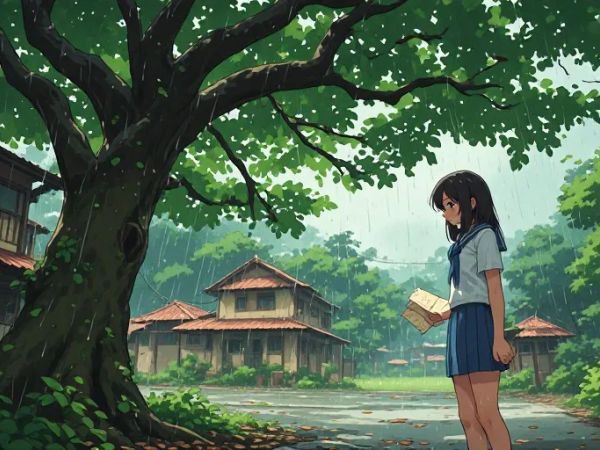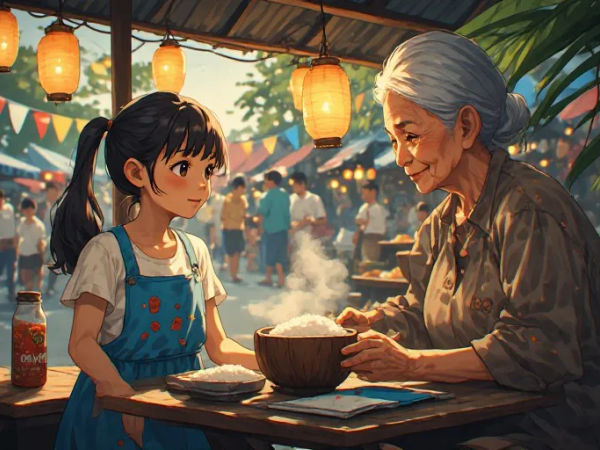
The first thing Eddy noticed that morning was that the sky looked like someone had spilled a bowl of grey soup over the whole neighborhood.
Not rain yet.
Just that heavy, waiting sort of sky that made everybody walk a little faster and shopkeepers pull their awnings halfway down.
Eddy stood outside his family’s little satay celup / lok-lok stall, balancing three empty bowls in one hand while trying to tie a loose piece of plastic sheet with the other.
“Eh, careful lah!” his younger sister called.
“I am careful!”
“You almost fell into the drain.”
“That was strategic.”
“Strategic, my foot.”
Eddy looked down at the narrow drain beside his slipper.
Okay.
Maybe he had almost fallen in.
The stall stood at the corner of a quiet Malaysian neighborhood where apartment blocks, old terrace houses, tiny workshops, fruit sellers, and food stalls squeezed together like they had all agreed not to waste an inch of space.
The neighborhood was called Taman Seri Embun.
Eddy had lived there his entire fifteen years.
He knew which uncle sold the sweetest bananas. He knew which alley flooded first when the rain came. He knew which stray cat liked fish balls and which one preferred chicken. He knew the auntie at the drink stall always gave extra ice to people who complained about the heat.
Most importantly, he knew the sound of his family’s stall.
The clink of bamboo skewers.
The bubbling broth.
The scrape of metal tongs against a steel tray.
The cheerful shout of customers choosing their food.
“Fish ball!”
“Two tofu!”
“Eh, mushroom got or not?”
“Got, got! Take yourself!”
And, every evening, his grandmother’s voice:
“One bowl at a time, Eddy. Don’t rush.”
That was Grandma Poh’s rule.
One bowl at a time.
She had been saying it for as long as Eddy could remember.
If there were twenty customers, one bowl at a time.
If the broth was boiling too quickly, one bowl at a time.
If someone spilled a tray, one bowl at a time.
If life became messy, confusing, or downright terrible—
“One bowl at a time,” Grandma Poh would say.
Eddy had always thought it was just something old people said when they wanted teenagers to slow down.
That morning, he was about to learn otherwise.
Chapter 1: The Notice
At eight thirty, Eddy’s father arrived carrying a folded piece of paper.
He didn’t say anything.
That was the first problem.
His father, Ah Tuck, normally talked constantly at the stall.
He talked about the price of vegetables.
He talked about football scores.
He talked about customers who always asked for extra sauce but never paid for it.
He even talked to the broth.
“Come on, come on,” he would mutter while stirring. “You can do better today.”
But now he simply stood beside the stall.
Grandma Poh looked at the paper.
Her smile disappeared.
Eddy stopped arranging the skewers.
“What happened?”
His father handed the paper to Grandma.
She read it once.
Then again.
“What is it?” Eddy asked.
Nobody answered.
“Hello? You all suddenly become statues ah?”
His sister, Anna, peeked around his elbow.
Grandma finally folded the paper.
“The stall has to close.”
Eddy laughed.
Not because it was funny.
Because sometimes your brain does that when something makes no sense.
“Close for what?”
“Safety repairs,” his father said quietly.
“How long?”
Grandma looked away.
“Three weeks.”
Eddy’s mouth fell open.
“Three weeks?!”
The family had already been struggling with the rising cost of ingredients. Three weeks without the stall would be difficult.
But then his father added, “If we cannot complete the repairs by then, we may have to give up the stall.”
Silence.
Even the bubbling broth seemed quieter.
Eddy looked around.
Their stall wasn’t fancy.
It had faded blue paint, two old plastic tables, six mismatched stools, a rusty fan, and a sign Grandma had painted herself years ago.
But it was home.
Eddy had done homework here.
He had celebrated birthdays here.
He had once fallen asleep beneath the table while waiting for his father to finish closing.
He knew every scratch on the counter.
“No,” he said.
His father sighed.
“Eddy.”
“No.”
“We need to think properly.”
“No. We need to fix it.”
Grandma gave him a tired smile.
“That is what we are going to do.”
Eddy picked up the paper again.
At the bottom was a list of repairs.
Electrical wiring.
Floor drainage.
A damaged cooking surface.
A replacement fire-safety container.
The total cost made Eddy’s stomach twist.
It was more money than the family had.
“We can’t afford this,” he whispered.
Grandma squeezed his shoulder.
“Then we find another way.”
“How?”
She looked at the steaming bowl in front of her.
“One bowl at a time.”
Chapter 2: The Mission
By lunchtime, Eddy had decided he was going to save the stall.
He just didn’t know how.
His best friend, Jiwoo, arrived on a bicycle with his backpack hanging from one shoulder.
“So,” Jiwoo said, “your face looks like somebody stole your last fish ball.”
“Worse.”
“Your phone died?”
“Worse.”
“You got homework?”
“Much worse.”
Eddy showed him the notice.
Jiwoo read it.
Then he whistled.
“Wah.”
“Exactly.”
“How much?”
Eddy told him.
Jiwoo’s eyebrows climbed higher.
“Wah.”
“You already said that.”
“Because the number deserves two wahs.”
They sat behind the stall.
Anna joined them with a cup of iced drink.
“So what’s the plan?”
“We raise the money.”
“How?”
Eddy shrugged.
Jiwoo shrugged.
Anna shrugged.
Three people.
Three shrugs.
Zero plans.
Then Jiwoo snapped his fingers.
“Food event.”
Eddy stared at him.
“What?”
“We make a big neighborhood food night.”
“That’s your genius idea?”
“Correct.”
“We already sell food.”
“Not like this.”
Jiwoo leaned forward.
“Your stall has been here for years. Everybody knows your family. We ask neighbors to come, buy bowls, donate if they want, and maybe help with repairs.”
Anna nodded slowly.
“Could work.”
Eddy frowned.
“What if nobody comes?”
“Then we think of something else.”
“And if it rains?”
“We put umbrellas.”
“What if—”
Jiwoo raised a hand.
“Bro. One problem at a time.”
Eddy froze.
He looked toward Grandma.
She was standing at the counter, carefully arranging tofu onto skewers.
One bowl at a time.
Eddy smiled.
“Okay.”
Chapter 3: The Neighborhood Wakes Up
The next two days became chaos.
Good chaos.
Eddy made handwritten posters.
Anna drew pictures of bowls and skewers.
Jiwoo went door to door with a notebook.
Their event was simple:
ONE BOWL NIGHT
Come eat.
Bring friends.
Help keep the neighborhood stall alive.
They hung posters near the community noticeboard, outside the laundry shop, beside the bicycle racks, and on the wall near the playground.
At first, Eddy worried nobody cared.
Then something strange happened.
People started offering help.
Uncle Jefri from the bicycle shop brought a toolbox.
Auntie Mala offered to make sweet snacks.
Old Mr. Tan, who usually complained about everything, donated two folding tables.
The school art club offered to paint a new sign.
Even the quiet woman from the upstairs apartment, who Eddy had never seen speak more than five words at a time, arrived with a bundle of cleaned plastic containers.
“What are these for?” Eddy asked.
“Takeaway.”
She walked away.
Jiwoo grinned.
“See?”
Eddy nodded.
The stall wasn’t just their family’s stall.
It belonged to everyone who had eaten there.
Every bowl had a memory attached to it.
Grandma Poh knew this already.
Eddy was only beginning to understand.
Chapter 4: Trouble in the Broth
On the afternoon before One Bowl Night, disaster struck.
The main cooking pot cracked.
Not a little crack.
A big one.
Water began leaking onto the floor.
Eddy stared.
Grandma stared.
His father stared.
Anna stared.
Jiwoo stared.
Then everyone looked at Eddy.
“Why everybody look at me?” he asked.
“Because you are standing nearest,” Anna said.
“Not my fault!”
Grandma crouched beside the pot.
“We need another one.”
“We don’t have money for another big pot,” Ah Tuck said.
Eddy felt panic rising inside him.
Tomorrow was the event.
Hundreds of bowls were expected.
Without the pot, there was no broth.
Without broth, there was no lok-lok.
Without lok-lok—
Eddy swallowed.
“No.”
He grabbed his bicycle helmet.
“Where are you going?” his father asked.
“To find one.”
“Eddy—”
“One bowl at a time, right?”
His father stared at him.
Then smiled.
“Right.”
Eddy cycled across the neighborhood.
He checked the kitchen supply shop.
Nothing.
He checked a restaurant.
Too small.
He checked a caterer.
They were using theirs.
He was about to give up when he remembered Uncle Rahman’s old storage room.
Uncle Rahman ran a tiny catering business behind his house.
Eddy knocked.
“Uncle!”
No answer.
He knocked again.
“Uncle Rahman!”
The door opened.
“What happened, boy?”
Eddy explained.
Uncle Rahman listened.
Then disappeared inside.
He returned carrying an enormous stainless-steel pot.
Eddy’s eyes widened.
“This can work?”
“Of course.”
“How much?”
Uncle Rahman shook his head.
“Nothing.”
Eddy blinked.
“But—”
“You helped my daughter fix her bicycle last month.”
“That was just tightening a chain.”
“Still help.”
He handed over the pot.
“Bring it back clean.”
Eddy grinned.
“Promise!”
Chapter 5: One Bowl Night
The rain came at five thirty.
Not gentle rain.
Not polite rain.
A proper Malaysian downpour.
The kind that turned roads shiny, filled drains in minutes, and made everyone shout, “Aiyo!”
Eddy stood beneath the stall awning watching sheets of water fall across the street.
Jiwoo arrived soaked from head to toe.
“Good news!”
“What?”
“I found three extra umbrellas.”
“Bad news?”
“They’re all broken.”
Anna appeared behind them.
“Good news!”
“What?”
“The rain is slowing down.”
Everyone looked outside.
It was.
Then came a loud crack of thunder.
Eddy sighed.
“Of course.”
At six thirty, only five customers had arrived.
Eddy’s stomach tightened.
At seven, there were twelve.
At seven fifteen, twenty.
Then thirty.
Then fifty.
People came carrying umbrellas.
They came wearing raincoats.
They came in slippers.
They came laughing because their shoes were already soaked.
Someone brought chairs.
Someone brought a folding table.
Someone tied plastic sheets across the side of the stall.
Someone shouted, “Make space, lah!”
The quiet woman from upstairs appeared with more takeaway containers.
Mr. Tan brought an old radio.
Auntie Mala brought trays of snacks.
Uncle Jefri brought a portable lamp.
The street glowed with warm yellow light.
Steam rose from the cooking pot.
Skewers disappeared from the trays.
Bowls filled.
Bowls emptied.
Eddy’s hands moved faster and faster.
“Chicken!”
“Here!”
“Fish ball!”
“Coming!”
“Two tofu!”
“Wait, wait!”
“Eddy!”
“What?”
“Your brother put mushroom in the wrong bowl!”
“Anna!”
“I thought that one was fish!”
“It literally has a mushroom on it!”
“Looks like fish from far!”
Jiwoo burst out laughing.
Eddy laughed too.
For the first time in days, he wasn’t afraid.
He was too busy.
Too happy.
The neighborhood had come.
One bowl at a time.
Chapter 6: The Missing Money
At nine thirty, the rain finally stopped.
The crowd slowly disappeared.
The tables were covered with empty bowls.
The ground glittered with puddles.
Eddy collapsed onto a stool.
“My legs are dead.”
“Your legs are dramatic,” Anna said.
Jiwoo counted the money.
Once.
Twice.
Then a third time.
His smile vanished.
“What?”
Eddy stood.
“What?”
“We’re short.”
“How short?”
Jiwoo told him.
Eddy stared at the pile of money.
After everything—
They still hadn’t raised enough.
His shoulders dropped.
His father sat beside him.
“Eddy.”
“We tried.”
“I know.”
“We worked so hard.”
“I know.”
“It still isn’t enough.”
His father didn’t answer.
Grandma Poh came over.
She sat beside them.
For a while, nobody spoke.
Then she placed a hand on Eddy’s shoulder.
“You thought saving something meant doing one big thing.”
Eddy looked at her.
“Isn’t that what we did?”
“No.”
She smiled.
“We did many small things.”
She pointed around the street.
“At the beginning, you had one problem.”
Eddy nodded.
“Then you found one friend.”
Jiwoo raised his hand.
“Hello.”
Grandma continued.
“Then one neighbor.”
She pointed toward Mr. Tan.
“Then another.”
Auntie Mala waved.
“Then another.”
Uncle Jefri lifted his cup.
“And another.”
Grandma looked at Eddy.
“Sometimes, young people think big problems require big heroes.”
She tapped the empty bowl in front of him.
“But most things are saved one small act at a time.”
Eddy stared at the bowl.
Then he heard something.
A cough.
He looked toward the end of the street.
The quiet woman from upstairs was standing there.
She walked over.
“I heard you’re short.”
Eddy nodded.
She took an envelope from her bag.
“Take this.”
His father immediately shook his head.
“No, no. You’ve already helped.”
She pushed the envelope toward him.
“I ate here for eleven years.”
Eddy blinked.
“What?”
She smiled.
“My husband liked the tofu.”
She looked down at the stall.
“He passed away some years ago.”
She paused.
“I still come because this place reminds me of him.”
Eddy’s throat tightened.
She placed the envelope on the counter.
“Let the stall stay.”
Then she walked away.
Nobody moved.
Jiwoo slowly picked up the envelope.
Inside was exactly the amount they were missing.
Not one cent more.
Not one cent less.
Eddy stared at it.
“How did she know?”
Grandma smiled.
“People know more than we think.”
Chapter 7: The Last Bowl
The repairs took two weeks.
It wasn’t easy.
There were delays.
There were mistakes.
There were days when Eddy wanted to give up.
But every time he felt overwhelmed, Grandma reminded him:
“One bowl at a time.”
They repaired the wiring.
They fixed the floor drainage.
They replaced the damaged cooking surface.
They installed the required safety equipment.
The old blue paint was scrubbed clean.
The school art club painted a new sign.
It showed a steaming bowl surrounded by tiny stars.
Underneath were four words:
GOOD FOOD. GOOD NEIGHBORS.
When the stall reopened, Eddy stood outside before sunrise.
The neighborhood was quiet.
No customers.
No laughter.
No clinking bowls.
Just birds in the trees and the distant sound of someone sweeping a pavement.
His father handed him the first bowl.
“Your turn.”
Eddy took it.
Steam curled toward his face.
He looked at the bowl.
It was ordinary.
Just broth.
Vegetables.
Fish ball.
Tofu.
Mushroom.
Nothing magical.
And yet Eddy thought about everything it represented.
The cracked pot.
The rain.
Jiwoo’s broken umbrellas.
Anna’s messy posters.
Uncle Rahman’s enormous pot.
Auntie Mala’s snacks.
Mr. Tan’s folding tables.
The quiet woman upstairs.
Every person who had helped.
Every person who had eaten.
Every person who had believed the little stall mattered.
Eddy carried the bowl to the first customer.
It was the quiet woman.
She smiled.
“Good morning.”
Eddy smiled back.
“Morning.”
He placed the bowl in front of her.
“For your husband?”
She looked at the steaming food.
Then shook her head.
“No.”
She picked up the chopsticks.
“For me.”
Eddy grinned.
“Good choice.”
She laughed.
He returned to the counter.
His father was already preparing another bowl.
Grandma was arranging skewers.
Anna was arguing with Jiwoo about whose poster had been better.
The street was waking up.
The first customer finished her bowl.
Then another customer arrived.
Then another.
Then another.
Eddy grabbed an empty bowl.
He filled it.
Passed it across the counter.
And for the first time, he understood what Grandma had been trying to teach him all along.
You couldn’t always fix everything at once.
You couldn’t control the rain.
You couldn’t make money appear.
You couldn’t stop every problem from arriving.
But you could always do the next small thing.
You could help one person.
You could wash one bowl.
You could carry one table.
You could make one meal.
You could say one kind word.
And sometimes, if enough people did that together—
A little stall could survive.
A neighborhood could become a family.
And a simple bowl of food could hold an entire world.
Grandma Poh watched Eddy serve another customer.
She smiled.
“One bowl at a time.”
This time, Eddy didn’t roll his eyes.
He simply smiled.
“One bowl at a time.”
And the morning carried on.
The End…