The humidity in Kuala Lumpur was no joke. Even at the Thean Hou Temple, perched high on Robson Heights, the air felt like a warm, wet blanket. Eddy wiped sweat from his forehead, his fingers stained with red ink and sticky rice glue.
“Aiyoo, Eddy! Don’t daydream, lah!” his grandfather, Gong Gong, called out across the courtyard. “The festival is in three days—if these lanterns aren’t ready, we will fail in our duty!”
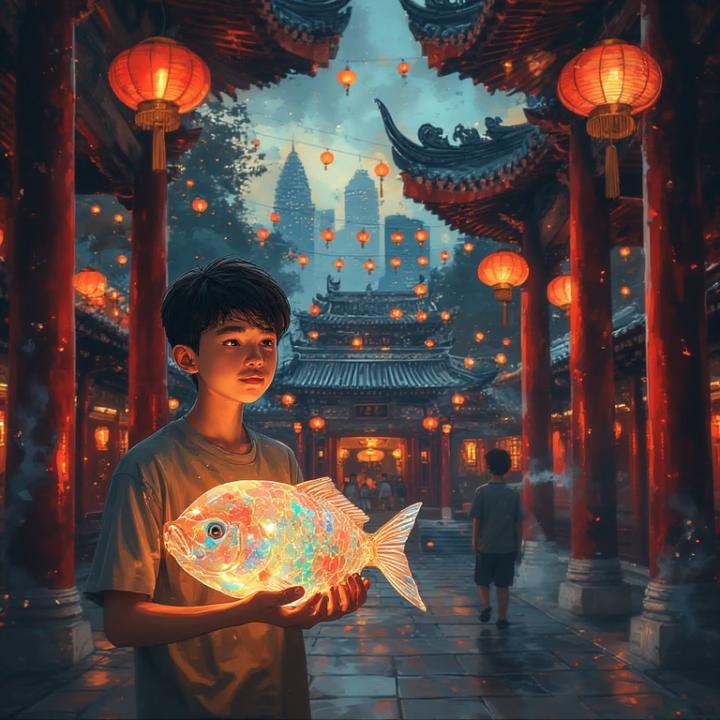
Eddy grinned. Gong Gong was always dramatic. The temple was already transforming. Thousands of red lanterns hung like glowing cherries against the curved pagoda roofs. For generations, Eddy’s family had been the “Masters of Light,” responsible for the most intricate lanterns at the festival.
But Eddy felt like a “Master of Mistakes.” His paper kept tearing, and his bamboo frames looked more like squashed durians than graceful lotus flowers.
“I’m trying, Gong Gong,” Eddy sighed, adjusting his glasses. “But why must we do it the old way? The shop downstairs sells LED lanterns for ten ringgit. Switch on, finish liao!”
Gong Gong stopped his work. He looked at Eddy with eyes that were cloudy but sharp. “LED is just light, boy. A handmade lantern is a story. You put your breath into the bamboo. You put your heart into the paper.”
The Discovery
Later that evening, while searching for extra wire in the dusty temple storehouse, Eddy tripped over a heavy wooden chest. It was tucked behind a stack of prayer mats, smelling of incense and old memories.
Inside, wrapped in yellowing silk, was a lantern unlike any he had ever seen.
It wasn’t round or star-shaped. It was shaped like a great leaping carp, but the “scales” weren’t made of paper. They were made of a strange, translucent material that shimmered like pearls under the dim storeroom bulb. When Eddy touched it, the material felt cool, like sea glass.
“Wah… so beautiful,” Eddy whispered.
He noticed a small tag attached to the frame. It had faded calligraphy: “To light the way home when the waves are high.”
The Challenge
Eddy became obsessed. He wanted to replicate the “Pearl Lantern” for the festival’s main display. He spent his afternoons trying to figure out the frame. It wasn’t just bamboo; it used thin strips of dark wood that bent in impossible curves.
“Boy, what are you doing?” Gong Gong asked, peeking into the workshop. He saw the old lantern and froze. His face went soft, a mix of sadness and pride. “You found the Sea-Silk Lantern.”
“Who made it, Gong Gong? It’s not like the others.”
Gong Gong sat down heavily. “Your great-great-grandfather. He was a fisherman before he was a lantern maker. He survived a terrible storm at sea because he followed a light on the horizon. He believed it was the Goddess of the Sea, protecting him. When he reached land, he vowed to create a light that would never go out in the wind.”
“What is this paper made of?” Eddy asked.
“It’s not paper. It’s treated fish scales and silk. A lost technique,” Gong Gong sighed. “Very difficult. Don’t waste time, Eddy. Just stick to the red paper.”
But Eddy couldn’t. He felt a connection to this fisherman ancestor. He felt like he finally had a story to tell.
Trial and Error
The next 48 hours were a disaster. Eddy tried using plastic—too stiff. He tried tracing paper—too dull. He even tried clear candy wrappers, but they melted under the heat of the candle.
“Give up lah,” his cousin, Jia En, teased as she walked by with a tray of tang yuan (sweet rice balls). “You look like a panda with those dark circles under your eyes.”
“Cannot give up,” Eddy muttered, his tongue poking out in concentration. “There’s a secret to this.”
He went back to the old lantern. He looked at the joints. They weren’t tied with string; they were notched together like a puzzle. He realized he didn’t need more glue; he needed better structure.
He spent the whole night scraping bamboo until it was as thin as a fingernail. He remembered what Gong Gong said: Put your breath into it. He stopped rushing. He listened to the wind whistling through the temple eaves. He thought about the sailors long ago, looking for a way home.
The Night of the Festival
The Lantern Festival arrived. The Thean Hou Temple was a sea of people. Tourists with big cameras, grandmothers in floral samfoos, and kids running around with battery-operated dragon toys.
Eddy’s display was in the center of the fountain courtyard.
When the sun dipped below the horizon, Gong Gong came out to light the main lanterns. He reached Eddy’s creation. It was a replica of the Sea-Silk Lantern, though not perfect. Instead of real fish scales, Eddy had used thin parchment soaked in a special oil he’d experimented with, layered like scales.
Gong Gong struck a match. The flame bloomed inside the lantern.
The crowd gasped.
The lantern didn’t just glow red; it shimmered with a soft, iridescent light, casting patterns on the temple walls that looked like moving waves. It was as if the ocean had been captured in a cage of bamboo.
“You did it,” Gong Gong whispered, his voice cracking. “You found the light.”
The Meaning of the Light
“Gong Gong,” Eddy said, watching the families pray and laugh. “I used to think the festival was just about pretty decorations. But it’s about not being lost, right?”
Gong Gong patted his shoulder. “Correct. We light lanterns to show our ancestors we remember them. We light them to show our friends we are here. And we light them so we don’t forget who we are in the dark.”
Eddy looked at his ink-stained hands. They weren’t just messy anymore; they were the hands of a Master of Light. He didn’t need the LED lanterns. He had the “Sea-Silk” in his blood.
“Next year,” Eddy said with a cheeky grin, “I’m making a dragon that actually breathes smoke.”
Gong Gong laughed. “Wow… I can’t wait to see it!”
As the moon rose full and bright over Kuala Lumpur, the Thean Hou Temple shone like a jewel on the hill, a bridge between the old world and the new, held together by bamboo, paper, and a young boy’s heart.
Share this story, Spread the joy or reading
Other Interesting Stories:
Chasing the Golden Hour Linh, a city girl obsessed with capturing the "perfect" social-media-worthy photo, travels to the Mu Cang Chai rice terraces during the harvest season. Through her interactions with her hardworking cousins…
Pineapple Tarts for a Rainy Day Pineapple Tarts for a Rainy Day is a moving story about twelve-year-old Ah Boy and his aging grandfather, Gong Gong, as they prepare traditional Lunar New Year treats in their…
The Owl Who Was Scared of the Dark Aru, an owl who prefers daylight and fears the dark, is unexpectedly chosen to guide a forest festival during a stormy night. Struggling with his fear, he learns to rely…
The Beast and the Firecracker: How the World Turned Red The Beast and the Firecracker is a vibrant reimagining of the Chinese New Year legend, centered on a spunky boy named Eddy and his clever friend Belly. Tired of their…
The Floating Market of Pangkor This slice-of-life story follows Kai, a 9-year-old boy, as he spends his school holidays helping his family run their food stall at a traditional floating market on Pangkor Island. Through…
When the Screens Went Asleep When every digital screen in Kampung Seri Paya mysteriously falls asleep at the same time, a curious boy and his friends uncover a hidden magical grove where old technology rests…
This mode enables people with epilepsy to use the website safely by eliminating the risk of seizures that result from flashing or blinking animations and risky color combinations.
Visually Impaired Mode
Improves website's visuals
This mode adjusts the website for the convenience of users with visual impairments such as Degrading Eyesight, Tunnel Vision, Cataract, Glaucoma, and others.
Cognitive Disability Mode
Helps to focus on specific content
This mode provides different assistive options to help users with cognitive impairments such as Dyslexia, Autism, CVA, and others, to focus on the essential elements of the website more easily.
ADHD Friendly Mode
Reduces distractions and improve focus
This mode helps users with ADHD and Neurodevelopmental disorders to read, browse, and focus on the main website elements more easily while significantly reducing distractions.
Blindness Mode
Allows using the site with your screen-reader
This mode configures the website to be compatible with screen-readers such as JAWS, NVDA, VoiceOver, and TalkBack. A screen-reader is software for blind users that is installed on a computer and smartphone, and websites must be compatible with it.