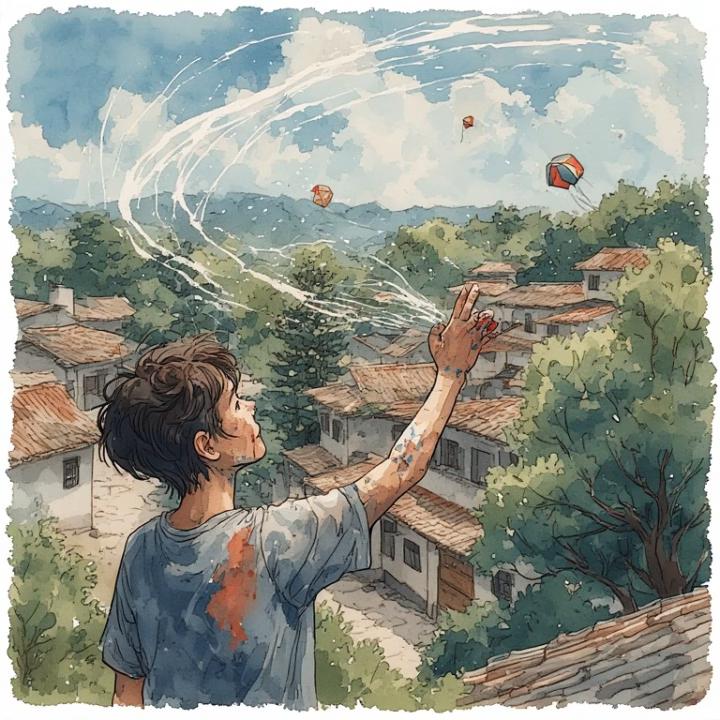
In the small town of Willow Creek, where the roofs were mostly red clay and the streets curled around groves of tall eucalyptus trees, lived a boy named Finn Calder. Finn had a mop of unruly brown hair, paint-stained fingers, and a habit of staring too long at the sky. Everyone in town knew him as the kid who always carried a sketchbook under one arm, a brush in his pocket, and a secret that even he didn’t fully understand yet.
Finn wasn’t just any artist. He could make the wind dance.
It started one late afternoon in early spring. Finn had been painting in the garden of his tiny home at the edge of town, trying to capture the way sunlight glimmered through the eucalyptus leaves. He swirled pale yellows and soft greens across the canvas, brushing in the tiniest strokes of blue and lavender. Then, he noticed the wind shifting. A sudden breeze rippled across the garden, moving the leaves exactly how he had painted them.
“Hmm,” Finn muttered, tilting his head. “That’s… strange.”
He set down his brush and lifted his arms, almost like a conductor. The wind tugged at his hair, lifting the leaves and petals around him as if responding. He laughed. “No way,” he said. “I… I painted this?”
Over the next week, Finn tested it. He painted a storm with rolling gray clouds over the mountains in the distance, and by the afternoon, dark clouds gathered in the sky, swirling above the town like a pot of ink. When he painted soft, lazy spring rain, tiny droplets began falling over the cobblestones. He tried a golden sunset, and the town glowed with the kind of light that makes even old paint on shop signs shimmer.
It wasn’t long before Finn realized that painting the wind wasn’t just fun—it came with responsibility.
Trouble in Willow Creek
At first, the townsfolk thought the sudden weather changes were lucky coincidences. People danced in his rain, laughed under his sunny spells, and praised the skies for being so “unusually perfect.” But as Finn’s moods began to bleed into his art, the magic started to cause problems.
One morning, Finn woke up angry. His little brother, Toby, had spilled paint all over his favorite sketchbook. Finn slammed his brushes down in frustration and sketched a stormy sky, gray and furious. By the afternoon, the town square was pelted by hail. Flowerbeds were flattened, a bakery’s sign swung dangerously, and the townspeople scrambled for cover.
Finn ran outside, horrified. “I didn’t mean—” he shouted, but the wind roared like a living thing, shaking rooftops and rattling windows. Toby tugged on his sleeve, eyes wide. “Finn… you have to calm it down!”
But how do you calm the wind when it’s your own anger that’s feeding it? Finn remembered what his art teacher, Mrs. Arlin, had told him: “Paint what you feel, yes, but know that your feelings will always color the world around you.”
He closed his eyes, breathed deeply, and tried to think of the quiet he felt when he painted the eucalyptus garden that first day. Slowly, he painted again—soft blues, gentle greens, wisps of white. The storm above melted into light drizzle, then faded completely. The town breathed a collective sigh of relief.
Finn realized that controlling the wind wasn’t just about talent. It was about understanding himself.
The Artist and the River
One day, Finn’s best friend, Maris, suggested he try painting near the Willow Creek river. “If the wind follows your emotions,” she said, “maybe it’ll follow your ideas too.” Finn was skeptical, but he grabbed his paints and set off.
The river was calm, its surface like liquid glass. Finn dipped his brush in a mix of emerald and turquoise, trying to capture the reflections of trees swaying gently. But then he got carried away, painting waves taller than any he’d seen, twisting around imaginary whirlpools.
The wind began to pick up. Small gusts became stronger, tugging at the trees and whipping his hair around. The river swelled and surged, churning with energy. Finn froze. “Uh… maybe that’s too much,” he muttered.
Maris grabbed his sleeve again. “Focus, Finn! You need to feel calm before you can paint it.”
Finn closed his eyes and pictured something steady—a lighthouse, anchored in a storm, unmoving no matter how strong the waves. Slowly, he sketched it on his canvas. The wind obeyed, softening, turning into playful ripples on the water. Finn felt a rush of pride. He was learning to work with his emotions, not just react to them.
The Festival of Winds
Spring in Willow Creek was celebrated with the Festival of Winds, a tradition where townsfolk flew kites of every size and color. This year, Finn had been asked to create the backdrop painting—a massive mural to hang across the town square.
But Finn hesitated. Every time he tried a grand painting, his emotions got tangled, and the wind went wild. What if he ruined the festival? What if he hurt someone?
Maris put a hand on his shoulder. “Finn, you’ve got to trust yourself. You’re the only one who can paint the winds that belong to Willow Creek.”
Taking a deep breath, Finn worked. He painted rolling clouds in soft pastels, twirling ribbons of wind, and golden sunlight spilling across the square. When he finished, he stepped back. The mural shimmered with life—and the wind in the town danced along perfectly, lifting kites gently into the air, spinning them without a crash or collision.
Children laughed, couples cheered, and Finn felt a warm light in his chest. For the first time, he realized that his gift could bring joy, not just chaos.
The Storm Inside
But not all storms are outside. Finn’s greatest challenge came later that summer, when his father became seriously ill. Finn tried to paint his worry away, but the more he tried to control it, the more the wind became wild and untamed. Windows rattled, flags tore, and trees bent under sudden gusts.
Finn sat by the river alone, clutching his sketchbook, heart heavy. He realized something: he couldn’t control everything—not the weather, not life, not the people he loved. What he could do was acknowledge his feelings and channel them carefully into his art.
He started painting not storms, but hope. He painted sunlight breaking through clouds, flowers bending gracefully in the breeze, birds returning to their nests. The wind followed him again, steady and kind, brushing his hair and carrying the scent of eucalyptus.
When his father recovered, Finn understood that painting the wind wasn’t just a trick—it was a way to understand life. And life, like the wind, would always shift, and he would always need to paint through it.
A New Chapter
By the time autumn came, Finn was well-known beyond Willow Creek. People traveled to see the boy who could paint the wind. But he never painted to impress; he painted to feel, to learn, and to bring balance to the world around him.
And every time he looked at the sky, a breeze brushing his cheeks, Finn smiled. Because now he knew: the storms outside only mattered as much as the storms inside—and he was finally learning how to calm both.
The boy who painted the wind had learned that his true gift wasn’t just in creating storms or sunlit skies—it was in understanding the power of his own heart, and letting that shape the world with care.
The End
Share this story, Spread the joy or reading
Other Interesting Stories:
Shadow-Tag In the magical town of Maplewood, children play a game called Shadow-Tag, where touching shadows swaps memories. When Eliot suddenly loses his own shadow, he discovers he can no longer…
When the Screens Went Asleep When every digital screen in Kampung Seri Paya mysteriously falls asleep at the same time, a curious boy and his friends uncover a hidden magical grove where old technology rests…
Letters from the Black Castle Through a series of heartfelt letters to her American pen pal Emma, twelve-year-old Kiko Suzuki shares her life in the shadow of Matsumoto's iconic "Crow Castle." Her quiet passion for…
The Owl Who Was Scared of the Dark Aru, an owl who prefers daylight and fears the dark, is unexpectedly chosen to guide a forest festival during a stormy night. Struggling with his fear, he learns to rely…
Red Envelopes and Empty Pockets Red Envelopes and Empty Pockets follows twelve-year-old Ah Boy as he struggles to live up to his family’s high expectations during the Lunar New Year celebrations. Constantly compared to his…
Sakura Petals on the Moat During the peak of cherry blossom season at Tokyo’s Chidorigafuchi Park, childhood friends Kenji and Aiko share a poignant final afternoon rowing through a moat blanketed in pink petals before…
This mode enables people with epilepsy to use the website safely by eliminating the risk of seizures that result from flashing or blinking animations and risky color combinations.
Visually Impaired Mode
Improves website's visuals
This mode adjusts the website for the convenience of users with visual impairments such as Degrading Eyesight, Tunnel Vision, Cataract, Glaucoma, and others.
Cognitive Disability Mode
Helps to focus on specific content
This mode provides different assistive options to help users with cognitive impairments such as Dyslexia, Autism, CVA, and others, to focus on the essential elements of the website more easily.
ADHD Friendly Mode
Reduces distractions and improve focus
This mode helps users with ADHD and Neurodevelopmental disorders to read, browse, and focus on the main website elements more easily while significantly reducing distractions.
Blindness Mode
Allows using the site with your screen-reader
This mode configures the website to be compatible with screen-readers such as JAWS, NVDA, VoiceOver, and TalkBack. A screen-reader is software for blind users that is installed on a computer and smartphone, and websites must be compatible with it.