Chapter 1: The Colour of Rain
In Air Itam, rain did not simply fall.
It arrived with a big, booming announcement, drumming on zinc roofs, splashing into open drains, and turning every lane into a silver ribbon. It made the hills wear mist like a shawl. It made the old jackfruit trees drip for hours after the clouds had gone. It even made the neighbourhood cats look offended, as if somebody had personally cancelled their afternoon nap.
Anna knew the language of rain.
She could tell the difference between a friendly afternoon shower and the dangerous kind that made Auntie Mei shout, “Eh, bring the laundry in, can or not?” She knew when the clouds were only bluffing and when the drains would soon gurgle like hungry dragons. Most of all, Anna knew how to paint rain.
She painted it as thin blue lines, fat grey strokes, and tiny white splashes that looked like secret messages.
“Rain is not just water,” she often told her younger brother, Jojo.
Jojo would squint at her sketchbook. “Then what is it? Soup?”
“Don’t be so blur, lah. Rain is a mood.”
“Your mood always hungry.”
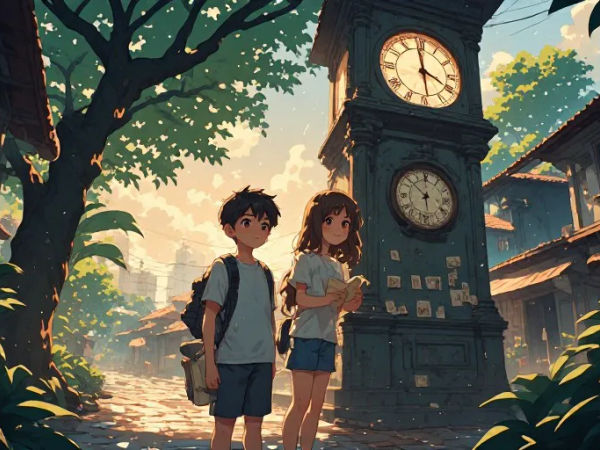
Anna would chase him around the kitchen with a paintbrush while their mother laughed from the stove. Their home stood near the bend of a steep lane, between a bicycle repair stall and a tiny shop that sold curry puffs, steamed buns, and cold drinks in plastic cups. Their house was narrow, bright, and always full of things drying somewhere: school socks on the railing, herbs near the window, Anna’s paint rags on the back of a chair.
At fourteen, Anna was famous in the neighbourhood for three things. She could draw a person’s face after seeing it once. She could climb the rambutan tree faster than any boy in her class. And she never, ever threw away an empty paint tin.
“Why keep all this rubbish?” her mother asked one Saturday morning, holding up a tin that once contained yellow wall paint.
“It’s not rubbish. It can become something.”
Anna had painted the tin with little green leaves and used it to hold pencils. Another tin became a pot for mint. A third one carried screws, buttons, and two mysterious marbles Jojo insisted were lucky.
Their mother shook her head. “You and your art. One day the whole house will be painted until no wall left.”
Anna grinned. “That is the plan, Ma.”
Then came the monsoon.
For three days, the sky stayed the colour of old metal. Rain battered the hills and rushed down through the lanes. The drains overflowed. Water climbed the front steps. Neighbours moved chairs, rice sacks, schoolbooks, and sleeping mats to higher places.
On the third night, the rain became a roar.
Anna woke to Jojo yelling, “Ma! Water inside!”
She jumped from bed. Cold brown water spread across the floor, carrying leaves, plastic wrappers, and one lonely slipper. Their mother grabbed the important things first—the family documents, the medicine box, the tin of savings hidden behind the rice container. Anna lifted Jojo’s schoolbag onto the table.
Outside, people shouted to one another through the storm.
“Come up this side!”
“Watch the drain!”
“Eh, somebody help Ah Seng with the boxes!”
The neighbourhood, usually noisy in a cheerful way, sounded frightened.
Anna climbed onto a chair to look through the window. Across the lane, a painted wall showed a blue kingfisher flying over yellow flowers. The mural had been there since before she was born. She had loved it since she was little.
Now half of it was under muddy water.
The kingfisher’s painted wing disappeared first. Then the flowers. Then the whole bottom of the wall became a brown, trembling mirror.
Anna pressed her palm against the glass.
“Hold on,” she whispered, though she did not know whether she was speaking to the wall, the bird, or the whole neighbourhood.
By morning, the rain had weakened. Air Itam was scarred and silent.
Mud lay in thick ridges along the lanes. Wooden crates had floated into the playground. The curry puff shop’s sign hung crooked. The bicycle stall was filled with wet cardboard. Everyone moved slowly, carrying brooms, buckets, and tired faces.
The kingfisher mural had lost its lower half.
Someone had scratched a message into the mud on the wall:
WE WILL REMEMBER.
Anna stared at it for a long time.
She did not know who had written the words. She only knew that the letters looked small against the enormous damage.
Chapter 2: The Wall That Would Not Stay Blank
For the next week, Air Itam smelled of wet wood, soap, and mud that refused to leave. The sun came out, but it did not feel like a victory. It only showed everyone what the flood had done.
At school, the teachers asked students to help clean the library. Anna and her friends spent the morning wiping books with old cloths. Her best friend, Amelia, wore bright yellow rubber boots and complained that the mud had entered places mud had no business entering.
“I found a leaf inside my pencil case,” Amelia said.
“Maybe it wants to study,” said Hafiz, who was balancing three books on his head.
“Then it can pay school fees.”
They laughed, but the laughter faded quickly.
At lunch, everyone talked about the flood. Somebody’s chicken coop had floated away. Somebody’s uncle had lost his tools. The playground fence leaned at a dramatic angle, like it was tired of standing.
Anna looked down at her rice and vegetables.
“I’m going to repaint the mural,” she said.
Amelia paused with her spoon halfway to her mouth. “The bird wall?”
“Mm.”
Hafiz lowered the books. “You know it’s a whole wall, right? Not your notebook.”
“I know.”
“And paint costs money.”
“I know.”
“And you need permission.”
Anna poked her rice. “I know all these things, lah.”
Amelia leaned closer. “But you still want to do it?”
Anna looked toward the school window. Beyond it, the hills were green again, shiny and innocent. That was what bothered her most. The hills looked as if nothing had happened.
“Yes,” she said. “If the wall stays blank, everybody will keep seeing the flood. I want them to see something after it.”
That afternoon, Anna went to inspect the mural. Mud had dried in a cracked line across the painted kingfisher. The wall was worse than she had imagined. The old colours had peeled away in bubbles. A long scratch ran through the bird’s eye.
She touched the scratch.
“Poor thing,” she murmured.
“Talking to walls now?”
Anna spun around. It was Uncle Raman, who repaired umbrellas under a striped canvas near the lane. He had a narrow face, silver hair, and a habit of appearing whenever somebody was being stubborn.
“I’m planning,” Anna said.
“Planning to paint without a ladder?”
“I can borrow one.”
“Planning to paint without money?”
“I can collect.”
“Planning to paint without knowing whether the wall is safe?”
Anna opened her mouth, then closed it.
Uncle Raman nodded. “Good. At least one brain cell is still working.”
He walked closer and tapped the lower part of the wall with his knuckle. It sounded hollow.
“Some plaster loose,” he said. “You paint now, next rain everything fall down. Then people say your artwork very modern—floating pieces.”
Anna sighed. “So what do I do?”
“First, ask. Second, listen. Third, do not make the whole thing your burden just because you have two hands.”
“I can handle it.”
“Can, but must you?”
That question followed Anna all the way home.
At dinner, she announced her plan. Her mother listened while serving soup. Jojo listened while secretly stealing the fried tofu.
“Paint the mural?” Ma asked.
“Repair and repaint. With everyone’s help.”
“Everyone’s help?”
“Maybe.”
Ma gave her a look. “Anna, after flood people are cleaning houses, replacing things, finding work. Art is good, but don’t expect everybody to stop life for a picture.”
“I’m not asking them to stop life. I’m asking them to put some life back.”
The kitchen became quiet.
Her mother’s face softened, but she still shook her head. “If you do this, do it properly. No sneaking out. No climbing unsafe walls. No borrowing my cooking bowls for paint.”
Jojo raised his hand. “Can I help?”
“You can wash brushes,” Anna said.
“Wah, big job.”
“You’re the youngest. Start with big dreams.”
Chapter 3: The Map of Small Things
The first hurdle was permission.
The wall belonged to the community hall, which meant Anna had to speak to Madam Leela, the hall keeper. Madam Leela was a compact woman with a strong voice and stronger eyebrows. She could make three noisy children become silent by simply looking at them.
Anna found her sweeping silt from the hall steps.
“Madam, can I ask something?”
“You already are asking.”
“Can I repair the wall mural?”
Madam Leela leaned on her broom. “With what money?”
“I’ll collect paint donations.”
“From who?”
“The neighbourhood.”
“Who will supervise?”
“Uncle Raman knows about walls.”
“Who will clean up?”
“Me and my friends.”
“Who will stop Jojo from painting his own face?”
Anna glanced at the hall doorway, where Jojo was peeking out.
“I’ll try.”
Madam Leela looked at the damaged mural. Her expression changed. She had been there when it was first painted by an elderly artist named Mr. Boon, who had moved away years ago. She told Anna the kingfisher had been chosen because it always returned after heavy rain, bright and quick, flashing between branches.
“Fine,” Madam Leela said at last. “You may repair it. But no rushing. Make a plan and show me first.”
Anna’s heart jumped. “Really?”
“Really. And if your plan is nonsense, I will say so.”
“That’s fair.”
“It is more than fair. It is free advice.”
Anna’s next job was gathering stories.
She carried her sketchbook from door to door and asked neighbours what they remembered about the lane before the flood, what they wanted to keep, and what they wished the wall could say.
Auntie Mei wanted her yellow flowering tree included because its branches had caught three floating baskets during the flood.
Uncle Raman wanted umbrellas, “because rain is not the boss of everybody.”
Hafiz’s grandmother wanted a row of small blue windows like the ones on her childhood house.
Amelia suggested painting hands—many hands, different sizes, passing buckets and food.
Jojo demanded a giant orange cat.
“Your cat did nothing useful,” Anna told him.
“It looked brave.”
“It hid under the bed.”
“Brave cats also need rest.”
Anna drew everything. She drew the hill, the drain, the old fruit trees, the crooked bicycle stall, the hall steps, and the people who had helped one another. She drew the floodwater as curling lines beneath the scene, not as a monster but as a powerful thing that had passed through.
At school, Amelia organised a small collection box. Hafiz spoke to the canteen auntie, who donated two tins of white paint and a bottle of bright green. A quiet boy named Kannan brought a bag of brushes from his father’s signboard workshop.
Even the curry puff seller, whose shop sign had been ruined, gave Anna a tin of red.
“Take,” he said. “But don’t use all until you know what you doing. Red very dramatic, ah.”
Anna saluted. “I’ll use responsibly.”
“You? Responsible? My shop roof also responsible until the flood carried it away.”
The collection grew, but not evenly. They had enough white, green, and brown. They had a little yellow. They had no blue, hardly any orange, and not enough weatherproof sealant to protect the finished work.
Then the rain returned.
It began as a soft tapping during the afternoon and became a steady curtain by evening. Anna stood by the window, watching water run along the lane. The fresh mud looked ready to swallow their work before it had begun.
Jojo came to stand beside her.
“Maybe the wall doesn’t want to be painted,” he said.
“Walls don’t want things.”
“You talk to them.”
“I listen. Different.”
“Maybe you should listen now.”
Anna turned to him. “What do you hear?”
Jojo pressed his nose to the glass.
“Drip. Drip. Drip.”
“Very deep.”
“And the roof making a funny sound.”
Anna listened. Under the rain was a thin metallic rattle from the back room. They hurried there and found water dripping through a cracked roof tile onto a stack of cardboard boxes.
One box had belonged to their father, who worked in another town and visited when he could. It held old photographs, letters, and Anna’s first painting.
She and Ma moved everything before it got soaked.
Later, while sorting the box, Anna found a small envelope of watercolour pans. The colours were faded but usable. Her father had bought them when she was eight, after she had painted a purple elephant on the kitchen wall.
Inside the envelope was a note in his slanted handwriting:
For the girl who sees colour in everything. Don’t save it all for a perfect day.
Anna held the note against her chest.
The next morning, she added another line to the plan.
The mural will not show a perfect neighbourhood. It will show a neighbourhood that keeps going.
Chapter 4: The Colour Hunt
To find the missing colours, Anna and her friends started what Jojo called the Great Paint Hunt.
They visited repair shops, storerooms, and the back corners of houses where half-used tins gathered dust. They traded chores for supplies. They washed Auntie Mei’s flower pots in exchange for a small jar of blue. They sorted screws at the bicycle stall for a spoonful of orange. They helped clean the hall’s ceiling fans and received a bottle of clear sealant from Madam Leela’s cousin.
Hafiz, who was excellent at talking and terrible at carrying fragile things, dropped a tin of turquoise on his own shoe.
“Don’t move!” Amelia shouted.
“I’m not moving.”
“You are standing on your other foot.”
“I need to stand somehow!”
Anna crouched to wipe the paint from the tiles. The turquoise spread like a bright river.
Hafiz looked miserable. “Sorry, Anna.”
Anna stared at the spilled colour. Then she dipped a small brush into it.
“It’s okay,” she said. “The wall needs a river.”
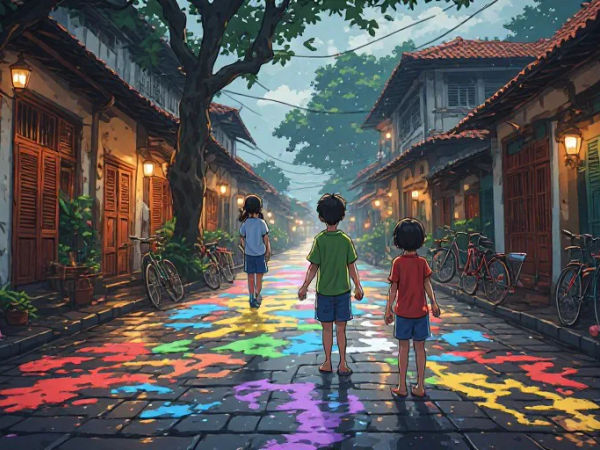
That was how the floodwater became turquoise—not brown, not black, but a vivid current curling beneath the painted homes. It carried tiny painted objects: a red sandal, a green lunch box, a yellow flower pot, a blue umbrella. Each one represented something the neighbours had rescued or shared.
The children worked on the mural every Saturday under the supervision of Uncle Raman and Madam Leela. They scraped loose plaster, patched cracks, and waited for each layer to dry.
Waiting was hard.
Anna wanted to paint the bird immediately. Instead, she had to sit on an overturned bucket while the wall cured. She wanted to add colour. Instead, she learned how to mix dull brown with a touch of blue to make the mud look real.
One afternoon, a group of older students passed by and laughed.
“Wah, art team! You all painting for free?” one boy called.
“Better than standing around for free,” Amelia answered.
The boys moved on, but Anna felt a hot pinch in her chest. She worried that the mural looked childish. She worried that people were only helping because they felt sorry for her. She worried that the kingfisher would never look as beautiful as it had before.
When she finally painted the bird’s new wing, the shape came out crooked.
She stepped back.
The wing was too large. The feathers tilted oddly. The blue paint had run down like tears.
“No,” Anna whispered.
She reached for a rag.
Uncle Raman stopped her hand. “Why erase?”
“It’s wrong.”
“Wrong according to who?”
“According to my eyes.”
“Your eyes are tired. They have been staring at one wall for five hours.”
Hafiz tilted his head. “Looks like the bird is turning.”
“Turning where?”
“Toward the hill.”
Amelia stepped beside him. “Like it’s checking whether everybody is safe.”
Anna looked again. The wing did not seem crooked now. It seemed caught in motion.
She added a few darker strokes. The kingfisher leaned into the wind, one wing raised, ready to fly.
That evening, Anna sat on the hall steps with Amelia.
“Do you ever feel like you’re not enough for what you start?” Anna asked.
Amelia nudged her shoulder. “Every day.”
“Really?”
“Of course. I joined the school speaking club and forgot the word for ‘environment’ in front of everybody.”
“What did you say?”
“Green things.”
Anna laughed.
Amelia smiled. “You don’t have to be enough alone. That’s the whole point of friends, lah.”
The words settled quietly inside Anna.
Chapter 5: The Night of the Black Water
The mural was almost finished when the weather report—read aloud by Madam Leela from her small radio—warned of another night of heavy rain.
Everybody became tense.
The drains were cleared again. Sandbags were placed at the lowest lane. Families moved boxes upstairs. The neighbourhood prepared without panic, but nobody forgot the first flood.
Anna stood before the mural at sunset. The wall now showed the Air Itam they knew: green hills rising behind colourful homes, hands passing buckets, umbrellas blooming along the lane, the turquoise river carrying small rescued treasures. Above it all, the kingfisher flew toward a patch of gold light.
Only the words were missing.
Anna had left a wide space beneath the bird because she wanted the neighbourhood to choose the final message together. But the rain was coming, and she did not know what words could hold such a large feeling.
That night, the rain began.
It hammered the roofs. Wind pushed leaves across the road. Water rose quickly, glimmering under the streetlights.
Anna woke before anyone called her. She heard the drains coughing.
Ma was already moving through the house. “Shoes on. Jojo, wake up.”
The water entered again, though not as high as before. Across the lane, someone shouted that the sandbags had shifted near the community hall.
Anna’s stomach tightened.
“The mural,” she said.
“Your life first,” Ma replied.
But Anna knew the hall wall was lower than their house. If the water broke through the lane, the mural could be damaged before morning.
She pulled on a raincoat. “I’m only going to help with the sandbags.”
Ma caught her wrist. For one second, they stared at each other through the dim kitchen light.
“Take Jojo with you?”
“No, he stays.”
“I’m coming too.”
Outside, the rain slapped their faces. Amelia and Hafiz were already carrying sandbags with their families. Uncle Raman stood ankle-deep in water, directing people toward the hall entrance.
“Don’t fight the water head-on!” he shouted. “Guide it to the open drain!”
The lane had become a rushing brown stream. A large wooden plank had wedged against the drain opening, forcing water toward the mural wall.
Anna saw it immediately.
“We need to pull that out!”
“It’s stuck,” Hafiz shouted.
“Then shift the water first!” Anna yelled back.
She looked at the wall, at the lane, and at the piles of empty paint tins stacked near the hall. An idea sparked.
“Bring the tins!”
The children grabbed the tins. Anna arranged them in a line, using them like little channels to guide water away from the mural and toward the side drain. It was not enough. The current knocked the first row over.
“Need more weight!” Amelia called.
Anna spotted the old sacks of sand in the hall storeroom. She and Ma dragged them out. One by one, they built a low barrier that curved away from the wall.
The water changed direction.
It rushed along the new path, carrying leaves and twigs toward the open drain. Uncle Raman and two neighbours pulled the plank free. The drain swallowed the water with a deep gulp.
For a moment, everyone cheered.
Then a crack of thunder shook the hill.
The wall trembled.
A section of fresh plaster bulged beneath the painted river. Anna saw the surface lifting like a blister.
“No!”
She ran toward it, but Uncle Raman grabbed her shoulder.
“Don’t touch!”
The plaster peeled away in a heavy sheet and crashed into the water. Part of the turquoise river vanished. The lower corner of the kingfisher’s tail broke off.
Anna stared at the ruined section.
The rain blurred her eyes.
All the Saturdays, the collecting, the mixing, the careful waiting—gone in one muddy splash.
“I’m sorry,” she whispered.
Amelia stood beside her, soaked and shivering. “For what?”
“For making everybody do this.”
Hafiz wiped rain from his face. “You didn’t make us. We came.”
“But it’s ruined.”
Uncle Raman looked at the broken plaster, then at Anna. “No. It is changed.”
“That’s the same thing.”
“Not always.”
Ma placed a hand on Anna’s head. “You cannot command the rain, child. You can only decide what you do after it arrives.”
Anna looked at the broken tail.
Then she looked at the people around her: Amelia holding a torn sack, Hafiz covered in mud, Jojo’s orange cat design waiting on a scrap of paper in his pocket, Madam Leela guarding the paint tins, and Uncle Raman standing firm in the dark.
The answer came quietly.
“We paint the break,” Anna said.
Chapter 6: The Kingfisher Flies Again
Morning arrived pale and wet.
The storm had moved away, leaving the neighbourhood exhausted but standing. The mural wall had lost a piece, but most of the painting remained. The missing section made the turquoise river look as if it had burst through the wall and continued into the lane.
Anna studied it over breakfast.
“It needs something,” she said.
Jojo, who had been waiting for his chance, pushed forward. “Orange cat.”
“Maybe.”
“Definitely.”
The community gathered at the hall after the cleanup. Anna explained her new idea. The mural would no longer pretend the flood had never happened. The broken plaster would become a bright opening in the painted river. From that opening, they would paint many small shapes rising upward: leaves, tools, baskets, flowers, books, and hands.
“And the cat,” Jojo said.
“And the cat,” Anna agreed.
The neighbours chose the final words too. Not one grand sentence, but four simple ones, painted in different handwriting beneath the kingfisher:
WE REMEMBER.WE REPAIR.WE HELP.WE FLY AGAIN.
Anna painted the words carefully. Amelia added tiny yellow dots around them like sparks. Hafiz painted a pair of muddy boots. Madam Leela added a strong red umbrella. Uncle Raman painted a silver needle and thread, because he said every broken thing deserved a chance to be mended.
Jojo painted his orange cat in the lower corner, sitting proudly on a floating box.
“What is the cat helping with?” Anna asked.
“Keeping watch.”
“Of course.”
When the final layer dried, they coated the mural with sealant. The wall shone softly in the afternoon sun. The old kingfisher was gone, but the new one looked alive—one wing raised, feathers swept by wind, eyes turned toward the bright hill.
People came to see it from every lane.
The curry puff seller stood with his hands on his hips. “The red is not too dramatic,” he admitted.
Auntie Mei pointed at the flowering tree. “You made my branches too big.”
“They were important.”
“Correct,” Auntie Mei said. “Make bigger next time.”
At school, Madam Leela asked Anna to tell the story of the mural at assembly. Anna hated standing in front of large groups. Her palms became sweaty, and her words tangled like earphone wires.
But she stood on the small stage and spoke.
She told them how the wall had been damaged, how neighbours gave what they had, how the children collected colours, and how the storm broke the plaster again. She told them that a painting could not stop rain or repair every roof.
“But it can remind us,” she said, “that the story doesn’t end with the worst night. We decide what comes after.”
The hall became very quiet.
Then Jojo shouted from the back, “And cats can help!”
Everybody laughed.
Anna laughed too, the nervousness loosening in her chest.
Chapter 7: After the Rain
Months passed.
The drains were repaired. The bicycle stall got a new roof. The curry puff shop hung a fresh sign, this one painted with a bright red umbrella. The community hall kept the empty paint tins in a row beneath the mural, each one holding a plant or a small tool.
Whenever heavy rain came, people checked the lanes early. They moved things to higher shelves, cleared leaves from the drains, and called to neighbours who lived alone. The children formed a little weather-watch group, though Hafiz insisted it needed a cooler name.
“The Storm Squad,” he suggested.
“Too dramatic,” said Amelia.
“The Rain Rangers.”
“Too noisy.”
“The Umbrella Department.”
Anna raised her hand. “That one is actually good.”
They created a painted board outside the hall to record weather, helpful phone numbers, and small reminders. Anna drew a kingfisher in the corner. Jojo drew the cat beside it, naturally.
Anna kept painting, but her work changed. Before the flood, she had painted things as she wished they looked: clean lanes, perfect skies, unbroken walls. Afterward, she began painting the marks too—the patched roof, the leaning fence, the muddy shoe, the hand with a plaster on one finger.
She learned that beauty did not mean pretending nothing hurt.
One evening, Anna stood before the mural while the sky turned peach behind the hill. The kingfisher seemed to lift out of the wall. Its painted wing pointed toward the clouds, where the last rain had left a pale opening.
Ma came to stand beside her.
“Your father called,” she said. “He saw the photo.”
“What did he say?”
“He said the girl who sees colour in everything is now making other people see it too.”
Anna smiled.
Jojo ran up the lane, waving a wet sheet of paper. “Anna! I made a new plan!”
“For what?”
“Painting the school stairway. And maybe the water tank. And the neighbour’s wall, if they say okay.”
Ma pointed one warning finger. “Ask first.”
Jojo saluted. “Ask first, paint later!”
Anna looked at her brother, her mother, the glowing mural, and the hill wearing evening mist.
In Air Itam, rain would always return. Some days it would be gentle. Some days it would arrive angry and loud. It would stain walls, fill drains, bend trees, and test every roof in the neighbourhood.
But now, when the first drops tapped on the zinc awnings, people did not only listen for danger.
They listened for one another.
And on the community hall wall, beneath the bright, turning kingfisher, four lines waited in many colours:
WE REMEMBER.WE REPAIR.WE HELP.WE FLY AGAIN.
Anna dipped her brush into a fresh tin of blue.
Then she painted one more tiny streak of rain—thin, shining, and full of promise.
The End…