Chapter 1: Rain on the Blue Shophouses
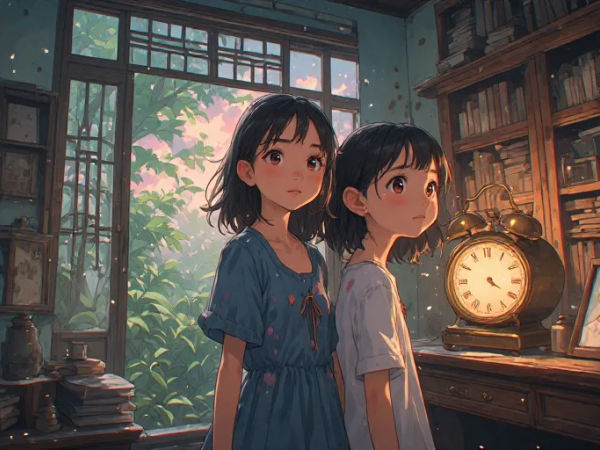
Every afternoon, when the sky over Lantae Old Quarter turned the color of watered-down mango juice, Lily climbed the narrow staircase above her grandmother’s stationery shop and checked the mailbox.
The mailbox was a dented green tin box tied to the railing with a piece of blue string. It had once held biscuits. Now it held bills, noodle-shop flyers, and, according to Lily, “the occasional miracle.”
“Nothing but a lizard tail,” Lily announced one Thursday.
The lizard, which was not actually in the mailbox but resting on the wall beside it, flicked its tail as if offended.
Downstairs, Grandma Mari called, “Lily, stop arguing with the wildlife and come help fold the paper lanterns!”
“Coming, Gran!”
Lily was thirteen, small for her age, and always carried three pencils behind her ear. One was for writing, one was for drawing, and the third was for emergencies. She had never explained what counted as a pencil emergency. Her best friend, Hyuga, said Lily simply liked looking prepared.
Their shop, Little Lantern Stationery, stood on a lane where the old shophouses leaned toward one another like tired aunties sharing gossip. The walls were painted faded blue, pink, and yellow. Wooden shutters clicked in the breeze. Motorbikes buzzed past the open drains, and somewhere nearby a wok shouted every time hot oil met garlic.
Lantae was not a quiet place. It had the slap of sandals, the clatter of dishes, the cry of vendors, the squeak of bicycle brakes, and the soft, constant mutter of the sea beyond the market roofs. When rain came, it arrived loudly, drumming on corrugated awnings and turning the lane into a mirror of puddles and colored lights.
Lily loved the quarter most after rain. The pavement smelled of wet dust and leaves. The old walls shone. Every puddle held a broken reflection of the evening—blue signboards, red umbrellas, gold windows, and faces hurrying home.
That Thursday, she helped Grandma Mari fold lanterns for the Night Bazaar, which happened every last Saturday of the month. The bazaar filled the main lane with grilled corn, woven bracelets, painted fans, coconut cakes, secondhand books, and children who ran around as if their feet had been wound up with keys.
Hyuga arrived carrying a plastic bag of fried dough sticks.
“Peace offering,” he said.
“For what?”
“For the fact that I borrowed your red pencil and forgot where I put it.”
“You lost it?”
“Not exactly. It is temporarily separated from us.”
Lily narrowed her eyes. “You lost it.”
“Correct, but with dignity.”
They sat on the shop steps, sharing the dough sticks while rain tapped the awning. Hyuga was fourteen, lanky, loud, and gifted at making ordinary trouble sound like a heroic mission. He lived behind the old clockmaker’s house with his aunt and two cousins. He could fix a bicycle chain, imitate seven kinds of bird, and remember the price of every snack in Lantae.
A gust of wind rattled the green mailbox.
Lily looked up.
Something pale had slipped through the slot.
She climbed the stairs two at a time. Inside the mailbox lay a postcard, damp around the edges but strangely warm. Its front showed a painted picture of Lantae’s oldest lane: the blue shophouses, the crooked banyan tree, and the old clock tower at the end of the street.
On the back, written in purple ink, were the words:
To the girl who keeps looking upward,When the seventh bell rings, find the blue window that has no room behind it. Bring a friend who can hear what others miss.Do not be late.
There was no name. No address. Only a tiny drawing of a lantern with one star inside.
Hyuga read it twice.
“Maybe it is from a secret admirer,” he said.
“I am thirteen.”
“Secret admirers can begin early. Very efficient.”
Lily turned the postcard over. The painted lane looked ordinary, but the blue window at the far end seemed different from the others. It was a tall, narrow window above the clockmaker’s house, sealed with wooden boards.
A low boom rolled across the quarter.
Lily and Hyuga looked toward the clock tower.
The first bell rang.
“One,” Hyuga whispered.
The second bell rang.
Lily gripped the postcard. “We have until seven.”
Chapter 2: The Window Above the Clockmaker
They waited until Grandma Mari became busy measuring ribbon and arguing with a customer about whether peach was a color or a mood.
Then Lily tucked the postcard inside her notebook. Hyuga put two dough sticks in his pocket “for emergency courage,” and they slipped into the lane.
The rain had stopped, but the whole quarter steamed gently beneath the cloudy sky. Water dripped from balconies. A street cat shook itself beneath a fruit cart. The air was thick with frying batter, wet wood, and the sharp green smell of crushed leaves.
They passed the noodle stall, where Auntie Ploy was stirring broth with the seriousness of a person conducting an orchestra.
“Where are you two rushing?” she called.
“School project,” Lily answered.
“School project wearing slippers?”
“It is an advanced project.”
Hyuga nodded. “Very advanced.”
The clockmaker’s house stood at the end of a narrow lane, squeezed between a closed tailor shop and a wall covered with painted fish. It had three floors, a tiled roof, and a balcony crowded with empty flowerpots. Above the third floor was the blue window from the postcard.
Lily had passed it a thousand times. She had always assumed there was a room behind it.
Hyuga cupped his hands around his mouth and listened.
“What do you hear?” Lily asked.
“Rain dripping. Auntie Ploy shouting at someone. A baby crying. Your stomach.”
“My stomach is not making noise.”
“It says it wants another dough stick.”
The seventh bell was still some time away. They circled the house, searching for a way inside. The front door was locked. The side door led to a storeroom filled with dusty clock parts. A narrow staircase climbed along the outer wall but ended at a balcony with a rusted gate.
Lily noticed a row of tiny blue tiles set into the pavement. They ran from the wall toward an alley behind the house.
“Look,” she said.
The tiles were shaped like little stars. One was cracked. Another was hidden beneath a fallen leaf. They continued around the back, where the lane grew quiet and green.
At the end stood a wooden door no taller than Lily’s shoulder. It had no handle, only a painted lantern with one star inside.
The same mark as the postcard.
Hyuga’s grin vanished. “That was not there yesterday.”
“You did not look yesterday.”
“I looked emotionally.”
Lily pressed the postcard against the painted lantern. The wood gave a soft click. The tiny door opened inward.
Behind it was not a room, but a narrow passage glowing with blue light.
Lily took one step. The air smelled of old paper and sea salt.
Hyuga caught her sleeve. “Maybe we should tell an adult.”
“Which adult? Grandma, who will lock the door and make us alphabetize notebooks? Or your aunt, who will bring three neighbors and a broom?”
“Good point.”
They entered.
The passage seemed to stretch farther than the house could possibly allow. On either side were shelves stacked with postcards. Hundreds of them. Some showed Lantae as it was now. Others showed streets Lily recognized but with different shop signs, different trees, and children in clothes from long ago.
At the end of the passage, a round window looked out over the entire quarter. Yet the clockmaker’s house was only three floors high. From that window, Lily could see the sea, the market, the rooftops, and the old water tower beyond the railway line.
A brass bell hung beneath the window.
On the wall was a sentence painted in blue:
A place remembers when someone takes the time to notice.
Hyuga touched a postcard showing Little Lantern Stationery. The picture was from decades earlier. Grandma Mari stood outside as a girl, her hair in two braids, holding a basket of paper flowers.
“She looks exactly like your gran,” Hyuga said.
“She looks like Gran if Gran had not discovered arguing with customers.”
A rustle moved through the shelves.
A postcard fluttered down and landed at Lily’s feet. Its picture showed the night bazaar. On the back was a fresh message:
The quarter is forgetting its way home. Find the three missing lights before the seventh bell tomorrow.
Lily swallowed. “What does that mean?”
Hyuga pointed to the window.
Far across the rooftops, three small lights flickered—one near the market, one by the sea wall, and one at the old water tower.
Then the seventh bell rang.
The passage went dark.
When Lily opened her eyes, she and Hyuga were standing behind the clockmaker’s house. The little door had vanished. In Lily’s hand was the postcard, now dry and warm.
Chapter 3: Three Lights and One Big Problem
The next morning, Lantae woke under a bright sun, but the quarter felt wrong.
The bakery owner forgot where she had placed her flour. The bicycle repairman stood beside a wheel, staring as if it had personally betrayed him. At the market, two vendors argued because neither could remember which stall belonged to whom.
Even Grandma Mari went quiet.
She stood behind the counter holding a bundle of yellow ribbon.
“Lily,” she said, “did this shop always have a green door?”
“It has always had a green door.”
Grandma frowned. “Has it?”
Lily looked at the postcard in her notebook. Three lights. Find them before the seventh bell tomorrow.
She told Hyuga during lunch. They sat beside the canal wall, eating rice cakes from a paper packet while dragonflies skimmed the water.
“The first light is near the market,” Hyuga said. “The second is by the sea wall. The third is the water tower.”
“And how do we find them?”
“By using our brains.”
“You have one brain between us?”
“I have the louder brain.”
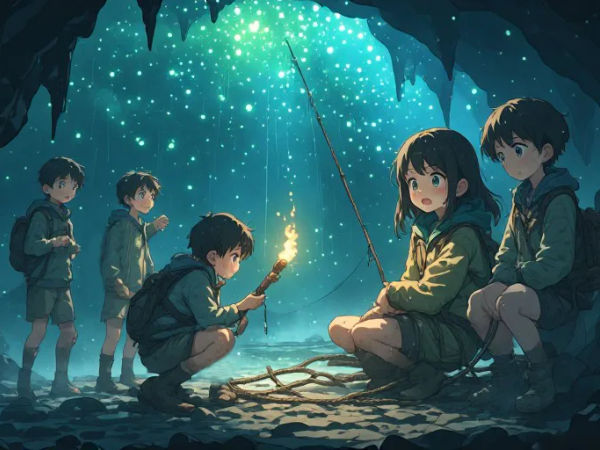
Their first stop was the Night Bazaar storage shed behind the market. Lanterns, folding tables, banners, and baskets were piled inside. Lily searched beneath the tables while Hyuga inspected the rafters.
“Found something!” he shouted.
He pulled down a dusty wooden lantern, but it was empty.
Lily noticed three children’s drawings pinned to the wall. Each showed the quarter with a bright yellow sun in the same corner. One drawing had a missing piece torn from the bottom.
“Who made these?” she asked.
A small boy named Teo peeked through the doorway. He was nine, with a bowl haircut and serious eyebrows.
“My sister and me,” he said. “But the bottom piece blew away last week.”
“Where?”
“Near the old water drain. I think.”
Hyuga crouched beside him. “What was on the missing piece?”
Teo scratched his cheek. “A door. And a lady with a basket.”
Lily thought of Grandma Mari’s old postcard.
They followed Teo to a drain behind the market. The missing drawing had caught beneath a metal grate. On its back was a silver thread tied into a loop.
When Lily touched it, the empty lantern on Hyuga’s arm flickered with yellow light.
“One,” she whispered.
The lantern became warm, and somewhere far away a bell chimed once.
Their second stop was the sea wall. The tide was low, revealing dark rocks glittering with tiny shells. Fishing boats rocked beyond the harbor, their ropes creaking. The wind carried the smell of salt and grilled squid.
Near the wall stood a row of painted stones. Most were bright with flowers and fish, but one had been turned face down.
Lily lifted it.
On the underside was a blue window.
Hyuga listened. “There is a humming sound.”
“From the sea?”
“No. From inside the stone.”
Lily tapped it gently. The stone split along a thin line, revealing a small glass bead the color of deep water. When she placed it in the wooden lantern, blue light joined the yellow.
“Two,” said Hyuga.
The third light gave them trouble.
The old water tower stood beyond the railway line, behind a field where tall grass brushed against the fences. Children rarely went there because the path twisted through abandoned sheds and thorny vines.
By late afternoon, clouds had gathered again. The sun dimmed. Lily’s slippers became muddy. Hyuga’s emergency dough sticks had turned flat.
“This is a dark day for courage,” he said.
They found the tower beneath a curtain of rain. Its legs were rusted, and the ladder had been removed. At the base lay a circle of broken tiles.
Lily searched the mud until her fingers struck metal. She pulled out a small tin key.
A voice called from behind the sheds. “Looking for this?”
A girl stepped into view holding a brass lantern. She was about their age, with a yellow raincoat and a braid tied with green thread.
Hyuga moved in front of Lily. “Who are you?”
“Pim.”
“Why are you holding our lantern?”
Pim tilted her head. “Because it was mine first.”
Lily noticed the same star-lantern symbol stitched on Pim’s raincoat.
“You sent the postcard,” Lily said.
Pim did not answer. She looked toward the water tower.
“My grandmother used to keep the three lights,” Pim said. “She said they helped the quarter remember its stories. But people stopped listening. They covered the blue tiles, painted over the old signs, and threw away things they thought were useless.”
“What happens if we do not find them?” Lily asked.
“Lantae will still stand. The buildings will still be here. But people will stop knowing why they love the place.”
The rain strengthened, ticking against the tower legs.
Pim held out the brass lantern. Inside was a green glow.
“Take it,” she said. “But the last light does not belong to one person. You must carry it together.”
Lily, Hyuga, and Pim each touched the lantern.
The green light flared.
For one breath, the whole quarter appeared around them—not as it was now, but as it had been and could become. Children ran through the bazaar. Old women painted shutters. Young workers hung bright cloth between buildings. The sea shone behind them all.
Then the vision vanished.
Lily looked at the three lights. Yellow, blue, green.
“What do we do now?”
Pim pointed to the sky.
A thin line of darkness had appeared along the horizon. The seventh bell would ring tomorrow evening, but something had changed. The bell tower had begun ringing early.
Chapter 4: The Night the Quarter Went Quiet
By sunset, Lantae had forgotten the Night Bazaar.
The vendors had prepared food but could not remember where to set up. The children who usually painted signs stood staring at blank paper. Grandma Mari opened a drawer and found old postcards, yet she could not recall who had written them.
Lily felt panic pressing behind her ribs.
“We have to return the lights to the clockmaker’s house,” she said.
Pim shook her head. “Not yet. The lights are not the answer by themselves.”
“Then what is?”
“Stories.”
Hyuga snapped his fingers. “Of course. The postcard said the quarter is forgetting its way home. We need to remind everyone.”
The three friends split up. Lily went to Grandma Mari. Hyuga ran to Auntie Ploy and the bicycle repairman. Pim visited the market vendors and the children.
They asked each person to tell one memory of Lantae.
Grandma Mari remembered selling her first packet of colored paper at age eleven.
Auntie Ploy remembered learning to cook rice cakes from a neighbor who never measured anything and always said, “Your hand knows.”
The bicycle repairman remembered a boy bringing him a broken wheel and paying with three mangoes.
Teo remembered the first time he saw the sea turn silver beneath the moon.
At first, people spoke slowly, uncertainly. Then one memory unlocked another.
Someone remembered the old blue tiles. Someone remembered the clockmaker’s house before its roof was repaired. Someone remembered how the bazaar began with only four stalls and one borrowed table.
Lily wrote each memory on a postcard. Hyuga drew little pictures. Pim arranged the cards along the lane, tying them to railings, baskets, bicycle handles, and tree branches.
As the evening deepened, the quarter began to glow—not with the three magical lights, but with small ordinary lights from kitchens, shop windows, and paper lanterns.
Then a terrible wind rushed down the lane.
The postcards tore loose.
They flew like a flock of white birds toward the clock tower.
“The lights!” Pim shouted.
The wooden lantern jerked from Lily’s hands. Yellow, blue, and green sparks twisted into a single bright ribbon and shot upward.
Lily ran.
The wind pushed against her chest. Rain returned in hard silver lines. Around her, people called out in confusion. The lane blurred into puddles and shadows.
Hyuga grabbed her hand. Pim grabbed Hyuga’s sleeve.
They climbed the clockmaker’s outside stairs as the bells began to ring.
One. Two. Three.
At the top balcony, the blue window stood open. Behind it was the glowing passage.
But the postcards had gathered inside, spinning faster and faster around a dark shape. It looked like a hole cut into the air.
Lily understood. The quarter had not simply lost its memories. It had made a place for forgetting.
The dark shape pulled at the cards. One by one, the written memories faded.
“Tell a story!” Hyuga yelled.
“What story?”
“Your story!”
Lily stepped into the passage. The wind seized her hair and tugged her toward the darkness.
She remembered the green mailbox. The dented tin. The lizard. Grandma’s ribbon. The first postcard.
“My name is Lily,” she shouted. “I live above a stationery shop in Lantae Old Quarter. I keep three pencils behind my ear, and one is for emergencies. I know which roof leaks during heavy rain. I know Auntie Ploy burns the first pancake and pretends it is intentional. I know the sea smells different before a storm. This is my home, and I notice it!”
The darkness trembled.
Hyuga stepped beside her.
“My name is Hyuga. I can hear the loose chain on any bicycle from half a lane away. I know where the best fried dough is kept warm. I once fell into the canal while trying to impress a cat. The cat did not care. This is my home, and I remember it!”
Pim stepped forward.
“My name is Pim. My grandmother kept the lights. She taught me that a place is not only its walls. It is the people who leave kindness behind. This is my home, and I will carry its stories!”
The dark shape split open.
Behind it was a tiny room filled with blank postcards. At the center sat a small, frightened creature made of dust and rainwater. It had round eyes and hands too thin for its body.
Lily softened her voice. “Are you the one taking the memories?”
The creature nodded.
“Why?”
It pointed to the blank cards.
No one had ever written to it.
No one had ever given it a story.
Hyuga looked at Lily. “That is very sad.”
“It does not mean it can swallow our whole quarter,” Lily said.
The creature lowered its head.
Lily took the postcard from her notebook—the first one, the one that had brought them there. She held it out.
“You can have this,” she said. “But you must help us return the others.”
The creature touched the card.
At once, the three lights burst across the passage. Yellow warmed the shelves. Blue filled the windows. Green curled around the creature like a blanket.
The postcards flew back into the quarter.
Outside, the bells stopped at six.
Only one bell remained.
Chapter 5: The Seventh Bell
The final bell rang at exactly midnight.
Its sound rolled over Lantae, through the market, across the sea wall, and into every house with an open window.
The people in the quarter remembered.
Grandma Mari remembered Lily’s grandfather painting the shop door green. Auntie Ploy remembered the first table at the bazaar. Teo remembered the missing drawing. The bicycle repairman remembered that he had promised to fix a wheel before breakfast.
The next morning, nobody could explain the blue window or the passage behind it. The clockmaker’s house had only three floors, and the little door behind it was nowhere to be found.
But everyone noticed something new.
On the old wall beside the market, someone had painted a lantern with one star inside.
Lily, Hyuga, and Pim stood before it after breakfast.
“What happened to the creature?” Hyuga asked.
Lily pointed toward the green mailbox.
Inside lay a postcard. Its picture showed a small rainwater creature sitting beside a window, holding a pencil.
On the back were the words:
Thank you for the first story. I will guard the forgotten ones.
There was also a second line:
P.S. The lizard says hello.
Lily laughed so loudly that Grandma Mari came upstairs to check whether the roof had fallen in.
That month, the Night Bazaar became the biggest one Lantae had ever seen. The vendors hung the three colored lanterns above the lane. Children displayed drawings of the old quarter. Adults brought out photographs, recipes, broken toys, faded maps, and letters they had kept in drawers for years.
Lily made a special stall called Postcards for Home. Anyone could write a message about Lantae and leave it there. Some cards were funny. Some were plain. One simply said, “The rain sounds better when you are not alone.”
Hyuga sold fried dough sticks and claimed he had invented a new flavor called heroic sugar. Pim taught children how to paint the star-lantern symbol.
Grandma Mari stood beside Lily, watching the crowd move beneath the lights.
“You see?” she said. “Miracles do not always arrive with thunder.”
Lily glanced at the green mailbox. “Sometimes they arrive damp and anonymous.”
“Sometimes.”
“And sometimes they bring you into impossible hallways.”
“Also sometimes.”
Grandma Mari handed her a new postcard. It showed the whole quarter from above: the blue shophouses, the market, the sea wall, the water tower, and the green mailbox tied with blue string.
On the back, Grandma had written:
To Lily, who looks upward but remembers to come home.
Lily pressed the card to her chest.
Across the lane, Hyuga waved a dough stick. “Emergency snack!”
Pim shouted, “Do not eat all of them before the children arrive!”
The evening wind moved through the old shophouses. It carried the smell of rain, sugar, salt, and warm paper. Somewhere above the rooftops, a small bell gave one soft chime.
Lily looked up.
For a moment, she saw a blue window shining where no window had been before.
Then it blinked away.
She smiled and tucked Grandma’s postcard into her notebook, beside the first one.
Lantae Old Quarter was still noisy. Still crowded. Still full of leaking roofs, stubborn cats, burnt pancakes, and people who forgot where they put their keys.
But now, whenever someone asked what made the place special, Lily knew the answer.
It was not only the painted walls or the sea beyond the market. It was not even the lanterns that glowed when the sky turned dark.
It was the way every ordinary life left a little light behind.
And if you took the time to notice, the old quarter always knew the way home.
The End…