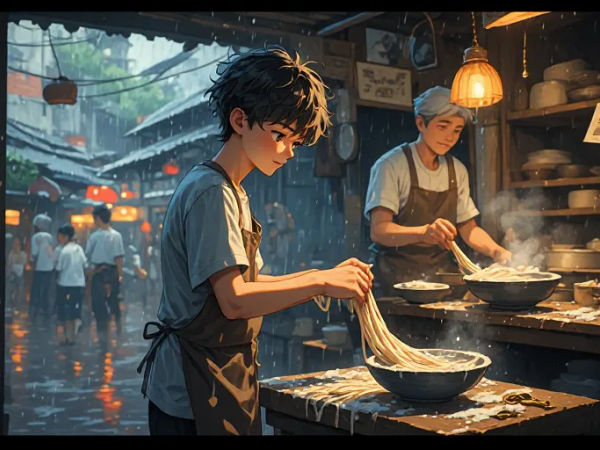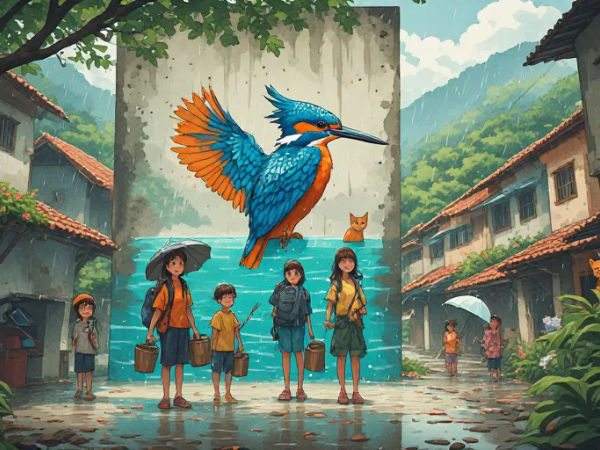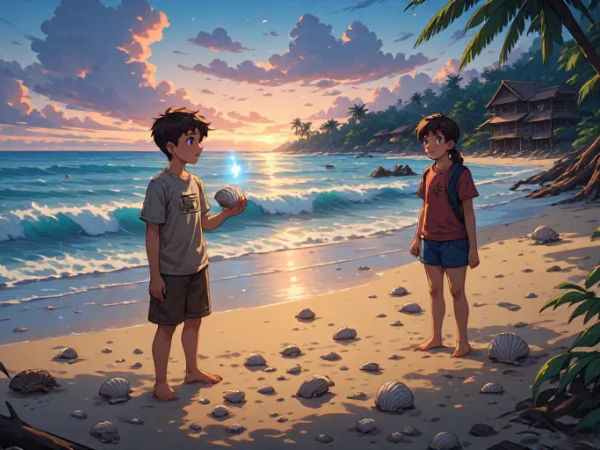
In the rain-drenched coastal town of Haven’s End, Eddy, struggling with creative block, discovers a mysterious shop that isn’t on any map, setting off a chain of events that will change his town—and his art—forever.
Chapter 1: The Drizzle and the Dead End
The rain in Haven’s End didn’t just fall; it lingered. It hung in the air like a cold, wet curtain, smelling of crushed pine needles and low-tide brine. Fourteen-year-old Eddy sat on the edge of Pier 44, his scuffed sneakers dangling over the churning gray water, staring at his sketchbook like it had personally insulted him.
The pages were a graveyard of crossed-out lines and smudged charcoal. He was supposed to be working on his submission for the Haven’s End Zine Fest, the biggest local art contest of the year. The winner got their comic printed and distributed to every coffee shop and surf shack in town. But right now, Eddy’s brain felt as empty as the dried-up tide pools in August. He had what the older kids at the marina called “canvas-crust”—a total, unyielding creative block.
“You’re doing that thing again,” a voice chirped, breaking his gloomy trance.
Eddy looked up to see Jax bouncing a neon-green rubber ball against the wooden pylings. Jax was a whirlwind of energy, currently drowning in an oversized, faded yellow raincoat that made him look like a walking traffic cone.
“What thing?” Eddy muttered, snapping his sketchbook shut.
“The fog-walker stare,” Jax said, catching his ball. “You’re zoning out so hard I thought your soul left your body and went to get a clam chowder. Come on, man, the Zine Fest deadline is in three days. You can’t submit a blank book.”
“It’s not blank, it’s just… conceptual,” Eddy lied, rubbing his temples.
Before Jax could roast him for that, a sleek, battered silver scooter pulled up onto the wooden boardwalk. Cleo kicked the stand down and hopped off, shaking the drizzle from her dark, choppy hair. She was fifteen, sharp as a oyster shell, and worked weekends at her dad’s bait shop, which meant she knew every piece of gossip in Haven’s End.
“Stop torturing the poor guy, Jax,” Cleo said, pulling a slightly squished granola bar from her pocket and tossing it to Eddy. “He’s just suffering from a severe case of drizzle-daze. We all get it. But seriously, Eddy, you need to get out of your own head. Inspiration doesn’t come from staring at the ocean until your eyes bleed.”
“Easy for you to say,” Eddy sighed, unwrapping the bar. “You just draw photos of the boats. Jax just draws weird rocks.”
“They’re geodes, you kelp-head,” Jax shot back, grinning. “And there’s magic inside them. Unlike your brain right now.”
Eddy chuckled, the tension in his shoulders easing just a fraction. This was why he loved his friends. They were loud, they were relentlessly local, and they never let him wallow in his own misery for too long.
“Look,” Cleo said, leaning against the railing and looking out at the misty horizon. “The fog is rolling in thick. We should head back to the mainland. The Lower Wards get pretty salt-slick when the mist settles, and I don’t feel like breaking my neck on the cobblestones today.”
Eddy nodded, tucking his useless sketchbook into his waterproof messenger bag. “Yeah. Let’s head back.”
He didn’t know it yet, but the fog wasn’t just rolling in. It was making room for something new.
Chapter 2: The Shop That Wasn’t There Yesterday
The walk back to the mainland part of town meant cutting through the Lower Wards, a maze of narrow, winding streets where the old brick buildings leaned together like gossips sharing secrets. The neon signs of the local diners and arcades reflected in the puddles, casting rippling pools of pink and blue light across the wet stones. The distant, mournful bwaaa of the harbor foghorn echoed through the alleys.
Eddy was walking a few paces behind Jax and Cleo, his mind still chewing on his creative frustration. He took a shortcut down Blind Eel Alley, a narrow passage usually blocked by stacked fishing crates, but tonight, the crates were gone.
At the end of the alley, nestled between a boarded-up chandler and a narrow bakery, was a door Eddy had never seen before.
It was made of dark, salt-warped wood, with a brass handle shaped like an anchor. Above it, a weathered wooden sign swung gently in the coastal breeze, the painted letters barely visible through the grime: The Ink & Anchor Bookstore.
“Hey!” Eddy called out, jogging to catch up with his friends. “Check this out. Since when is there a bookstore here?”
Jax squinted at the door. “Dude, that’s been an empty lot since before we were born. Old Man Miller’s crab shack burned down there like, ten years ago.”
“Well, it’s here now,” Eddy said, already reaching for the brass handle.
“Eddy, don’t be gale-brained,” Cleo warned, though she stepped closer, her curiosity piqued. “It could be, like, a front for a smuggling ring.”
“It’s a bookstore, Cleo. The most they’re smuggling is overdue copies of maritime law journals,” Eddy joked, pushing the door open.
A tiny brass bell chimed, a bright, clear sound that seemed to cut right through the damp heavy air. Eddy stepped inside, and his friends followed.
The interior was a sensory explosion. It smelled intensely of old paper, binding glue, and peppermint. The walls were lined with towering, crooked bookshelves that reached all the way to the tin ceiling, packed with leather-bound tomes, rolled parchments, and stacks of paper that looked like they belonged in a museum. Dust motes danced in the warm, amber light cast by several green glass banker’s lamps.
Behind a massive oak counter sat a man who looked like he was made of the same materials as his shop. He was elderly, with a wild shock of white hair, a tweed vest, and fingers that were permanently stained with black ink.
“Ah,” the old man said, his voice a rich, gravelly baritone. “A fog-walker wanders in out of the damp. Welcome, young artists.”
Eddy blinked. “How did you know we’re artists?”
The old man chuckled, tapping his ink-stained fingers on the counter. “I am Mr. Vance. And I know because only an artist carries the heavy, tragic look of a blank page in their eyes. You, my boy, are stuck.”
Eddy felt a flush of embarrassment. “I’m just looking for some reference books. For a comic.”
“Reference books won’t cure canvas-crust,” Mr. Vance said gently. He reached under the counter and pulled out two items. The first was a heavy, brass compass, but instead of North, South, East, and West, the dial was marked with strange, swirling symbols. The second was a folded piece of thick, cream-colored parchment.
“Take these,” Mr. Vance said, sliding them across the counter.
“I don’t have any money on me,” Eddy said, shaking his head.
“It’s not for sale. It’s a loan,” Mr. Vance replied, his eyes twinkling in the lamplight. “That is a map of Haven’s End. But as you can see, it is incomplete. The blank spaces represent the hidden truths of our town. The compass will point you to what is lost. But remember: a map only fills itself when you walk the truth.”
Before Eddy could ask what that meant, Jax grabbed his arm. “Come on, man, this place is creeping me out. Let’s go.”
Eddy grabbed the compass and the map, muttered a quick thanks to Mr. Vance, and hurried out the door. When he turned back to look, the fog had thickened, and for a second, he could have sworn the door wasn’t there at all.
Chapter 3: The Blank Spaces on the Map
Back in the safety of Eddy’s cramped, attic bedroom, the trio gathered around his desk. The map was unfolded, revealing a stunning, hand-drawn illustration of Haven’s End. The coastlines were perfect, the streets meticulously detailed. But the center of the town, and the area around the old abandoned cannery on the north shore, were completely blank.
“Okay, so Old Man Vance gave you a magic map and a broken compass,” Jax said, spinning the compass on the desk. The needle just lazily drifted in circles. “This is totally gale-brained.”
“It’s not broken,” Eddy said, frowning. He picked up the compass. “Look, the needle is reacting to something. It’s not pointing north, it’s pointing… toward the north shore. Toward the old Rusty Hook cannery.”
Cleo leaned in, her eyes narrowing. “The cannery has been locked up since the nineties. My dad says the foundation is crumbling. Why would a magic map point there?”
“Only one way to find out,” Eddy said, grabbing his waterproof jacket.
Twenty minutes later, they were standing before the towering, rusted corrugated iron walls of the Rusty Hook cannery. The building loomed against the night sky like a sleeping metal beast. The rain had picked up, drumming a steady, rhythmic beat on the roof.
“This is a terrible idea,” Jax whispered, his yellow raincoat squeaking as he hugged his arms. “If we get tetanus, I’m haunting both of you.”
“Keep the compass steady, Eddy,” Cleo urged, pulling a heavy-duty flashlight from her scooter’s basket.
Eddy held the compass flat in his palm. The needle was spinning wildly now, before suddenly snapping straight, pointing directly at a massive, rusted shipping container stacked against the back wall.
They crept through the mud and puddles, slipping past jagged pieces of scrap metal. When they reached the container, Eddy noticed something odd. The heavy metal door was slightly ajar, and beneath it, the concrete foundation was cracked.
“Shine the light down there,” Eddy told Cleo.
The beam cut through the gloom, revealing a loose, heavy iron grate set into the concrete. Eddy and Jax grabbed the edges, grunting as they heaved it upward. Beneath it was a small, dry crawlspace. Inside sat a rusty metal lockbox.
Eddy pulled it out and popped the corroded latch. Inside, wrapped in oilcloth, was a leather-bound journal.
He opened it carefully. The pages were filled with elegant, looping handwriting and intricate sketches of the town.
“Listen to this,” Eddy whispered, reading aloud. “October 14th. The town grows, but it forgets. They pave over the soil and build over the stone. I have hidden the First Seed where the light once bled into the sea. When the compass points to the weeping stone, and the tide pulls back the veil, the Sunken Garden awaits.”
“The weeping stone?” Jax asked.
Eddy looked at the map. As he read the words from the journal, the blank space over the cannery began to shimmer. Ink bloomed across the parchment like magic, drawing a winding path from the cannery to the northernmost point of the peninsula.
“The weeping stone is the old decorative waterfall at the cannery entrance,” Cleo realized, her eyes wide. “And ‘where the light once bled into the sea’… that’s the old lighthouse at Widow’s Peak!”
“The lighthouse has been dark for fifty years,” Eddy said, his heart hammering against his ribs. He looked at his friends, a sudden, fierce spark of inspiration igniting in his chest. “We have to go there. Tonight.”
Chapter 4: The Lighthouse at the Edge of the World
The storm hit just as they reached the base of Widow’s Peak. The wind howled off the ocean, whipping the rain into stinging, horizontal sheets. The old lighthouse stood at the very edge of the cliff, a towering cylinder of peeling white paint and rusted iron, looking like a skeletal finger pointing at the angry sky.
“Are you sure about this, Eddy?” Jax yelled over the wind, his yellow hood blown back. “We could literally blow off the cliff!”
“The map says the garden is inside!” Eddy yelled back, clutching the parchment to his chest to keep it from blowing away. “We have to see it!”
The main door of the lighthouse was boarded up and rusted shut. But Cleo, who had explored half the town’s forgotten nooks, pointed to the exterior maintenance ladder. “The inside stairs are probably collapsed anyway. We have to climb the outside to the lantern room!”
The climb was brutal. The iron rungs were slick with rain and algae. Eddy’s arms burned, and the wind threatened to peel him off the ladder with every gust. He focused on the rungs, on the sound of Jax’s heavy breathing below him, and on Cleo’s steady, encouraging voice calling out the safe footholds.
Clang. Clang. Clang.
When they finally hauled themselves over the railing onto the narrow catwalk surrounding the glass lantern room at the top, they were soaked to the bone, shivering, and gasping for air.
Eddy stumbled to the heavy iron door that led into the lantern room. It was locked, sealed with a complex, circular iron mechanism that looked like a giant combination dial. In the center of the dial was a shallow, stone basin.
“It’s locked,” Jax groaned, slumping against the railing. “We climbed all this way for a locked door. We’re gonna catch our deaths out here.”
Eddy looked at the map. The ink was swirling frantically, but the path stopped right at the lighthouse. He looked at the stone basin in the door, then at his sketchbook. He remembered Mr. Vance’s words: A map only fills itself when you walk the truth.
“It doesn’t want a combination,” Eddy realized, his voice cutting through the wind. “It wants a story. It wants us.”
He pulled out his charcoal pencil. He didn’t draw the lighthouse, or the storm, or the ocean. He drew Jax, his yellow raincoat bright against the gray. He drew Cleo, her hair wild, her eyes fierce and determined. He drew the winding streets of the Lower Wards, the smell of the bait shop, the sound of the foghorn. He drew the feeling of being stuck, and the feeling of breaking free. He drew the soul of Haven’s End.
As his pencil flew across the heavy parchment, the map began to glow with a faint, warm, golden light. The ink flowed off the page, dripping down into the stone basin in the door.
Click. Clack. Thunk.
The heavy iron gears groaned. The circular dial spun, and with a rush of displaced air, the door swung inward.
The trio stepped inside, and the breath left their lungs.
It wasn’t just a lantern room. The glass walls enclosed a massive, thriving, impossible ecosystem. Bioluminescent ferns curled along the iron railings, glowing in soft hues of cyan and violet. Rare, silver-leafed coastal flowers bloomed in hanging baskets, and in the center of the room, growing out of a bed of rich, dark soil, was a massive, ancient tree with leaves that shimmered like spun glass. This was the First Seed. The Sunken Garden.
The air inside was warm, smelling of rich earth and blooming jasmine, a stark, beautiful contrast to the freezing storm outside. On a wooden pedestal beneath the tree lay the original, hand-drawn charter of Haven’s End, preserved perfectly.
“It’s beautiful,” Cleo whispered, reaching out to gently touch a glowing blue leaf.
Eddy didn’t say a word. He just dropped his bag, pulled out a fresh, clean sheet of paper, and began to draw. The canvas-crust was gone, shattered like thin ice. The inspiration wasn’t something he had to force; it was right here, in the hidden magic of his town, in the history beneath their feet, and in the friends who had climbed a storm-swept lighthouse just to see what was on the other side.
Chapter 5: Drawing the Future
Three days later, the community hall was packed for the Haven’s End Zine Fest. The room smelled of wet wool, cheap coffee, and excitement.
When the judges announced the winner of the grand prize, the room erupted. Eddy stood on the small stage, holding a thick, beautifully bound comic book titled The Sunken Garden.
The cover featured a stunning, vibrant illustration of the glowing lighthouse, but the real magic was inside. Eddy had woven the history of Elias Thorne, the secret of the cannery, and the breathtaking beauty of the hidden greenhouse into a sweeping, emotional adventure. But more than that, he had captured the feeling of Haven’s End. He had drawn the grit, the rain, the slang, and the unbreakable bond of the kids who called the foggy coast home.
Mr. Vance, who had shown up in the front row wearing a surprisingly sharp tweed suit, gave Eddy a slow, proud nod.
After the ceremony, Jax slung an arm around Eddy’s neck, nearly knocking him over. “Told you, man! No canvas-crust when you’ve got the best crew in the world!”
Cleo walked up, holding a flyer. “Hey, the town council just read your comic. They’re thrilled. They’re going to restore the lighthouse properly and turn the Sunken Garden into a protected botanical sanctuary. They even want you to design the signage.”
Eddy looked at his friends, then out the window at the gray, rain-swept sky of his hometown. It didn’t look gloomy anymore. It looked like a blank page, just waiting to be filled.
He smiled, pulling his sketchbook from his bag. “So,” he said, clicking his pen. “What do we explore next?”
The End…