In Kampung Seri Paya, mornings usually started the same way.
Roosters yelling like they were competing in a shouting contest. Aunties sweeping leaves that somehow always came back by noon. The smell of fried noodles drifting out from the corner stall near the old bus stop.
And—most importantly—kids half-awake, already glued to glowing screens before their feet even touched the floor.
That was normal.
Until the morning everything changed.
It began with Afiq.
Afiq bin Rahman, age twelve, professional procrastinator, and self-declared “champion of late homework submissions,” rolled over in bed and reached for his tablet.
Except… it wasn’t glowing.
He blinked once.
Then twice.
He tapped the side of it like it was a stubborn rice cooker.
Nothing.
“Eh?” he muttered. “Low battery again ah?”
He plugged it in.
Still nothing.
Across the room, his little sister Mira was already whining.
“Abang! My screen also not working lah!”
From outside the house came another sound.
Not one.
Many.
“Eh my phone dead!”
“My gaming console cannot on!”
“Even TV also blank sia!”
Afiq sat up slowly, feeling like the world had suddenly forgotten how to wake up properly.
That was when his mother shouted from the kitchen, “Don’t tell me all your gadgets spoil at the same time! Today I still need my recipe app!”
But when she checked her phone, she went quiet.
Completely quiet.
That was scarier than shouting.
Because in Kampung Seri Paya, adults only went quiet when something was seriously wrong.
2. The Sleeping Screen Mystery
By 9 a.m., the whole kampung had gathered near the community hall.
Kids, parents, even Pak Mail the old bicycle repair uncle who usually avoided crowds like mosquitoes.
Every device in the village was the same.
Phones. Tablets. Gaming devices. Televisions. Even the digital school board at the hall.
All dark.
All cold.
All… asleep.
“It’s like they all kena fever at the same time,” said Lina, Afiq’s best friend, poking her dead tablet.
“Maybe virus attack?” suggested Badrul, who believed everything was either virus-related or ghost-related, depending on his mood.
“No internet, no signal, no nothing,” grumbled Uncle Suresh. “I tried restarting five times already. Five times!”
Afiq crossed his arms. “Devices don’t get sick lah.”
Mira tugged his sleeve. “Then why all sleeping?”
No one had an answer.
Except Pak Mail.
The old man leaned on his rusty bicycle and squinted at the sky like it owed him money.
“It’s the Quiet Weekend,” he said slowly.
Everyone turned to him.
“The what?” Lina asked.
Pak Mail shrugged. “Happens once in a long while. When screens get too tired, they sleep.”
A kid from the back laughed. “Uncle, screens don’t sleep lah!”
But Pak Mail wasn’t laughing.
“I’m serious. When they’re overused… they rest. Like humans.”
That should’ve sounded ridiculous.
But when your entire world of glowing rectangles stops working at the same time, even ridiculous starts to feel possible.
3. Life Without Glow
By afternoon, panic had turned into confusion.
By evening, confusion turned into boredom.
And by night… boredom turned into something dangerous.
Kids didn’t know what to do with themselves.
Afiq tried sitting still.
That lasted exactly three minutes.
Mira tried reading an old storybook.
She fell asleep on page one.
Lina wandered outside and kicked pebbles until she invented a game called “Pebble Football,” which only she understood the rules of.
But the strangest thing?
The kampung felt… different.
Without screens glowing in every corner, the world became louder in ways nobody remembered.
Crickets sounded like tiny engines.
Wind moved through coconut trees like whispering voices.
Even the river near the back of the village seemed to shimmer more brightly, like it had been waiting for attention all along.
Afiq sat on the wooden steps outside his house, staring at the sky.
No scrolling.
No tapping.
No glowing distraction.
Just stars.
“Boring lah,” he muttered.
But he didn’t go inside.
4. The First Clue
The next morning, something unexpected happened.
Afiq woke up early—without any alarm, without any buzzing notification—just because Mira was shaking him violently.
“Abang! Abang! Come quick!”
“What lah…” he groaned. “If this is about missing cartoons, I swear—”
“It’s not that!”
She dragged him outside.
Behind their house, near the old mango tree, something was glowing faintly.
Not bright like a screen.
Soft.
Like moonlight trapped inside glass.
Afiq squinted.
There, half-buried under leaves, was a small rectangular object.
But not like any phone or tablet he had ever seen.
It looked… older.
Like it had been made of polished wood and thin glass, with tiny carvings along the edges that looked like swirling vines.
And it was warm.
Not hot like electronics usually got.
Warm like a sleeping animal.
Lina arrived running from next door.
“What is that?!”
Afiq crouched slowly and picked it up.
The moment his fingers touched it—
It pulsed.
Once.
Like a heartbeat.
Then went still again.
“It’s breathing,” Mira whispered.
“No it’s not,” Afiq said automatically.
But his voice didn’t sound confident.
Because the object felt alive in a way no modern device ever had.
5. Pak Mail’s Secret
They ran straight to Pak Mail.
He was sitting outside his shop, repairing a broken bicycle chain like nothing in the world had gone wrong.
Afiq slammed the strange device onto the table.
Pak Mail looked at it.
For a long moment, he didn’t speak.
Then he sighed.
“I was hoping it wouldn’t show up this early.”
Lina leaned forward. “Uncle, what is this thing?”
Pak Mail wiped his hands slowly.
“That,” he said, “is a Dream Screen.”
Afiq frowned. “Dream what?”
“A long time ago,” Pak Mail said, “screens weren’t just tools. They were companions. They learned from people, grew with them, even rested when they were tired.”
Mira blinked. “So like… magical phone?”
Pak Mail smiled faintly. “Something like that.”
He tapped the object gently.
“But modern screens… they changed. Too many hours. Too little rest. Too much noise. So now, every few years, they do this.”
“Do what?” Afiq asked.
“They sleep. All of them. At the same time.”
Silence settled over the group.
Then Lina said, “So when they wake up?”
Pak Mail’s smile faded.
“That depends on how you treat the world while they’re asleep.”
6. The Rule of the Quiet Screens
That afternoon, strange things started happening.
Without screens, kids began noticing things they never cared about before.
Like how old Uncle Suresh could whistle entire songs while fixing bicycles.
Like how the school field had tiny flowers growing near the fence that nobody had ever stepped on.
Like how the wind seemed to carry different smells depending on the time of day.
But there was also unease.
Because without devices, nobody knew what time it was exactly.
No notifications.
No schedules popping up.
Even school felt… uncertain.
Afiq noticed something else too.
The Dream Screen he found kept changing slightly.
Sometimes it showed faint images when touched.
Not videos.
More like memories.
A playground.
A river.
Kids laughing.
And sometimes, just sometimes, it showed a shadow of something moving in the background.
Watching.
Lina didn’t like that part.
“I think we should put it back,” she said one evening.
“Put it back where?” Afiq asked.
“The mango tree.”
Mira shook her head quickly. “No! What if it disappears again?”
Afiq stared at the device.
It pulsed softly in his hands.
“I think it wants something,” he said quietly.
That made Lina uncomfortable.
“But we don’t even know what it is.”
Afiq looked up.
“Then we find out.”
7. The Journey Into the Kampung
The next morning, the three of them set off.
No screens in pockets.
No navigation apps.
Just memory, instinct, and a slightly crumpled paper map Lina found in her dad’s drawer.
They walked past the wet market, where vendors were actually talking to customers instead of shouting prices into phones.
Past the river bridge, where dragonflies hovered like tiny helicopters.
Past the abandoned field where kids used to play before everyone got too “busy.”
Without screens, the kampung felt bigger.
Not physically.
Emotionally.
Like the world had been quietly waiting for them to notice it.
As they walked, the Dream Screen in Afiq’s bag warmed slightly whenever they passed certain places.
Old playground? Warm.
Riverbank? Warmer.
Hills near the edge of the village? Warmest.
“That means something,” Lina said.
“Or it just likes heat,” Mira replied.
But Afiq wasn’t listening.
He was thinking about Pak Mail’s words.
“They sleep… and how you treat the world matters.”
8. The Hidden Grove
By noon, they reached the edge of the kampung where the trees grew thicker and the air felt different.
No roads here.
Just dirt paths and tangled vines.
The Dream Screen began to glow more steadily.
“It’s like it’s guiding us,” Afiq said.
“Or trapping us,” Lina muttered.
But they kept going.
Until they reached a clearing.
And there—
Was something none of them expected.
Old devices.
Hundreds of them.
Phones, tablets, gaming devices, screens of all kinds.
But not broken.
Resting.
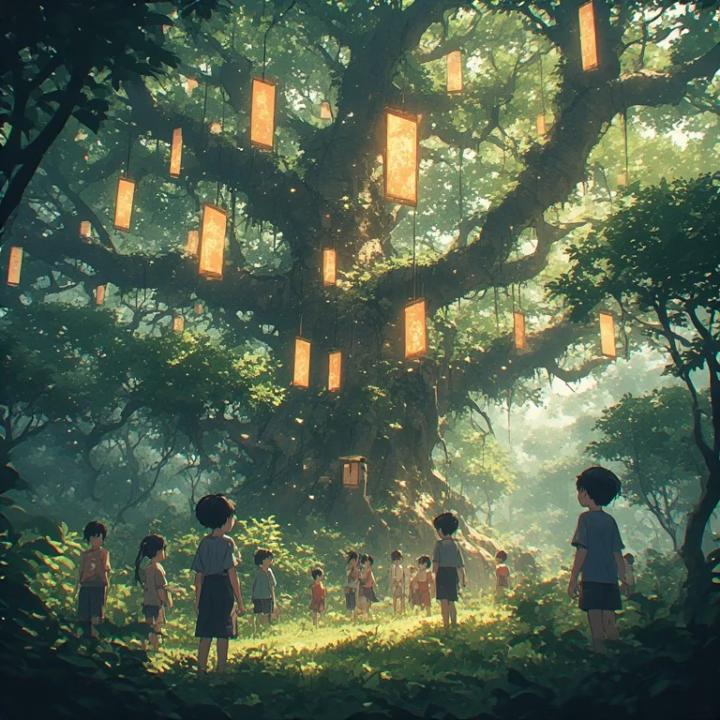
Arranged carefully in circles around a massive banyan tree.
And at the center…
A larger version of the Dream Screen.
Except this one wasn’t small or portable.
It was part of the tree itself.
Growing into it.
Like roots and circuits had become one.
Mira stepped back. “Okay. This is officially creepy.”
But Afiq walked forward slowly.
The air felt calm here.
Too calm.
And then—
The tree spoke.
Not with sound.
With feeling.
A soft vibration in the ground.
A message in the air.
We are tired.
9. The Choice
The group froze.
Lina grabbed Afiq’s arm. “We should go back now lah.”
But Afiq didn’t move.
He felt it too.
Not fear.
Understanding.
The devices weren’t just broken.
They were resting because nobody ever let them stop.
Always on.
Always needed.
Always used.
The Dream Screen pulsed again.
Images appeared in its surface.
Children laughing outside.
Playing games in real sunlight.
Drawing in sand instead of tapping glass.
Afiq swallowed.
“So what happens now?” he whispered.
The feeling answered.
If balance is restored… we wake.
If not… we remain asleep.
Silence.
Mira looked up. “So we just… stop using screens forever?”
The feeling softened.
No.
Use us. But also live beyond us.
Lina frowned. “That’s it? That’s the big lesson?”
But Afiq wasn’t thinking about lessons.
He was thinking about something else.
“How long do you need to sleep?” he asked.
The tree responded.
Until people remember the world again.
10. The Return of Real Life
They returned to the kampung before sunset.
Nothing looked different.
But everything felt different.
Afiq stood in the middle of the field.
“No screens for a while,” he said.
Lina raised an eyebrow. “A while?”
“Just… try.”
Mira sighed dramatically. “No cartoons…?”
Afiq nodded.
“Play outside instead.”
At first, it was chaos.
Kids didn’t know what to do.
No digital games.
No instant entertainment.
But slowly…
Something changed.
Someone started a game of chase.
Someone else built a fort from cardboard.
A group of kids discovered skipping ropes again.
Even adults joined in conversations they hadn’t had in years.
Laughter returned in layers.
Not the short bursts of online jokes.
Real, messy, loud laughter.
And Afiq noticed something important.
The Dream Screen in his bag was getting lighter.
Less warm.
Less active.
Like it was finally resting properly.
11. The Awakening
A week passed.
Then two.
The kampung adjusted.
Not perfectly.
But meaningfully.
One morning, Mira screamed from the living room.
“ABANG! IT TURNED ON!”
Afiq rushed in.
Her tablet was glowing again.
Slowly.
Softly.
Like waking up after a long nap.
Outside, he could hear similar shouts.
Phones blinking back to life.
Screens returning.
But something was different.
People didn’t rush to them immediately.
They hesitated.
Looked outside first.
Finished conversations before checking notifications.
Even Mira didn’t immediately scroll.
She just held her device.
Then looked at Afiq.
“Can we still go outside later?”
Afiq smiled.
“Yeah lah. Later.”
12. The Last Visit
That evening, Afiq went alone to the mango tree.
The clearing was quieter now.
The Dream Screen in his bag was cold.
Not dead.
Just peaceful.
He placed it gently at the base of the tree.
“I think we get it now,” he said softly.
The wind moved through the leaves.
And for a moment—
He felt something like approval.
Not words.
Just calm.
Then the grove slowly dimmed.
Not disappearing.
Just becoming less urgent.
As if satisfied.
Afiq turned and walked back home.
Behind him, the kampung continued to live.
Not screen-free.
Not screen-bound.
Just… balanced.
13. A Different Kind of Normal
Months later, Kampung Seri Paya looked the same.
Phones still existed.
Gaming devices still existed.
Screens still glowed at night.
But something had shifted underneath everything.
Kids still played outside after school.
Mornings weren’t swallowed immediately by devices.
Families talked more at dinner.
And sometimes, when someone used a screen too long…
They would feel it.
A kind of tiredness.
A reminder.
A whisper from somewhere older than technology.
Afiq often sat under the mango tree alone.
He never told anyone about the grove again.
Some things didn’t need explaining.
Mira still teased him sometimes.
“Eh, Dream Screen hero.”
He’d just roll his eyes.
“Go play lah.”
And she would.
Because now, there was more than one world to choose from.
And both mattered.
Share this story, Spread the joy or reading
Other Interesting Stories:
The Night Riders of Putrajaya Bridge "The Night Riders of Putrajaya Bridge" follows three teenage friends—Yusof, David, and Maya—as they embark on a secret midnight cycling quest to cross the city's three most iconic bridges. Throughout…
The Teh Tarik Acrobat’s Great Escape In Kampung Sungai Jati, a talented boy named Aiman uses his extraordinary teh tarik–pulling and acrobatic skills to protect his village from greedy outsiders. When villains attempt to scare villagers…
The Shared Umbrella When a mysterious umbrella begins to expand every time someone steps beneath it, a group of students and strangers are drawn together during a heavy rainstorm in a small neighborhood.…
The Pocketful of Tomorrow A young girl relocates to a new place carrying seeds from her old home, struggling to adapt while clinging to memories of where she came from. As she learns to…
The Uncharted Islands of Pulau Rawa Eddy, Bell, Lily, and Kenji, a group of curious friends, stumble upon an ancient, hand-drawn map leading them to what they believe is an uninhabited island near Pulau Rawa. Driven…
Sticky Rice and Second Chances In the heart of Penang, when the struggling Youth Dragon Boat team faces disbandment due to lack of funds, determined rowers Eddy and Anna refuse to give up—instead launching a…
This mode enables people with epilepsy to use the website safely by eliminating the risk of seizures that result from flashing or blinking animations and risky color combinations.
Visually Impaired Mode
Improves website's visuals
This mode adjusts the website for the convenience of users with visual impairments such as Degrading Eyesight, Tunnel Vision, Cataract, Glaucoma, and others.
Cognitive Disability Mode
Helps to focus on specific content
This mode provides different assistive options to help users with cognitive impairments such as Dyslexia, Autism, CVA, and others, to focus on the essential elements of the website more easily.
ADHD Friendly Mode
Reduces distractions and improve focus
This mode helps users with ADHD and Neurodevelopmental disorders to read, browse, and focus on the main website elements more easily while significantly reducing distractions.
Blindness Mode
Allows using the site with your screen-reader
This mode configures the website to be compatible with screen-readers such as JAWS, NVDA, VoiceOver, and TalkBack. A screen-reader is software for blind users that is installed on a computer and smartphone, and websites must be compatible with it.