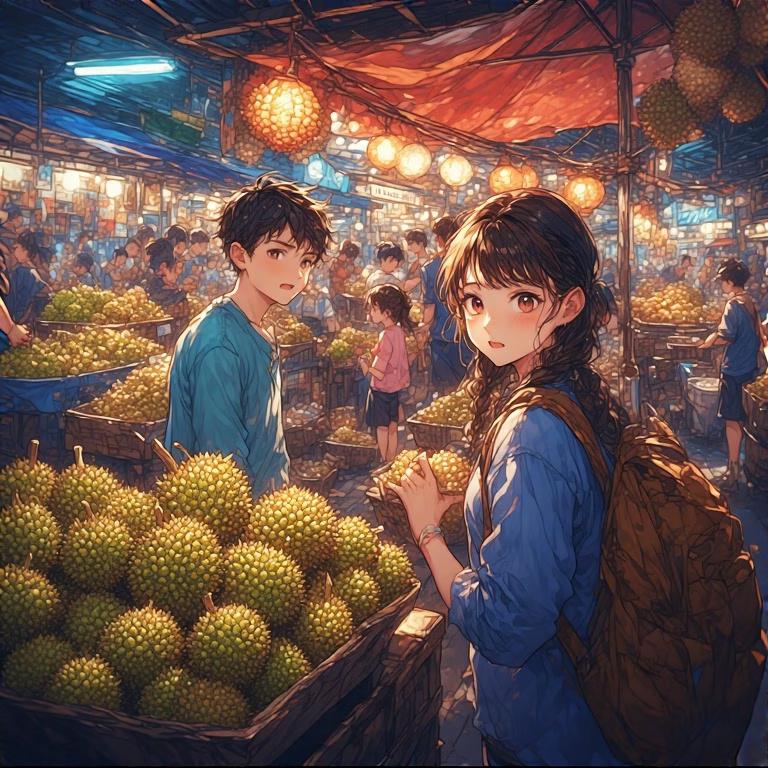
The wooden planks of Chew Jetty always sang a song under Yang Zi’s feet. It was a rhythmic creak-clack, creak-clack that told her exactly where the wood was soft from the salt spray and where it was sturdy enough to run.
To most tourists, the jetties were just a “scenic spot” to buy magnets and eat durian ice cream. But to twelve-year-old Yang Zi, it was home. It was where her Jin Ping (grandfather) dried his fishing nets and where the smell of salty sea air mixed with the scent of her mother’s frying pisang goreng.
One rainy Tuesday, while Yang Zi was “helping” Jin Ping clear out the dusty store cupboard beneath their stilt house, she found it. It was a rusted biscuit tin—the kind with faded floral patterns.
“Jin Ping, what’s this?” Yang Zi asked, wiping a smudge of spiderweb off her nose.
Jin Ping squinted through his thick glasses. “Aiyo, that old thing? I thought the flood took it years ago. Open it, sayang.”
Inside wasn’t gold or jewelry. It was a stack of postcards. They weren’t the shiny, colorful ones you buy at the airport today. These were black-and-white and sepia-toned, their edges curled like dried shrimp.
Yang Zi picked one up. It showed a young man standing on the edge of the pier, his hair slicked back with pomade, wearing a crisp white shirt and baggy trousers. Behind him, the sea was filled with wooden sampans—hundreds of them—instead of the massive container ships that sat on the horizon today.
“That’s your Great-Uncle Ah Boon,” Jin Ping chuckled, a faraway look in his eyes. “1954. Before the big bridge was even a dream. Back then, the jetty was the center of the world. We didn’t have TikTok, Yang Zi. We had the tides.”
Yang Zi looked at the postcard, then at the view outside the door. The spot where Ah Boon had stood was still there, but the sampans were gone, replaced by a few motorboats and a view of the glistening Komtar tower in the distance.
A spark lit up in Yang Zi’s chest. “Jin Ping, I want to see what else changed. I’m going to find these exact spots and take pictures. A then-and-now project!”
Jin Ping patted her head. “Don’t fall in the water, budak bertuah. And watch out for the stray cats; they are the real bosses of this pier.”
The Search Begins
Yang Zi borrowed her mother’s old digital camera. It wasn’t fancy, but it worked.
The first postcard was tricky. It showed a group of children jumping off a wooden platform into the water. They looked so happy, frozen in mid-air. The caption on the back, written in neat, cursive ink, said: “High tide at the end of the walkway. July 1956.”
Yang Zi walked to the very end of the jetty. Today, there was a heavy iron railing there to stop tourists from falling in. A group of aunties were sitting nearby, gossiping and cleaning vegetables.
“Auntie Bee!” Yang Zi called out. “Do you remember when kids used to jump off here?”
Auntie Bee laughed, her gold tooth sparking. “Mana boleh jump now, Yang Zi! Too many boats, and the water is different. But in my time? Wah, we were like dolphins! I remember that platform. It broke during a storm in ’68.”
Yang Zi positioned herself. She held the postcard up, lining up the horizon line of the old photo with the real horizon. Snap. In her camera screen, the ghostly black-and-white children seemed to be jumping into the modern, murky green water. It felt like she was catching a glimpse of a ghost world living right on top of her own.
The Vanishing Grocery
The second postcard was of a shop called “Kedai Runcit Hock Hin.” In the photo, a man was weighing out bags of rice while a little girl—maybe Yang Zi’s age—pointed at a jar of colorful marbles.
Yang Zi spent two hours walking up and down the narrow wooden walkways. She saw souvenir shops selling “I Love Penang” t-shirts. She saw a cafe selling expensive iced lattes. But no Hock Hin.
Finally, she stopped at the temple at the entrance of the jetty. An old man was sweeping the floor.
“Uncle, do you know where Hock Hin grocery was?”
The man stopped sweeping. “Hock Hin? Aiya, girl, that closed twenty years ago. It’s a homestay now. See that blue house with the air-con units? That was it.”
Yang Zi felt a pang of sadness. The shop where people bought their daily rice and shared stories was now a place for strangers to sleep for one night. She took the photo anyway. The contrast was sharp: the old photo showed a community hub; the new photo showed a locked door with a keypad.
The Mystery of the “Girl with the Flower”
The last postcard in the tin was the most beautiful. It wasn’t a wide shot of the pier. It was a portrait of a young girl sitting on a wooden bench, holding a hibiscus flower. She was wearing a traditional cheongsam with intricate embroidery. She wasn’t smiling, but her eyes looked like they were full of secrets.
There was no name on the back. Just a date: August 31, 1957.
“Independence Day,” Yang Zi whispered. The day Malaysia became a nation.
She showed the photo to everyone. Most people shook their heads. “Too long ago,” they said. “Everyone moves away eventually.”
Yang Zi was about to give up when she visited Mrs. Lim, the oldest resident of the jetty, who spent her days sitting in a rocking chair watching the cruise ships pass by.
Mrs. Lim took the postcard. Her hands trembled slightly. She peered at it for a long time, then a small, watery smile broke across her face.
“That is Fatimah,” Mrs. Lim said. “She lived in the house next to mine. Her father was a boat builder. We were best friends.”
“Is she still here?” Yang Zi asked breathlessly.
“No,” Mrs. Lim sighed. “Her family moved to the mainland in the 70s. But look at her face, Yang Zi. She was so proud that day. We all were. We wore our best clothes because we were a new country.”
Yang Zi looked at the girl in the photo. She realized that while the buildings changed—becoming cafes or homestays—the feeling of the jetty stayed in the memories of people like Mrs. Lim.
Yang Zi asked Mrs. Lim to sit in the same spot, even though the old wooden bench had been replaced by a plastic chair. Mrs. Lim straightened her hair and held a fresh hibiscus Yang Zi had plucked from a nearby pot.
Snap.
The photo was perfect. Mrs. Lim’s wrinkled face held the same quiet strength as the young girl from 1957.
The Exhibition
A week later, Yang Zi pinned her “Then and Now” photos onto a large corkboard outside Jin Ping’s house. She used bits of string to connect the old postcards to her new photos.
A crowd began to gather. The aunties stopped gossiping. The tourists stopped looking at their phones.
“Look! That’s my father’s old boat!” someone shouted. “I remember that grocery store! They used to give me free candy,” another voice added.
Jin Ping stood next to Yang Zi, looking at the display. He looked at the photo of Great-Uncle Ah Boon next to the modern pier.
“You did a good thing, Yang Zi,” he said softly. “Things change. That is the way of the world. But as long as we remember, nothing is truly lost.”
Yang Zi looked out at the water. The sun was setting, turning the sky a dusty orange-pink. The jetty felt different to her now. It wasn’t just wood and nails; it was a library of stories, stacked one on top of the other, waiting for someone to pick up a postcard and read them.
She reached into her pocket and felt the cool metal of the camera. She realized she didn’t just want to find old stories; she wanted to make sure she captured the new ones, too. Because fifty years from now, another girl might be standing on these same planks, wondering what life was like back in 2026.
Yang Zi raised her camera and took a photo of Jin Ping laughing with his friends.
Creak-clack. The jetty sang along.
Share this story, Spread the joy or reading
Other Interesting Stories:
The Tides of Desaru Beach The Tides of Desaru Beach follows twelve-year-old Hana, a curious girl living in a Malaysian coastal town, who discovers a mysterious message in a bottle washed up on the shore.…
The Night Market Detectives When prized durians mysteriously vanish from stalls at the bustling Gurney Drive Night Market, best friends Eddy and Anna form the "Midnight Durian Society" to solve the puzzling case. With…
The Shimmering Surprise of Seabrook In the secluded town of Seaside Pines, there lived a quirky old sailor named Chen "Chili Peppers" Wu. Chen was a retired fishing captain known for his love of green…
Oranges in the Esplanade Oranges in the Esplanade is a charming tale set in the vibrant streets of Penang during the Chap Goh Mei festival. Thirteen-year-old Belly participates in the tradition of throwing an orange…
The Floating Market of Pangkor This slice-of-life story follows Kai, a 9-year-old boy, as he spends his school holidays helping his family run their food stall at a traditional floating market on Pangkor Island. Through…
Wings Over the Peninsula Jax, a boy who lives at the remote Taiaroa Head wildlife centre, faces a fierce southern storm that strands a vulnerable albatross chick on a dangerous cliff ledge. Embracing his…
This mode enables people with epilepsy to use the website safely by eliminating the risk of seizures that result from flashing or blinking animations and risky color combinations.
Visually Impaired Mode
Improves website's visuals
This mode adjusts the website for the convenience of users with visual impairments such as Degrading Eyesight, Tunnel Vision, Cataract, Glaucoma, and others.
Cognitive Disability Mode
Helps to focus on specific content
This mode provides different assistive options to help users with cognitive impairments such as Dyslexia, Autism, CVA, and others, to focus on the essential elements of the website more easily.
ADHD Friendly Mode
Reduces distractions and improve focus
This mode helps users with ADHD and Neurodevelopmental disorders to read, browse, and focus on the main website elements more easily while significantly reducing distractions.
Blindness Mode
Allows using the site with your screen-reader
This mode configures the website to be compatible with screen-readers such as JAWS, NVDA, VoiceOver, and TalkBack. A screen-reader is software for blind users that is installed on a computer and smartphone, and websites must be compatible with it.