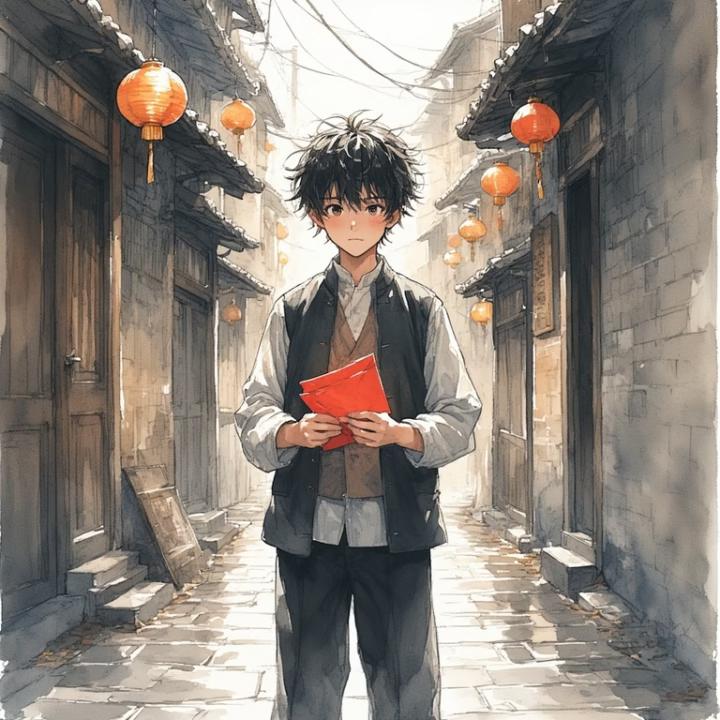
The Lunar New Year in the Lim household didn’t start with firecrackers or lion dances. It started with the “The Look.”
12 year-old Ah Boy sat at the round kitchen table, watching his Ma carefully stuff crisp, red hongbao with even crisper bills. She didn’t look up, but she knew he was there.
“Ah Boy-ah,” she said, her voice like a violin string pulled just a bit too tight. “This year is the Year of the Dragon. Very auspicious. Your Auntie May’s son, Ah Bin? He got into the top science academy last week. Such a lucky boy.”
Ah Boy felt a familiar sinking feeling in his stomach, like he’d swallowed a lead marble. In his family, “luck” wasn’t about finding a coin on the ground. Luck was earned through 4.0 GPAs, piano trophies, and never talking back.
“I’m trying, Ma,” Ah Boy muttered, pushing a piece of steamed nian gao around his plate.
“Don’t just try. Be lucky,” she said, finally looking at him. “Tomorrow at the big family dinner, Gong Gong will ask about your math competition. Make sure you have a ‘lucky’ answer for him.”
The Red Packet Race
The next day, the air was thick with the scent of fried garlic and incense. Ah Boy’s house was a sea of red and gold. Relatives he only saw once a year were everywhere, pinching his cheeks and asking how tall he’d grown.
His cousin, Ah Bin—the “Lucky One”—was already there, wearing a brand-new silk vest and a smug grin. Ah Bin was a Year-of-the-Dragon baby, which meant everyone treated him like a mini-celebrity.
“Hey, Ah Boy! How many red envelopes you got so far?” Ah Bin asked, waving a thick stack of hongbao.
“Just two,” Ah Boy said, tucking his thin envelopes into his pocket.
“Aiyoh, so sad! My pockets are basically exploding,” Ah Bin bragged. “But I guess luck follows the winners, right? My dad gave me a huge one because I won the regional chess match. What did you get yours for? Participating?”
Ah Boy’s face burned. He wasn’t bad at school, but he wasn’t Ah Bin. He liked drawing—sketching the messy, beautiful life of the wet markets and the way the neon signs reflected in rain puddles. But you couldn’t put “Artist” on a college application at twelve, according to his Ma.
The Weight of Expectations
Dinner was a marathon of food and pressure. Gong Gong, the family patriarch, sat at the head of the table. He was the one who handed out the biggest envelopes, but they always came with a “Life Lesson.”
One by one, the cousins went up to greet him.
“Gong Gong, Gong Xi Fa Cai!” Ah Bin shouted, bowing low.
Gong Gong beamed. “Ah Bin-ah! The scientist! Here, a big one for a big future.”
Then it was Ah Boy’s turn. The table went quiet.
“Ah Boy,” Gong Gong said, his eyes sharp behind thick glasses. “I heard you got a B in Advanced Math. Is your pocket feeling light because your head is light on numbers?”
A few aunts chuckled. Ah Boy’s Ma looked down at her tea, her face tight with embarrassment.
“I’m working harder, Gong Gong,” Ah Boy whispered.
“Luck is a fickle thing,” Gong Gong said, handing Ah Boy a single, slim red envelope. “It stays with those who respect the tradition of hard work. Don’t let your pockets stay empty forever.”
Ah Boy took the envelope, but it felt like it weighed a hundred pounds. He went to his room while the adults started their loud games of Mahjong.
The Empty Pocket
Ah Boy sat on his bed and opened the envelope. Inside was a small amount of money and a handwritten note: Luck is what you make when you stop looking at others.
He felt a hot tear track down his nose. He looked at his sketchbook, filled with drawings of his family—not the “perfect” versions they pretended to be, but the real ones. He had a sketch of Ma laughing when she thought no one was looking, and Gong Gong napping in his favorite chair with a newspaper on his face.
Suddenly, a loud thud came from the hallway, followed by a frantic cry.
Ah Boy ran out. In the middle of the living room, Ah Bin was frantic. His “exploding” pockets were empty. He had lost his stack of red envelopes—all of them.
“I had them right here!” Ah Bin cried, his face pale. “I was showing them to the little cousins near the balcony and… and…”
The adults scrambled. They checked under the sofa, behind the TV, even in the trash. The “Lucky One” was suddenly the unluckiest person in the room.
Real Luck
Ah Boy looked at the balcony. It was a windy night. If the envelopes had fallen over the railing, they would be scattered across the messy alleyway behind their apartment building.
“I’ll go look,” Ah Boy said.
“Don’t bother,” Ah Bin snapped, his eyes red. “It’s dark and dirty down there. They’re gone. Gong Gong is going to think I’m a loser now. My ‘luck’ is gone.”
Ah Boy didn’t listen. He grabbed a flashlight and ran down the stairs. The alley was a maze of crates, old bicycles, and puddles. He searched for an hour, his hands getting cold and his sneakers getting muddy.
He found one wedged under a dumpster. Then another caught in a thorny bush. Finally, he spotted a splash of red high up on a fire escape. He climbed the rusty metal, his heart hammering. He gathered every single one.
When he walked back into the apartment, dripping with sweat and a bit of mud, the room went silent. He handed the stack to Ah Bin.
“You found them?” Ah Bin gasped, counting them quickly. “Every single one? Why? I was mean to you.”
Ah Boy shrugged. “Because having empty pockets sucks. But having everyone think you’re only ‘lucky’ because of a piece of paper sucks more.”
Gong Gong watched this from his chair. He didn’t say anything at first. He just gestured for Ah Boy to come closer.
“You missed the Mahjong games, Ah Boy-ah,” Gong Gong said. “You spent your New Year in a dirty alley for a cousin who bragged.”
“I just did what I thought was right,” Ah Boy said.
Gong Gong reached into his inner vest pocket. He pulled out an old, faded red envelope—one he hadn’t given out. He handed it to Ah Boy.
“This is not for math,” Gong Gong said loudly, so the whole room could hear. “This is for having a heart that is bigger than your ego. That is the only kind of luck that lasts a lifetime.”
A New Narrative
Ah Boy didn’t become a math genius overnight. He still got the occasional B, and his Ma still compared him to Ah Bin sometimes. But something had changed.
He realized that “luck” wasn’t a score or a stack of money. It was the resilience to keep going when things were tough and the kindness to help others even when they didn’t deserve it.
He went back to his sketchbook. He drew the scene in the alley—the dark shadows, the single beam of his flashlight, and the bright, defiant red of the envelopes against the grey stone.
He wasn’t the “Lucky Dragon” or the “Science Star.” He was Ah Boy, the boy who found what was lost. And for the first time, his pockets didn’t feel empty at all.
Share this story, Spread the joy or reading
Other Interesting Stories:
Seven Wishes in the Air Seven Wishes in the Air is a heartwarming tale of seven childhood friends, known as the "Seven Stars," who gather for their annual Lunar New Year Yee Sang ritual. As…
The Ghost Festival Mix-Up In The Ghost Festival Mix-Up, twelve-year-old Mei accidentally invites a talkative, nostalgic ghost named Ah-Boh into her life after misplacing a pineapple tart during Hungry Ghost Month. Now stuck with…
Pineapple Tarts for a Rainy Day Pineapple Tarts for a Rainy Day is a moving story about twelve-year-old Ah Boy and his aging grandfather, Gong Gong, as they prepare traditional Lunar New Year treats in their…
The Umbrella Mender of China Street In the rain-soaked lanes of Penang’s China Street Ghaut, a solitary old man known only as Mr. Lim mends broken umbrellas with quiet devotion, refusing payment and speaking little—until thirteen-year-old…
Kites Over Kepong Metropolitan Park Kites Over Kepong Metropolitan Park is a touching slice-of-life story about the Lim family, who have become distant and strained following a year of financial hardship. During a Sunday outing…
The Peranakan Doll’s Journey The Peranakan Doll’s Journey is a lyrical historical fiction that follows Lily, a beautifully crafted Peranakan doll, as she passes through four generations of a family in Penang, Malaysia. From…
This mode enables people with epilepsy to use the website safely by eliminating the risk of seizures that result from flashing or blinking animations and risky color combinations.
Visually Impaired Mode
Improves website's visuals
This mode adjusts the website for the convenience of users with visual impairments such as Degrading Eyesight, Tunnel Vision, Cataract, Glaucoma, and others.
Cognitive Disability Mode
Helps to focus on specific content
This mode provides different assistive options to help users with cognitive impairments such as Dyslexia, Autism, CVA, and others, to focus on the essential elements of the website more easily.
ADHD Friendly Mode
Reduces distractions and improve focus
This mode helps users with ADHD and Neurodevelopmental disorders to read, browse, and focus on the main website elements more easily while significantly reducing distractions.
Blindness Mode
Allows using the site with your screen-reader
This mode configures the website to be compatible with screen-readers such as JAWS, NVDA, VoiceOver, and TalkBack. A screen-reader is software for blind users that is installed on a computer and smartphone, and websites must be compatible with it.