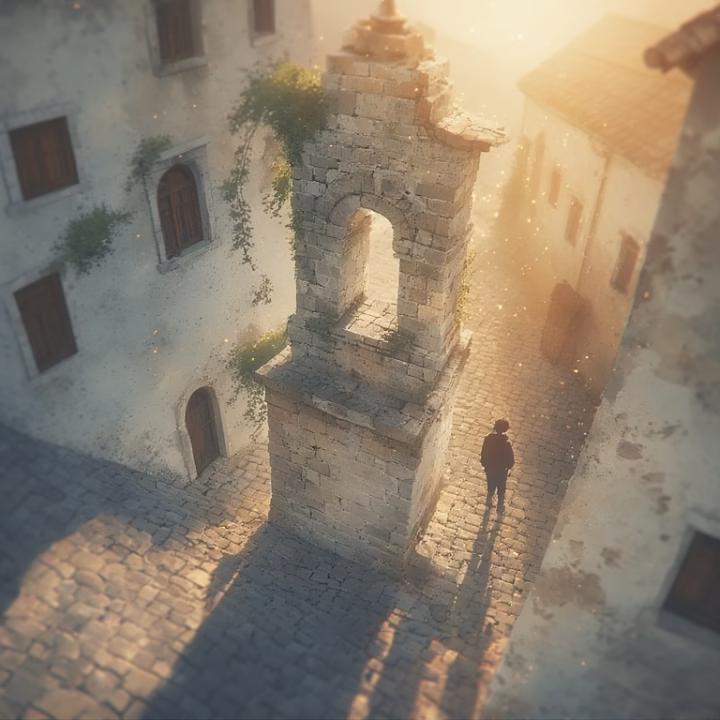
Eliot had always been careful with his shadow. In Maplewood, a small town tucked between foggy hills and twisting rivers, shadows were tricky things. They didn’t just follow you—they remembered you. And if your shadow touched someone else’s? Well, you swapped a memory with them.
It started as a game for the kids in Eliot’s class. On sunny afternoons, they’d chase each other down the cracked sidewalks, yelling “Shadow-Tag!” and laughing as memories flickered between them. One minute you’d remember winning the school spelling bee, and the next you’d be reliving the taste of last summer’s strawberry ice cream from someone else’s picnic.
Eliot had always liked the game enough to play cautiously. He didn’t want his memories floating around like lost leaves, nor did he want anyone to know about the quiet moments he kept to himself. But one bright Tuesday afternoon, everything changed.
He was darting past the library when he felt it—cold, strange, and hollow where his shadow should have been. He stopped, spinning in a circle. Nothing. His shadow had vanished.
“What the—?” Eliot whispered, crouching on the pavement. He looked behind him, around him, even under him. Nothing. Just his shoes.
At first, he tried to laugh it off. Maybe the sunlight was weird, maybe he’d imagined it. But over the next few hours, strange things began to happen. People he passed on the street seemed to flinch or frown, as though he’d just brushed past a memory they weren’t ready to remember. And Eliot’s own memories began to shift on their own. He’d open a notebook, only to find he couldn’t remember writing the last few sentences. He’d look at a photo of his dog, and it felt like someone else had been the one to take it.
By evening, Eliot realized the truth. Without his shadow, he couldn’t hold onto his memories properly. The shadow was like a tether, a silent keeper of everything he had lived through. Without it, the town’s game—the innocent swapping of small moments—had turned dangerous.
He ran home, hoping his parents would have some answer.
“Mom! Dad! My shadow’s gone!” he shouted.
His parents exchanged worried glances. His mother knelt to his level. “Eliot… shadows don’t usually leave people,” she said slowly. “But maybe… maybe your shadow has something to teach you. Sometimes, when a memory is too big or too heavy, the shadow steps in. And sometimes, it leaves when it’s trying to protect you.”
Eliot frowned. “Protect me from what?”
“From losing yourself,” his father said quietly. “If your shadow is gone, it means you’re ready to see the world in a new way. But you need to be careful. Without it, the memory swaps aren’t just playful anymore—they can… take more than you realize.”
Eliot didn’t fully understand, but the warning sank in. That night, he lay awake in bed, feeling the absence of the soft outline that had always followed him. He imagined it wandering the streets, brushing past other shadows, carrying pieces of himself across Maplewood.
The First Memory
The next day at school, Eliot tried to stay close to the walls, avoiding other students’ shadows. But the more he avoided them, the more he realized that some memories were already gone. His lunch with his best friend last week, his favorite hiding spot in the park, the way his grandmother used to hum while baking—fading, like smoke.
During art class, his friend Mara ran up to him with a grin. “Shadow-Tag!” she called. She leapt, her shadow stretching toward him.
Eliot froze. He couldn’t let it touch him. But Mara’s shadow flicked across his feet anyway. A shiver ran up his spine. And then—nothing.
Wait. Nothing? He looked down. Still no shadow.
But something else had happened. He remembered Mara’s first day at school, when she had tripped over her own shoelaces and cried in the corner. He hadn’t remembered it before—it wasn’t one of his memories. But now he did.
Eliot realized the truth: without a shadow, he couldn’t give memories, but he could still receive them.
Learning the Rules
It was terrifying—and amazing. Eliot spent the next days learning the rules of this new game. He discovered that memories were delicate and heavy, and sometimes they came with feelings too big to carry. He could gain someone’s joy, their excitement, their sadness—but he had to be careful. One wrong touch could leave him with more than he could handle.
On Wednesday, he followed a stray cat to the edge of town. There, he brushed past a shadow stretching from the grocery store window. Suddenly, he felt a pang of hunger he didn’t recognize. The shadow had given him a memory of a little girl’s picnic, her hands sticky with jam, laughing with her brother. Eliot had never had a sibling, yet he knew the warmth of that moment now.
He tucked it into his mind like a treasure and continued home, careful not to take too much at once. He realized each shadow carried a lifetime’s worth of small moments, and some were heavier than others.
The Mayor’s Secret
One evening, Eliot ventured to the town square, where the shadows of the old oak trees stretched across the cobblestones. The mayor’s shadow was always the longest. Eliot hesitated, but curiosity got the better of him.
A touch.
Suddenly, he was sitting in the mayor’s office, years ago, listening to her grandmother tell stories of Maplewood during the floods. He could smell the old wood and the river water and feel the excitement of learning a town secret he wasn’t supposed to know yet. When Eliot blinked, he was back in the square. But the memory stayed with him.
It was exhilarating—and dangerous.
The Playground Incident
One Friday, Eliot found himself near the old playground. He saw two younger kids arguing, shadows tangling. He wanted to help, but without a shadow, he couldn’t swap back memories. He could only watch.
A flicker of movement—a shadow brushing past him—and he suddenly remembered the exact moment he had won his first soccer game, the pride and cheering from the sidelines. It belonged to someone else now. He realized that memories could travel, could linger, could sometimes change you without warning.
Eliot began keeping a notebook, writing down the memories he collected and describing the feelings that came with them. Some were happy, some sad, some confusing, but each was important.
A Visit to the Hills
One Saturday, Eliot climbed the hills above Maplewood. The fog rolled in, and the shadows of the trees danced like spirits. Here, far from the streets, he practiced receiving memories more gently. He brushed against the shadows of birds perched on branches and felt flashes of flight and freedom.
He learned to pause, breathe, and release memories if they became too heavy. By the time he returned home, he could handle a few at a time without becoming dizzy or overwhelmed.
The Memory Swap That Changed Everything
One evening, a strong gust of wind blew through the town square, and Eliot stumbled into the shadow of a boy named Finn, who had been new to Maplewood. Eliot felt a rush—this memory was big, almost too big for him. He caught a fragment: Finn’s fear the first day he arrived, the loneliness, the longing for a friend.
Instead of storing it for himself, Eliot made a decision. He left a note by the fountain where Finn had been playing the day before. It read, simply: “You’re not alone. Someone remembers.”
The next morning, Finn found it and smiled. Eliot realized that memories weren’t just things to hold—they were ways to connect.
The Shadow Returns
Weeks passed. Eliot grew careful, thoughtful, and strong in his understanding of the town’s magic. One evening, after a particularly bright sunset, he felt a faint warmth at his back. A thin outline shimmered on the pavement behind him, stretching and curling like a ribbon in the wind.
It was his shadow, returning—not as a tether to everything he had lost, but as a guide for everything he had learned.
Eliot smiled. He didn’t need to chase it. He didn’t need to play the game the way he used to. Now, he knew how to navigate the town, the memories, and the magic without losing himself.
He became Maplewood’s secret guardian of memories. Children would continue to play Shadow-Tag, but Eliot knew the importance of balance: memories could be shared, treasured, and returned. And sometimes, when the sun was just right, he swore he could feel his shadow brushing past, carrying a memory back to him, whispering: “You’re never truly alone.”
Share this story, Spread the joy or reading
Other Interesting Stories:
Journey to the Forgotten Land The forest loomed overhead, a tangle of twisted branches and thick foliage that seemed to swallow the light. Anna paused, brushing a strand of hair from her face, her heart…
Sakura Petals on the Moat During the peak of cherry blossom season at Tokyo’s Chidorigafuchi Park, childhood friends Kenji and Aiko share a poignant final afternoon rowing through a moat blanketed in pink petals before…
The Shared Umbrella When a mysterious umbrella begins to expand every time someone steps beneath it, a group of students and strangers are drawn together during a heavy rainstorm in a small neighborhood.…
When the Screens Went Asleep When every digital screen in Kampung Seri Paya mysteriously falls asleep at the same time, a curious boy and his friends uncover a hidden magical grove where old technology rests…
The Last Boat to Kukup Fishing Village "The Last Boat to Kukup Fishing Village" follows Mei-Mei, a city girl initially resistant to spending her summer with relatives in a unique stilted fishing village. Through daily chores, traditional…
The Boy Who Painted the Wind In Willow Creek, young artist Finn Calder discovers his paintings can control the wind, reflecting his emotions. As he struggles with anger, joy, and fear, he learns the responsibility of…
This mode enables people with epilepsy to use the website safely by eliminating the risk of seizures that result from flashing or blinking animations and risky color combinations.
Visually Impaired Mode
Improves website's visuals
This mode adjusts the website for the convenience of users with visual impairments such as Degrading Eyesight, Tunnel Vision, Cataract, Glaucoma, and others.
Cognitive Disability Mode
Helps to focus on specific content
This mode provides different assistive options to help users with cognitive impairments such as Dyslexia, Autism, CVA, and others, to focus on the essential elements of the website more easily.
ADHD Friendly Mode
Reduces distractions and improve focus
This mode helps users with ADHD and Neurodevelopmental disorders to read, browse, and focus on the main website elements more easily while significantly reducing distractions.
Blindness Mode
Allows using the site with your screen-reader
This mode configures the website to be compatible with screen-readers such as JAWS, NVDA, VoiceOver, and TalkBack. A screen-reader is software for blind users that is installed on a computer and smartphone, and websites must be compatible with it.