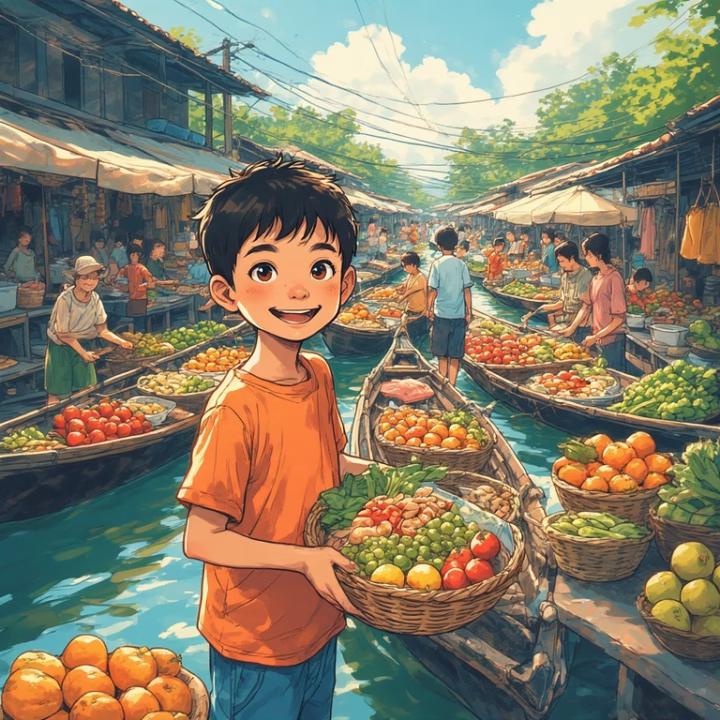
The sun, like a big, hot roti canai, was already high in the sky when Kai woke up. He stretched like a lazy cat, his small room on stilts creaking around him. Outside, he could hear the gentle lapping of waves against the wooden planks and the distant, familiar hubbub of the floating market. School holidays! No boring arithmetic, no writing essays until his hand felt like jelly. Just pure, unadulterated freedom… well, mostly.
“Kai, bangun lah! The early bird catches the worm, not the sleepyhead who misses all the good durian,” his Mama’s voice, sweet but firm like a mangosteen, drifted up from below.
Kai groaned. He loved helping at the family’s stall, really, he did. But waking up before the chickens sometimes felt like a superpower he hadn’t quite mastered yet. He tumbled out of bed, splashed some water on his face from the big earthenware jar, and quickly pulled on his favorite faded blue shorts and a comfortable t-shirt. Downstairs, the smell of freshly fried keropok and strong kopi-o filled the air. His Baba was already busy, his broad back bent over a large wok, stirring something fragrant.
“Morning, Baba!” Kai chirped, grabbing a piece of warm keropok. It was still crispy from the early morning batch.
“Morning, son. Good, you’re up. Plenty to do today. Auntie Mei’s boat is coming in with a fresh catch, and we need to help unload,” Baba said, his voice a low rumble.
Their family stall, ‘Pangkor Delights,’ wasn’t really a stall on land. It was a sturdy wooden boat, painted a cheerful turquoise, moored alongside many others in a wide, calm channel just off Pangkor Island. This was the heart of the Floating Market, a place where generations of families bought and sold everything from juicy rambutans and glistening fish to handmade batik clothes and intricate shell crafts. It was a kaleidoscope of colors, smells, and sounds, a symphony of life played out on the water.
Kai loved the market. It was his playground, his school, and his universe all rolled into one. He knew every twist and turn of the waterways, every shortcut between the bigger cargo boats, and the best spots to catch tiny fiddler crabs when business was slow.
Today, Kai’s first job was to help sort the fish. Auntie Mei’s boat, a smaller, quicker vessel, soon glided alongside ‘Pangkor Delights,’ laden with buckets of shimmering, fresh-from-the-sea bounty. The air immediately filled with the briny scent of the ocean.
“Auntie Mei! Your catch looks superb today!” Mama called out, a warm smile spreading across her face.
Auntie Mei, a stout woman with a hearty laugh, wiped her hands on her apron. “Only the best for Pangkor Delights, Ah Bee! These took some chasing, I tell you.”
Kai and his cousin, Lina, who was a year older and much faster at sorting, started carefully transferring the fish into large ice-filled containers on their boat. Lina, with her quick fingers, could tell a good snapper from a so-so one with just a glance.
“See, Kai, this one,” Lina pointed to a fish with bright, clear eyes and firm scales. “This one is happy fish. Good for bakar.” Bakar meant grilled, and grilled fish was a specialty at Pangkor Delights.
Kai tried to mimic her, picking up a fish and inspecting it closely. Sometimes, he felt a bit squeamish touching the slimy scales, but he knew it was important. Their family depended on selling the freshest fish and the most delicious food.
As the morning wore on, the market became a hive of activity. Tourists, their cameras clicking away, mingled with locals bargaining for the best prices. The air was thick with the chatter of different languages, the sizzling of woks, and the melodic calls of vendors advertising their wares.
“Fresh satay! Hot off the grill!” cried a man from a nearby boat, the scent of grilling meat wafting over.
“Sweet mango sticky rice! Special today!” a woman’s singsong voice announced.
Kai’s job shifted. He helped Mama prepare the tables on their boat, setting out plates of nasi lemak, bowls of laksa, and their famous grilled fish. He practiced his polite smiles, remembering Mama’s constant reminder: “A friendly face makes happy customers, Kai.”
One tourist, a friendly Uncle with a big straw hat, pointed to a plate of nasi lemak. “What is this deliciousness, young man?” he asked in slightly accented Malay.
“This is nasi lemak, Uncle! Rice cooked in coconut milk, with sambal, fried ikan bilis, peanuts, and a boiled egg,” Kai recited proudly, just like Mama had taught him. He even added, “It’s very good, lah!”
The Uncle chuckled and ordered two plates. Kai felt a little thrill of accomplishment. He wasn’t just a boy helping out; he was part of the business, a small but important cog in the big, beautiful machine of Pangkor Delights.
Later in the afternoon, when the sun wasn’t quite so fierce, Kai got to do his favorite job: making deliveries. He hopped into their smaller sampan, a light, nimble boat, with a few carefully packed orders. His first stop was to Auntie Leena, who ran the batik shop two channels over. She had ordered their special fish curry for her lunch.
Paddling through the maze of boats was like navigating a secret water city. He greeted other vendors, some waving back, some too busy to notice. He saw Uncle Muthu polishing his handcrafted wooden boats, and Kak Ros weaving intricate straw mats. Everyone knew everyone here. It was like one big, sprawling family.
When he reached Auntie Leena’s vibrant batik shop, she was sitting cross-legged, painting a swirling pattern onto a piece of silk. “Ah, Kai! My curry, finally! My tummy was rumbling like a thunderstorm!” she exclaimed, her eyes twinkling.
Kai carefully handed her the package. “Mama says enjoy, Auntie Leena!”
Auntie Leena gave him a small, sweet kuih lapis. “For your good work, little helper. And tell your Mama the patterns are flying off the shelves today. Business is good!”
Kai smiled, munching on the delicious layered cake as he paddled to his next delivery. Business was good. He knew that meant more food on their table, new school books for him, and maybe even a new fishing rod for Baba. It wasn’t just about selling food; it was about keeping their families afloat, literally and figuratively.
As the day began to fade, casting long, golden shadows across the water, the market started to wind down. The boisterous chatter softened into contented murmurs. Vendors began packing up, their boats looking a little emptier, a little lighter.
Kai and Lina helped Mama and Baba clean up Pangkor Delights. They washed plates, wiped down tables, and packed away any leftover ingredients. It was tiring work, but there was a quiet satisfaction in seeing everything neat and orderly again.
Sitting on the edge of their boat, his legs dangling in the cool water, Kai watched the sunset paint the sky in fiery oranges and soft purples. The fishing boats, their lights beginning to twinkle, started to head out for their night’s work. He could hear the distant strains of a melodious Malay song from someone’s boat.
“Tired, son?” Baba asked, sitting down beside him, a comfortable silence settling between them.
Kai nodded, leaning his head against Baba’s arm. “A little, Baba. But it was fun today. And I sorted the fish quite fast!”
Baba chuckled, ruffling Kai’s hair. “You did good, Kai. Very good. This market… it’s not just a place to sell things, you know? It’s our home. It’s where we help each other, where we share our lives.”
“Like Auntie Mei sharing her fish, and Auntie Leena sharing her kuih?” Kai asked, remembering the sweet treat.
“Exactly, lah! We all depend on each other. If one boat sinks, we all help pull it up. That’s community, Kai. It’s important,” Baba explained, his gaze sweeping across the tranquil market.
Kai thought about it. He thought about Uncle Muthu helping Baba fix a leaky plank last month, and Mama sending extra food to Kak Ros when she was sick. He thought about Lina teaching him the best way to slice cucumbers, and Auntie Mei always saving the biggest prawns for their family. It wasn’t just individual boats bobbing on the water; it was a network, strong and interconnected, like the woven fishing nets he saw every day.
The sky was now a deep indigo, dotted with the first hesitant stars. The air was cooler, carrying the scent of salt and damp wood. Kai felt a warmth spread through him, a feeling that had nothing to do with the sun. It was the warmth of belonging, of being part of something bigger than himself.
He might not be a grown-up yet, but he was learning. He was learning how to sort fish, how to serve customers, and most importantly, how to be part of the Floating Market of Pangkor. And for a 11-year-old boy on school holiday, that felt like the most important lesson of all. He smiled, a happy, contented smile. Tomorrow, he would wake up early again. And he wouldn’t mind it one bit.
Share this story, Spread the joy or reading
Other Interesting Stories:
The Lost Island of Mochi Creatures Eddy had always been a dreamer, the kind of guy who saw the world through a lens of whimsy. He stood on the edge of the dock, arms wide open…
The Skyway Pact "The Skyway Pact" tells the heartwarming story of Minah and Sabre, two best friends on their final cable car ride together before Minah moves to a different state. As they…
Voices of the Neon Bloom The air hung thick and humid, saturated with the scent of ozone and caramelized sugar. Kai traced the condensation on his chilled synth-ale, the neon glow of the 'Floating Lotus'…
My Best Friend Is a Mynah Bird In the bustling heart of Bangsar, ten-year-old Wei battles loneliness until he rescues an injured mynah bird from a pet shop. Naming him Kecil, Wei nurses him back to health,…
Chasing the Kingfisher "Chasing the Kingfisher" tells the heartwarming story of Zack, an asthmatic city boy who moves to a kampung near Sungai Pinang and feels out of place until he spots a…
The 100-Kilometer Jam to Ipoh The Teoh family’s annual journey to Ipoh turns into a hilarious and heartfelt ordeal when they get trapped in a massive 100-kilometer traffic jam. As the heat rises and the…
This mode enables people with epilepsy to use the website safely by eliminating the risk of seizures that result from flashing or blinking animations and risky color combinations.
Visually Impaired Mode
Improves website's visuals
This mode adjusts the website for the convenience of users with visual impairments such as Degrading Eyesight, Tunnel Vision, Cataract, Glaucoma, and others.
Cognitive Disability Mode
Helps to focus on specific content
This mode provides different assistive options to help users with cognitive impairments such as Dyslexia, Autism, CVA, and others, to focus on the essential elements of the website more easily.
ADHD Friendly Mode
Reduces distractions and improve focus
This mode helps users with ADHD and Neurodevelopmental disorders to read, browse, and focus on the main website elements more easily while significantly reducing distractions.
Blindness Mode
Allows using the site with your screen-reader
This mode configures the website to be compatible with screen-readers such as JAWS, NVDA, VoiceOver, and TalkBack. A screen-reader is software for blind users that is installed on a computer and smartphone, and websites must be compatible with it.