In the sleepy, coastal town of Kota Bharu, where the air smells of salt and fried dough, eleven-year-old Aisyah lived for two things: her grandmother’s cooking and a good mystery.
Aisyah wasn’t like the other kids who spent their afternoons playing football or scrolling on phones. She was a “detective in training.” She wore a faded batik headband and carried a magnifying glass she’d bought at a night market for five ringgit.
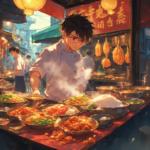
One humid Tuesday, her grandmother, Wan, placed a plate of Nasi Kerabu in front of her. It was a masterpiece. The rice was stained a deep, brilliant indigo from butterfly pea flowers. Surrounding the blue mound was a garden of finely shredded herbs: daun kesum, wild ginger buds, crunchy bean sprouts, and salted egg.
“Eat, Aisyah,” Wan said, her voice like crinkling paper. “Don’t just stare at it until it gets cold. Nanti kempunan (otherwise you’ll crave it forever).”
Aisyah picked up her spoon, but then she paused. She looked at the way the toasted coconut (kerisik) was sprinkled. It wasn’t scattered randomly. It formed a thin, straight line leading from the blue rice to a small pile of ulam (herbs).
“Wan,” Aisyah whispered, squinting. “Did you put the salted egg on the left today? You usually put it at the top.”
Wan just winked, her eyes twinkling behind thick glasses. “Sometimes the ingredients tell their own story, Cucu. Look closer.”
Aisyah tilted her head. If she connected the dots of the chopped long beans and followed the curve of the blue rice, it looked exactly like the floor plan of Istana Lama, the big, creaky wooden mansion at the end of their street that had been turned into a museum.
But there was one detail that shouldn’t be there. A tiny, bright red piece of chili was tucked deep inside the blue rice, like a “You Are Here” marker.
“This isn’t lunch,” Aisyah gasped. “It’s a map!”
The Haunted Mansion
Aisyah grabbed her bicycle. “I’m going to the library, Wan!”
“Don’t be back late! Hujan nak turun (It’s going to rain)!” Wan called out, though she was smiling.
Aisyah didn’t go to the library. She pedaled furiously toward Istana Lama. The mansion was a grand, dark-timbered building with intricate carvings of flowers and vines. It was said to have belonged to a wealthy merchant who vanished decades ago, leaving behind a legendary “Blue Diamond of the Coast.”
She entered the museum, her sandals clicking on the polished floorboards. The place was empty except for a sleepy guard named Pak Abu, who was nodding off in a plastic chair.
Aisyah pulled out a drawing she had quickly made of her Nasi Kerabu plate. She followed the “rice path.” In the mansion, the blue rice represented the grand central hall. The salted egg was the ticket counter. The shredded herbs were the garden corridors.
And the red chili? It was located in the Store Room under the Stairs.
Aisyah crept past Pak Abu. The air inside the mansion felt heavy and smelled of old wood and beeswax. She reached the small door under the grand staircase. It was locked with a heavy iron latch.
“Alamak,” she muttered. “Now what?”
Suddenly, she remembered the side of her plate. Wan had placed three small crackers (keropok) in a specific pattern: vertical, horizontal, vertical.
Aisyah looked at the door latch. It wasn’t a keyhole. It was a sliding puzzle—a traditional wooden lock. She moved the wooden bits: up, across, up.
CLICK.
The door creaked open.
The Secret Chamber
Inside was pitch black. Aisyah pulled out her small torchlight. The beam cut through the dust motes, revealing stacks of old newspapers and broken chairs. But in the center of the room sat an old wooden chest, carved with the same butterfly pea flower pattern as her rice.
She opened the chest. Her heart was thumping like a drum.
Inside wasn’t gold or diamonds. Instead, there was a stack of old letters tied with a blue ribbon and a small, hand-painted ceramic bowl filled with dried butterfly pea flowers.
Aisyah picked up the top letter. It was dated 1950.
“To my dearest sister, the secret to our family’s happiness isn’t in the wealth we keep, but in the flavors we share. The ‘Blue Treasure’ is the recipe that saved our village during the hard years. Keep the map alive in the rice, so we never forget where we came from.”
Aisyah realized then—the “Blue Diamond” wasn’t a stone. It was the specific, secret blend of herbs and the technique to make the perfect Nasi Kerabu that had kept their family business alive for generations.
“Checking my homework, are you?”
Aisyah jumped, nearly dropping her torch. Wan was standing in the doorway, leaning on her cane.
“Wan! You followed me?”
“I walked. You took the bike, so I had to take the bus,” Wan laughed softly. “You have a detective’s eye, Aisyah. This mansion used to be our family home. When things got difficult, we turned it into a museum to share our history, but I wanted to see if you were ready to learn the real secret.”
Wan reached into the chest and pulled out a small, leather-bound book. “This is the original recipe. The one with the 20-herb blend. No one else has it. It’s the treasure of our family.”
The New Legend
Aisyah looked at the old book, then at her grandmother. She felt a surge of pride. She wasn’t just a detective; she was the keeper of a legacy.
“So,” Aisyah said, grinning. “Does this mean I get to help in the kitchen tomorrow?”
Wan patted her cheek. “Only if you can slice the daun kunyit as thin as hair. No thick pieces, or the map will be wrong!”
As they walked out of the mansion, the rain began to fall—a warm, tropical drizzle. Aisyah looked back at the old house. It didn’t look scary anymore. It looked like a giant puzzle box, and she was the one who held the key.
From that day on, the Nasi Kerabu at Wan’s stall tasted even better. People came from all over Malaysia to try the “Mystery Rice.” And if you looked closely at your plate, you might just find a secret message hidden in the herbs, waiting for the next young detective to find it.
Share this story, Spread the joy or reading
Other Interesting Stories:
Project D: The Spiky Space Capsule In a future Kuala Lumpur where the Twin Towers function as a galactic docking station, twelve-year-old scientist Aisyah discovers that the powerful smell of durian releases unique energy particles capable…
The Penang Sentral Food Court’s Friendship Feast In the lively heart of George Town, Penang, a bustling food court becomes the backdrop for an extraordinary journey of connection as children from diverse cultural backgrounds—Malay, Chinese, Indian, Korean,…
The Last Firefly of Taman Tasik Perdana In the heart of bustling Kuala Lumpur, 11-year-old Amirah discovers the last fading firefly in Taman Tasik Perdana — a fragile beacon of a forgotten natural magic. Refusing to let…
The Last Boat to Kukup Fishing Village "The Last Boat to Kukup Fishing Village" follows Mei-Mei, a city girl initially resistant to spending her summer with relatives in a unique stilted fishing village. Through daily chores, traditional…
Secret of the Silver Compass In the coastal town of Seabrook, eleven-year-old Junie Bellweather is heartbroken when her best friend, Leo Chen, stops speaking to her after a beloved kite is destroyed. Her wise grandfather…
The Gurney Drive Hawker Stalls’ Midnight Feast In the heart of Penang, a disillusioned young chef named Eddy returns home only to stumble upon a mystical trail of clues hidden within the city’s hawker stalls, leading him…
This mode enables people with epilepsy to use the website safely by eliminating the risk of seizures that result from flashing or blinking animations and risky color combinations.
Visually Impaired Mode
Improves website's visuals
This mode adjusts the website for the convenience of users with visual impairments such as Degrading Eyesight, Tunnel Vision, Cataract, Glaucoma, and others.
Cognitive Disability Mode
Helps to focus on specific content
This mode provides different assistive options to help users with cognitive impairments such as Dyslexia, Autism, CVA, and others, to focus on the essential elements of the website more easily.
ADHD Friendly Mode
Reduces distractions and improve focus
This mode helps users with ADHD and Neurodevelopmental disorders to read, browse, and focus on the main website elements more easily while significantly reducing distractions.
Blindness Mode
Allows using the site with your screen-reader
This mode configures the website to be compatible with screen-readers such as JAWS, NVDA, VoiceOver, and TalkBack. A screen-reader is software for blind users that is installed on a computer and smartphone, and websites must be compatible with it.