Xiao-Ming’s summer started with a long, twisty bus ride that made his stomach feel funny. He left behind the loud scooters and tall buildings of Taipei for a place where the air smelled like wet soil and old trees. His mom said, “You go stay with your Ah-Gong (grandfather). It’ll be good for you.” But Xiao-Ming thought it would be boring.
Ah-Gong lived in a small wooden house near the Alishan forest railway station. He was a small, tough man with a face full of wrinkles that looked like a map of the mountain paths. He used to drive the little red train that chugged up the mountain, the one all the tourists took to see the sunrise. Now he was retired.
The first morning, Ah-Gong woke Xiao-Ming up when it was still dark outside. “Kín khí-lâi! (Hurry up and get up!)” he said, his voice rough. “The sun won’t wait for a lazy city kid.”
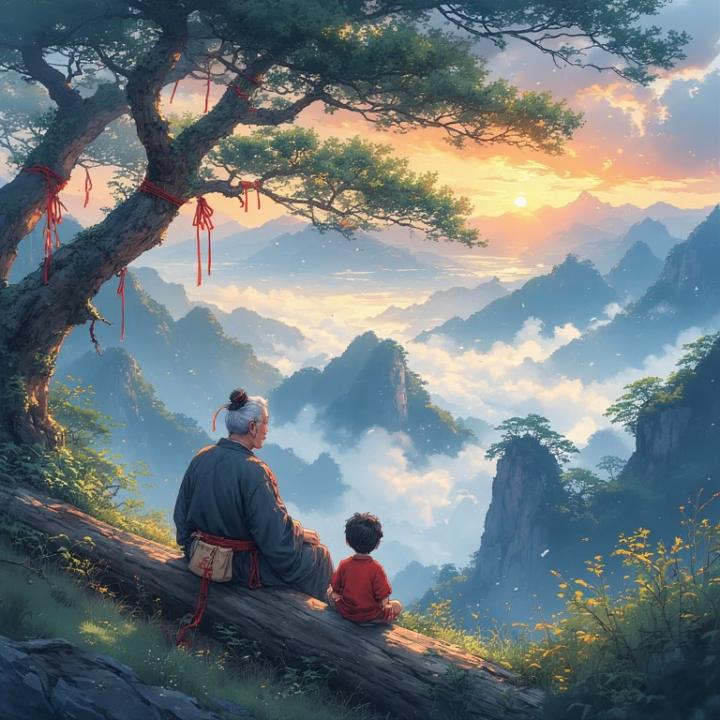
They walked in the cool, quiet darkness. It wasn’t like the city’s dark. This dark was alive with the sounds of insects and dripping water. They didn’t go to the big viewing platform with all the tourists. Instead, Ah-Gong led him down a narrow, mossy path to a small, quiet clearing. Below them, a huge, soft blanket of white clouds stretched out forever—the “Sea of Clouds.”
“We wait,” Ah-Gong said simply, sitting on a old log.
Xiao-Ming fidgeted. He checked his phone—no signal. “How long, Ah-Gong?”
“As long as it takes. Sunrise isn’t a 7-Eleven, heh? Not open all hours. You have to thàn (earn) it.”
So they waited. As the sky changed from black to deep blue, then to purple and pink, Xiao-Ming slowly stopped feeling itchy to leave. It was… peaceful. Then, a tiny sliver of gold peeked over the distant mountains. It painted the sea of clouds in brilliant orange and red. The ancient cypress trees around them, some thousands of years old, seemed to stand taller, their twisted shapes turning from shadows into guardians. Xiao-Ming forgot to breathe. It was the most beautiful thing he’d ever seen.
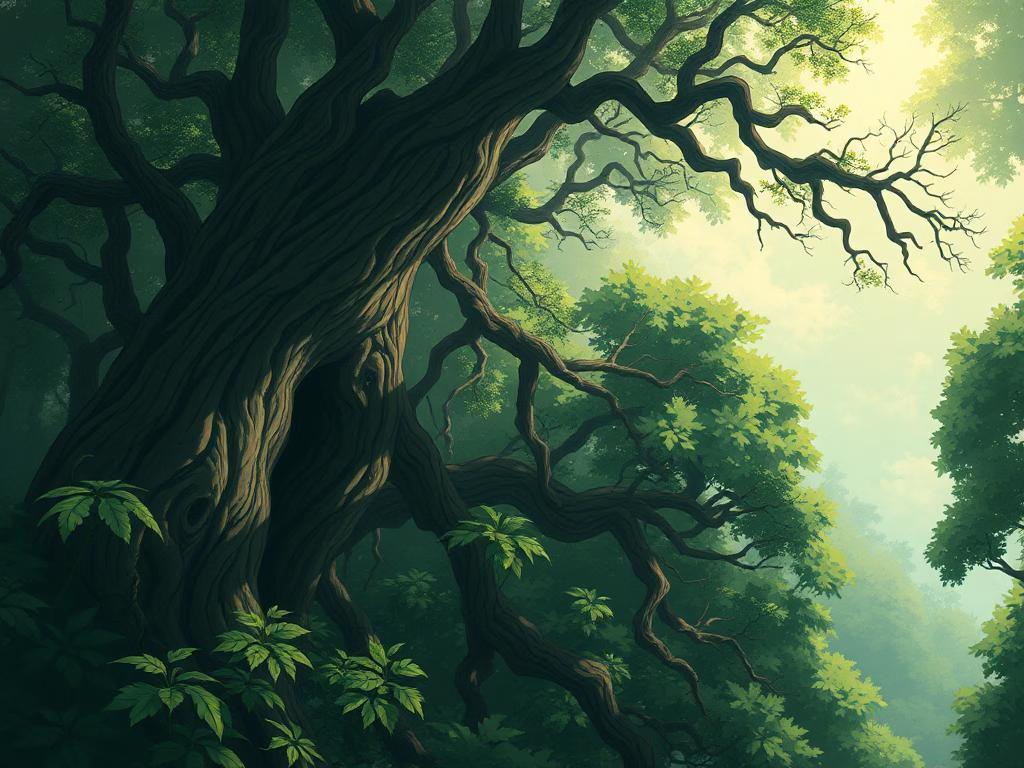
That was their new routine. Every morning, they’d hike to the clearing. Ah-Gong didn’t talk much, but he pointed things out. He showed Xiao-Ming the “Sacred Tree,” a giant red cypress that had lived for three thousand years. “See its branches?” Ah-Gong said, touching the thick bark gently. “They tell stories of storms survived. This tree was here before your great-great-great-great Ah-Gong. We are just its guests.”
One day, on their walk back, they saw something that made Ah-Gong’s happy face disappear. On a younger cypress tree near the path, someone had used a knife to carve a big heart with initials inside. “Ùi-siáⁿ-mi̍h! (Why!?)” Ah-Gong growled. His old hands trembled as he touched the wound in the bark. “This isn’t a notebook. This is its skin. Now sickness can get in.”
That afternoon, instead of napping, Ah-Gong mixed a special paste from herbs and minerals. He brought Xiao-Ming back to the wounded tree and carefully applied it to the carving. “We can’t undo the stupid,” Ah-Gong said, “but we can try to help it heal. Protecting them isn’t just about big rules. It’s about small cares.”
Xiao-Ming started to see the forest differently. It wasn’t just a pretty view. It was a living, breathing home. He learned the Taiwanese names for birds from their calls. He helped Ah-Gong clear little drains on the paths so rain wouldn’t erode the soil around the old trees. He even started to recognize some of the giant cypresses personally, giving them silly nicknames in his head.
The big challenge came in the middle of summer. A group of loud teenagers from the city came to camp. Xiao-Ming saw them one evening, and they had cans of spray paint. He heard them talking about “leaving a mark” on the “old tree by the sunrise spot.”
His heart pounded. That was their tree, the one with the branch that looked like a dragon. He ran home, his chest tight. “Ah-Gong! Some bad kids are going to paint on the trees!”
Ah-Gong’s eyes got hard. He stood up. “We go.”
“Shouldn’t we call the ranger?” Xiao-Ming asked, a little scared.
“No time. The tree needs us now.”
They hurried through the twilight forest. When they reached the clearing, the teens were there, laughing, a can of red paint in one boy’s hand, aimed at the dragon-branch tree.
“Tíng! (Stop!)” Ah-Gong’s voice wasn’t loud, but it was sharp as a knife, cutting through the laughter. Everyone froze. He walked forward, looking small but mighty like an ancient tree root. “What do you think you’re doing?”
“Just having fun, old man,” the leader said, trying to sound tough.
“Fun?” Ah-Gong stepped closer. “This tree was a seedling when Koxinga was on this island. It has seen more years than all your families put together. And you want to give it a graffiti mustache? Li bô siáⁿ béh (You have no respect).”
Xiao-Ming felt a surge of courage. He stepped beside Ah-Gong. “Yeah! This isn’t your city wall. This… this is our ancestor. If you hurt it, you hurt everyone who comes to see its beauty tomorrow.”
The teenagers looked at the old man’s fierce eyes, at the determined city kid, and then at the huge, silent tree towering over them. It suddenly didn’t seem like “just a tree.” It felt powerful and old. The boy with the paint slowly lowered his arm. Muttering, the group packed up and left.
Ah-Gong put a hand on Xiao-Ming’s shoulder. His grip was strong. “Lí chin gâu. (You did well.) You spoke not just for the tree, but for the mountain.”
On the last morning of summer, Xiao-Ming and Ah-Gong went to their clearing one more time. They sat in their usual spot, waiting in comfortable silence. When the sunrise came, it wasn’t just colors to Xiao-Ming anymore. He saw the patience in the slow light. He saw the strength in the trees holding fast to the mountain. He felt the history in the clouds below.
“Ah-Gong,” he said softly. “I don’t want to leave.”
Ah-Gong smiled, his wrinkles deepening. “The mountain won’t leave. The trees will keep growing. And you,” he poked Xiao-Ming’s chest, “you take this sunrise inside you. The city needs people who know how to wait, and how to protect precious things. Now you are one of them.”
Xiao-Ming nodded. He wasn’t just a city kid anymore. He was a kid who had stood with the ancient trees. As the warm sun finally cleared the peaks, he knew this sunrise was just the beginning. He had earned it.
Share this story, Spread the joy or reading
Other Interesting Stories:
The Secret of the Silvered Leaf A group of friends – Mika, Siti, Raj, and Mei Lin – on a nature camp in the Selangor forest, discover a mysterious encoded message hidden within the unique "Crown…
The Paperweight Heart In a quiet Malaysian village, a young girl named Yana discovers a strange weight in her chest that appears whenever she feels overwhelmed. As she tries to escape it, she…
The Pocketful of Tomorrow A young girl relocates to a new place carrying seeds from her old home, struggling to adapt while clinging to memories of where she came from. As she learns to…
Journey to the Forgotten Land The forest loomed overhead, a tangle of twisted branches and thick foliage that seemed to swallow the light. Anna paused, brushing a strand of hair from her face, her heart…
Footprints at Low Tide After her mother returns from Singapore emotionally distant and silent, eleven-year-old Emma begins walking the Teluk Duyung shoreline each evening, collecting seashells and uncovering mysterious notes left behind years ago…
The Shared Umbrella When a mysterious umbrella begins to expand every time someone steps beneath it, a group of students and strangers are drawn together during a heavy rainstorm in a small neighborhood.…
This mode enables people with epilepsy to use the website safely by eliminating the risk of seizures that result from flashing or blinking animations and risky color combinations.
Visually Impaired Mode
Improves website's visuals
This mode adjusts the website for the convenience of users with visual impairments such as Degrading Eyesight, Tunnel Vision, Cataract, Glaucoma, and others.
Cognitive Disability Mode
Helps to focus on specific content
This mode provides different assistive options to help users with cognitive impairments such as Dyslexia, Autism, CVA, and others, to focus on the essential elements of the website more easily.
ADHD Friendly Mode
Reduces distractions and improve focus
This mode helps users with ADHD and Neurodevelopmental disorders to read, browse, and focus on the main website elements more easily while significantly reducing distractions.
Blindness Mode
Allows using the site with your screen-reader
This mode configures the website to be compatible with screen-readers such as JAWS, NVDA, VoiceOver, and TalkBack. A screen-reader is software for blind users that is installed on a computer and smartphone, and websites must be compatible with it.