Sophie Kauri kicked at a bit of driftwood. It skittered across the wet sand of Koekohe Beach, making a sad little scratchy sound that fit her mood perfectly. She stuffed her hands deeper into the pockets of her puffer jacket. Otago was proper cold, not like the muggy Auckland heat she was used to. Behind her, the new house – well, new to them, a tired old villa in Hampden – felt like a stranger’s place. Boxes everywhere, Dad trying to be cheerful, Mum looking tired. So Sophie had mumbled something about “going for a look” and walked the track down to the famous boulders.
“Famous,” she muttered to a seagull. “Big round rocks. Choice.”
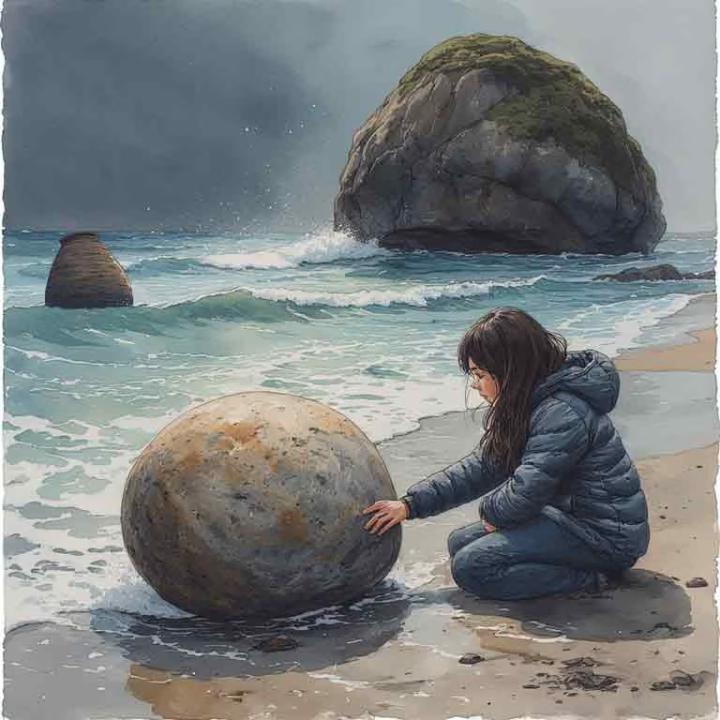
But as she rounded the headland, she stopped. They weren’t just rocks. They were… aliens. Giants’ marbles. Huge, heavy spheres, some split open like cracked eggs, just sitting there in the sand and the shallows as if they’d fallen from the sky. The Māori legend, the sign at the carpark said, was that they were the kumara (sweet potato) baskets and eel pots from the great canoe Arai-te-uru that wrecked here ages ago. Sophie liked that story better than the science one about concretions and mud and millions of years. Baskets from a wreck felt familiar.
The tide was on its way out, leaving glossy, dark mirrors around the base of the biggest stones. The air smelled of salt and kelp and something ancient. Sophie plonked herself down in the sand, her back against one of the smaller, dryer boulders. It was surprisingly warm, like it had been soaking up the weak winter sun.
She closed her eyes, thinking about her best mate, Zoe, back in Auckland. They were probably at the mall right now, getting smoothies, without her. A hard lump formed in her throat.
Then she felt it. A faint, deep vibration, like the lowest note on the school piano played very softly. Hmmmmmm.
She snapped her eyes open. The sound wasn’t in the air; it was in the rock. She pressed her palm flat against its rough, rust-coloured surface. Hmmmmm.
Out in the water, a gentle wave washed over the base of a half-submerged boulder. As the foamy water swirled around it, the hum deepened, and for a split second, Sophie didn’t just hear it—she saw it. A flicker of colour, a glimpse of a woven flax basket, enormous, bobbing in wild, green water.
She yanked her hand back. “Yeah, nah,” she said aloud, her breath a white cloud. “I’m cracking up. Too much moving-house stress.”
But the beach seemed to hold its breath. The gulls were quiet. Another wave came, a bit stronger this time, and slid up the sand to touch the boulder beside hers. The hum came again, a chorus now from two stones. This time, images flashed behind her eyes, clear as day: not a wreck, but a landing. People, tired but smiling, pulling a massive, graceful waka high onto a beach further north. The relief on their faces was a physical warmth. They’d made it.
Sophie’s heart thumped. She wasn’t scared, she realised. She was… curious. The stones felt lonely. Like they had stories stuck inside them and the seawater was the key.
“Alright,” she whispered to the closest boulder. “What’s your story then?”
She stood up, brushing sand off her jeans, and walked to the water’s edge. The freezing sea soaked her trainers instantly, making her gasp. She placed both hands on a boulder that was regularly washed by the waves. She shut her eyes.
Whoosh.
This story wasn’t warm. It was cold and desperate. The hum was a mournful drone. She saw the great canoe, the Arai-te-uru, being thrown by a storm. The baskets, heavy with precious kumara and finely woven eel pots, were ripped from the lashings and tossed overboard. They didn’t sink. They rolled in the furious surf, tumbling towards the shore, where they settled and grew heavy with time, turning to stone. The grief of the loss was in the stone – the lost food, the lost hope.
Sophie pulled away, her fingers numb. She understood loss. She felt a weird connection to this grumpy, sunken boulder. “That’s rough,” she said softly.
Over the next hour, Sophie worked her way around the beach like a librarian visiting different shelves. Each boulder had its own mood, its own fragment of memory, unlocked by the touch of the sea.
One small, smooth stone near the cliffs sang a happy, bubbling tune. Its memory was of playful kids, centuries ago, using it as a backrest while an elder told stories of Maui fishing up the North Island. Sophie felt the joy of that, the simple comfort of family and tale-telling.
Another, a huge one cracked clean in half, held a quieter, deeper wisdom. Its hum was the sound of the deep ocean, patient and slow. It showed her the land itself changing, rivers shifting, cliffs wearing down, and the boulders slowly, slowly emerging from the mud. It was a story of slow change, of things taking the time they need.
Sophie sat between the two halves of the cracked boulder, feeling like she was in a giant stone book. The frantic worry about her new school, the anger at her parents for moving, the ache for her old friends… it all started to feel smaller. Not gone, but smaller. These stones had seen storms. They’d seen landings and wrecks, centuries passing. Her moving from Auckland to Otago was just a tiny, tiny ripple.
A voice broke her thoughts. “Getting the full tour, are ya?”
Sophie jumped. An older Māori man was standing a few metres away, a woven kit bag over his shoulder. He had a kind, weathered face and eyes that crinkled at the corners.
“Sorry,” Sophie stammered. “I wasn’t doing anything…”
“Hearing the stories,” he said, not as a question. He nodded towards the boulders. “Our tūpuna, our ancestors, said the stones remember. The salt water wakes the memories up. Most people just take photos.” He looked at her sogggy shoes. “You’re listening.”
“I’m Sophie,” she said.
“Tama,” he replied. He walked over and patted the cracked boulder like it was an old dog. “This one’s the wise one. Doesn’t say much, but what it says counts, eh?”
“It showed me… time. How slow it can be.”
Tama smiled. “Good lesson. Nothing good rushes. Not the forming of stones, not the settling of a person in a new place.” He glanced at her. “You’re new.”
“How’d you know?”
“You’ve got that ‘lost pigeon’ look. And I saw your dad’s ute in Hampden with the Auckland rego. Big move.”
Sophie nodded, the lump back in her throat. “I hate it. It’s cold. I don’t know anyone. It’s… it’s a wreck.”
Tama chuckled, a sound like rolling pebbles. “A wreck? Maybe. The Arai-te-uru was a wreck too. But from that wreck came these.” He gestured to all the boulders. “And from these stones come stories that help people. Maybe your wreck is just the start of a new story. You’ve just got to let the tide touch it.”
He reached into his kit bag and pulled out a small, smooth, perfectly round pebble. It wasn’t a Moeraki boulder, but it looked similar. “Here. A pocket-sized one. For when you feel untethered. Remember the stories. The happy, the sad, the slow, and the patient. They’re all in here.”
Sophie took the pebble. It was warm. “Thank you, Mr. Tama.”
“Just Tama. Now, you’d better head back before your folks think the taniwha got you. The stories will still be here tomorrow.”
Sophie walked back along the beach track, the pebble a comforting weight in her pocket. The house still looked tired when she saw it, but now it looked like it was waiting, not judging.
That night, after a dinner of slightly-burned sausages (the oven was dodgy), Sophie didn’t retreat to her room. She sat in the lounge with a box labelled “Sophie’s Stuff.”
“Need a hand, love?” her mum asked, surprised.
“Yeah, maybe,” Sophie said. She pulled out a photo of her and Zoe, laughing. She didn’t put it on the bedside table. She propped it up on the mantlepiece, right in the middle. A piece of her old story, right in the heart of the new one.
Later, in bed, she held Tama’s pebble. Outside, she could faintly hear the distant rush of the tide. She imagined it washing over the boulders, waking their dreams. She thought of the wreck, the landing, the kids laughing, the slow patience of the earth.
Her own worries didn’t feel like a storm anymore. They felt like baskets washed ashore. Heavy, maybe. Different. But containing something that could, with time, become solid. Become part of a new landscape.
She fell asleep with the faint, imagined hum of stone in her ears, and for the first time since the move, she didn’t dream of Auckland. She dreamed of a calm sea, and round, quiet stones holding all the time in the world.
Share this story, Spread the joy or reading
Other Interesting Stories:
Beyond the Break at Waikiki A shy twelve-year-old named Kai spends his afternoons at Waikiki Beach, keeping safely near the shore until he befriends Kimo, a retired lifeguard who teaches him that waves carry history,…
The Silver Locket of the Sound Maia, a 12-year-old girl on a school trip to the breathtaking Milford Sound, discovers an ancient silver locket hidden near a waterfall. Along with her friend Jun-Ho, she embarks on…
The Guard of the Golden Sands In Penang's bustling Batu Ferringhi, four schoolfriends—Bibi, Ahmad, Sangeeta, and Ming—form a secret society to protect a clutch of endangered green turtle eggs from the encroaching night market. After the…
Midnight at the Museum After getting accidentally locked inside Te Papa Tongarewa following a late-night visit, siblings Ben and Marama must navigate a series of hilarious and nerve-wracking obstacles—including the infamous earthquake house and…
The Great Sand Dune Escape The Great Sand Dune Escape is a gripping tale set in the iconic White Sand Dunes of Mui Ne, following a talented young boy named Dung who is determined to…
The Paperweight Heart In a quiet Malaysian village, a young girl named Yana discovers a strange weight in her chest that appears whenever she feels overwhelmed. As she tries to escape it, she…
This mode enables people with epilepsy to use the website safely by eliminating the risk of seizures that result from flashing or blinking animations and risky color combinations.
Visually Impaired Mode
Improves website's visuals
This mode adjusts the website for the convenience of users with visual impairments such as Degrading Eyesight, Tunnel Vision, Cataract, Glaucoma, and others.
Cognitive Disability Mode
Helps to focus on specific content
This mode provides different assistive options to help users with cognitive impairments such as Dyslexia, Autism, CVA, and others, to focus on the essential elements of the website more easily.
ADHD Friendly Mode
Reduces distractions and improve focus
This mode helps users with ADHD and Neurodevelopmental disorders to read, browse, and focus on the main website elements more easily while significantly reducing distractions.
Blindness Mode
Allows using the site with your screen-reader
This mode configures the website to be compatible with screen-readers such as JAWS, NVDA, VoiceOver, and TalkBack. A screen-reader is software for blind users that is installed on a computer and smartphone, and websites must be compatible with it.