It was the first week of summer holidays, and Chloe Te Whare couldn’t wait to get back to her favourite spot—Lake Wānaka, right by that lone tree sticking out of the water like it owned the whole lake. She’d been coming here every year since she was six, ever since Koro (that’s her grandad) brought her for the first time. “That tree’s seen more sunrises than most of us,” he’d said, his voice soft like the lapping waves. “It’s got stories in its roots.”
Chloe always took a photo of the tree on the same day—December 15th. Same angle, same lens, same quiet moment before the tourists showed up with their selfie sticks and loud voices. It wasn’t just a photo; it was a promise. A way to say, “I’m still here, and so are you.”
But this year, something was wrong.
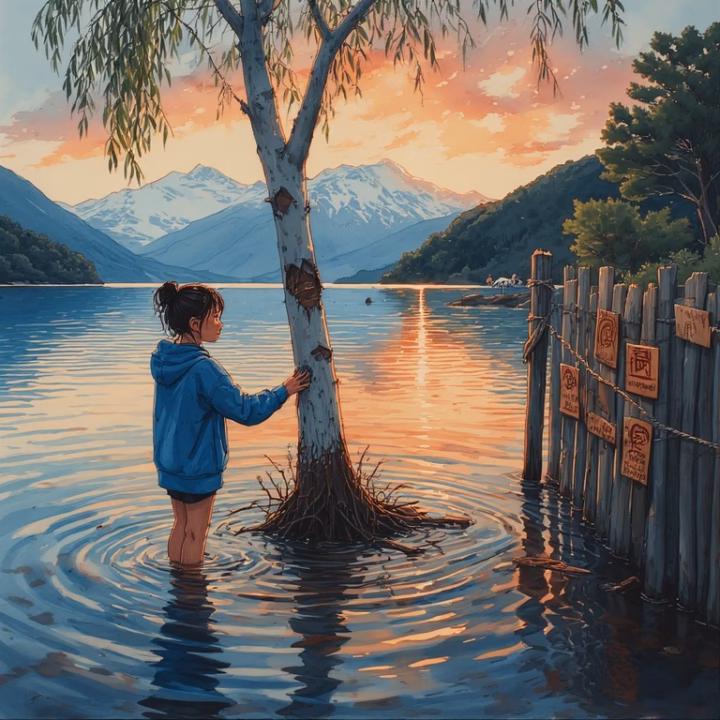
She crouched on the rocky shore, camera in hand, heart thumping like a trapped tūī. The tree… it looked broken. One of its big branches hung low in the water, snapped clean off. Bark was scraped raw near the base, and muddy footprints trailed right up to it—boot prints, not bare feet. Someone had climbed it. Or worse, pushed a boat too close.
“No way,” she whispered, her throat tight. She zoomed in on the damage. The willow’s leaves drooped like it was tired. Sad.
“Chloe?” Her best mate, Tama, came crunching over the gravel behind her, munching on a pineapple lump. “You alright? You look like you’ve seen a taniwha.”
“It’s the tree,” she said, not looking up. “Someone’s wrecked it.”
Tama squinted. “Aw, bro. That’s rough.” He sat beside her, legs dangling over the edge. “Tourists reckon it’s just a photo op. They don’t get that it’s… special.”
Chloe nodded. Everyone knew the tree. It was famous—on postcards, Instagram, even in travel mags overseas. But for locals like her, it was more than a backdrop. It was part of the whenua—the land. Part of them.
That night, over kai at her nan’s place (steamed fish, kūmara mash, and fresh bread), Chloe couldn’t stop thinking about it. Nan noticed.
“You’re quiet tonight, moko,” she said, stirring her tea.
“The tree’s hurt,” Chloe said. “And no one’s doing anything.”
Nan leaned forward, her eyes sharp but kind. “Then maybe someone should.”
Chloe blinked. “Like who?”
“Like you.”
The next morning, Chloe didn’t go to the lake. She went to the library instead. She printed photos—her yearly shots of the tree, side by side. Six years of growth, of seasons changing, of quiet strength. Then she added a new one: the broken branch, the scuff marks, the lonely look in its leaves.
She made posters. Big ones. Bright green paper, bold black letters:
“This tree can’t speak. But we can.” “Protect Our Pōhutukawa Sister”(Okay, so it was a willow—but everyone called it “the pōhutukawa of the south” because it stood alone like one.) “No climbing. No boats too close. Just respect.”
She stuck them up at the dairy, the school noticeboard, the i-SITE, even the bakery (Mrs. Patel let her tape one near the pies). She asked Mr. Hohaia, her science teacher, if she could talk to the whole school at assembly.
He raised an eyebrow. “You sure, Chloe? Whole school?”
“Yeah,” she said, chin up. “They need to know.”
On Friday, she stood on the stage in front of two hundred kids, some yawning, some fiddling with their ties. Her hands shook, but she held up her photo series.
“This tree’s been here longer than any of us,” she said, voice steadier than she felt. “It’s not just pretty—it’s part of Wānaka’s heart. And last week, someone broke it. Not on purpose, maybe. But it happened because people treat it like a toy, not a taonga—a treasure.”
She paused. “So I’m starting a project. We’re gonna build a little fence—not to keep people away, but to give the tree space to heal. And we’re gonna put up signs that tell its story. Not just ‘don’t climb,’ but ‘this tree has watched over our lake for decades. Please look after it.’”
Silence. Then Leo from Year 8 yelled, “Sweet! Can I help hammer stuff?”
Laughter rippled through the hall. But then hands went up. Dozens of them.
By Monday, Chloe had a team. Tama brought his dad’s old toolbox. Aroha from Year 7 designed the signs with Māori phrases woven in: Kia whakatōpū tātou—Let us stand together. Mateo and his cousins offered to carry wood. Even grumpy old Mr. Finch from down the road showed up with a thermos of soup and said, “My nana used to picnic under that tree. Count me in.”
They met every afternoon after school. Chloe’s mum brought sandwiches. Nan taught them how to weave flax strips for decorative borders on the signs. They used recycled timber—old fence palings, driftwood smoothed by the lake—and painted everything with eco-friendly paint.
One day, while they were measuring where to place the posts, a tourist family wandered over.
“Can we take a photo with you lot?” the dad asked, holding up his phone.
Chloe hesitated. Then she smiled. “Sure. But after, can you read our sign? And maybe tell your friends back home why this tree matters?”
The man nodded slowly. “Yeah. Yeah, we can do that.”
Word spread. A local news crew came. Not the big-city kind—just Sam from Lakeside FM with a mic and a friendly smile. He interviewed Chloe while she sanded a post.
“So what made you step up?” he asked.
She thought about Koro, about Nan’s words, about how the tree looked like it was crying into the lake.
“I guess… someone had to care enough to try,” she said simply.
The story aired that weekend. By Monday, donations poured in—$20 from a café, $50 from a hiking group, even a box of native plant seedlings from a nursery in Queenstown. The council sent a letter saying they’d install permanent mooring buoys further out so boats wouldn’t drift close anymore.
And the fence? It wasn’t fancy. Just waist-high posts linked by rope, with carved signs hanging between them. But it worked. People stopped right at the edge. They read the signs. Some even left little offerings—a smooth stone, a feather, a handwritten note that said thank you.
On the last day of the project, Chloe stood alone by the lake again. Sunset painted the sky pink and gold, and the tree stood tall in the calm water, its reflection perfect except for that one missing branch.
But new shoots were already growing.
She took her photo—December 15th, like always. This time, the frame included the rope fence, the carved sign, and Tama’s dog, Rua, sitting proudly like he’d helped build it all.
Back home, she printed it and added it to her wall. Six photos. Six years. One tree. One town. One girl who cared enough to speak up.
And as the stars blinked awake over the Southern Alps, Chloe whispered, “We’ve got your back, old friend.”
Share this story, Spread the joy or reading
Other Interesting Stories:
Sakura Petals on the Moat During the peak of cherry blossom season at Tokyo’s Chidorigafuchi Park, childhood friends Kenji and Aiko share a poignant final afternoon rowing through a moat blanketed in pink petals before…
When the Screens Went Asleep When every digital screen in Kampung Seri Paya mysteriously falls asleep at the same time, a curious boy and his friends uncover a hidden magical grove where old technology rests…
Eddy and the Portal to Pirate Cove Eddy stood at the edge of the old pier, his sneakers scuffing against the weathered planks as he peered into the turbulent waters of Taiping Lake. The sun dipped low…
Secret of the Silver Compass In the coastal town of Seabrook, eleven-year-old Junie Bellweather is heartbroken when her best friend, Leo Chen, stops speaking to her after a beloved kite is destroyed. Her wise grandfather…
A Journey on the Melaka River Cruise This slice-of-life story follows Jali, a young boy working on the Melaka River Cruise during his school holidays. Through his interactions with diverse passengers like the wise Uncle Tan and…
The Owl Who Was Scared of the Dark Aru, an owl who prefers daylight and fears the dark, is unexpectedly chosen to guide a forest festival during a stormy night. Struggling with his fear, he learns to rely…
This mode enables people with epilepsy to use the website safely by eliminating the risk of seizures that result from flashing or blinking animations and risky color combinations.
Visually Impaired Mode
Improves website's visuals
This mode adjusts the website for the convenience of users with visual impairments such as Degrading Eyesight, Tunnel Vision, Cataract, Glaucoma, and others.
Cognitive Disability Mode
Helps to focus on specific content
This mode provides different assistive options to help users with cognitive impairments such as Dyslexia, Autism, CVA, and others, to focus on the essential elements of the website more easily.
ADHD Friendly Mode
Reduces distractions and improve focus
This mode helps users with ADHD and Neurodevelopmental disorders to read, browse, and focus on the main website elements more easily while significantly reducing distractions.
Blindness Mode
Allows using the site with your screen-reader
This mode configures the website to be compatible with screen-readers such as JAWS, NVDA, VoiceOver, and TalkBack. A screen-reader is software for blind users that is installed on a computer and smartphone, and websites must be compatible with it.