Chapter 1: Merdeka Day
The first thing Aiman noticed that morning was that the village sounded different.
Usually, Kampung Kuantan woke up slowly.
Roosters complained from behind wooden fences. Motorbikes coughed themselves awake. Auntie Salmah’s metal gate squeaked every morning at exactly seven, as if it had a personal grudge against the whole neighbourhood.
But on 30th August, the village was already buzzing before sunrise.
Aiman sat cross-legged on the front steps of his grandmother’s house, tying a strip of yellow-and-black ribbon around a bamboo pole.
“Eh, Aiman!” shouted his best friend Faris from across the lane. “You tying ribbon or building a sarong?”
Aiman looked at the crooked ribbon in his hands.
“Very funny.”
“I’m serious. That thing looks like it has surrendered.”
Faris jogged over, carrying three small paper flags and a packet of fried banana fritters.
Behind him came Mei Lin, balancing a cardboard box on her hip.
“Morning!” she called. “Where’s the decoration team?”
Aiman pointed at himself.
“Here.”
Mei Lin raised an eyebrow.
“Decoration team of one?”
“For now.”
Faris popped a fritter into his mouth.
“Actually, I’m the food department.”
“You appointed yourself,” said Mei Lin.
“Leadership is about recognising your strengths.”
“Your strength is eating.”
“Exactly.”
Aiman laughed.
Their village was preparing for its annual Merdeka celebration, and this year everyone seemed determined to make it special.
The celebration would take place on the evening of 31 August at the old community field beside the small river. There would be lanterns, traditional games, food stalls, a children’s performance, storytelling, singing, and a giant picnic where everyone brought something to share.
The adults had been planning it for weeks.
But the children had their own plan.
They wanted to make it the best Merdeka ever.
Not the biggest.
Not the loudest.
Just the kind of celebration people would remember.
Aiman had even written the words on a piece of cardboard:
OUR BEST MERDEKA EVER — KAMPUNG KUANTAN
Unfortunately, the cardboard was now lying underneath a chicken.
“Hey!” Aiman shouted.
The chicken stared at him.
Then it pecked the cardboard again.
Faris crouched down.
“Maybe it likes the slogan.”
“Get away from my sign!”
The three friends chased the chicken across the yard, laughing until Aiman’s grandmother came out of the kitchen.
Tok Wan Mariam stood in the doorway holding a tray of kuih.
She shook her head.
“Three children against one chicken.”
“It started it,” Aiman said.
“Of course.”
Tok Wan smiled.
Then her eyes moved toward the old wooden storage shed at the side of the house.
Her smile faded slightly.
“Aiman,” she said. “After breakfast, can you help me clean the storeroom?”
Aiman groaned.
“Tok Wan…”
“No groaning. You are twelve years old. Twelve-year-olds are excellent at cleaning.”
“Who told you that?”
“Your grandfather.”
Aiman froze.
Tok Wan noticed.
She smiled gently.
“Come. There are some things in there your grandfather left behind.”
Aiman followed her.
The storeroom smelled of dust, dried pandan leaves and old wood. Sunlight slipped through the gaps between the boards.
At the back sat an old wooden trunk.
Aiman had seen it before but never opened it.
Tok Wan knelt beside it.
“Your grandfather kept many things here.”
Aiman lifted the lid.
Inside were bundles of old photographs, folded cloth, notebooks, handmade decorations, and little objects from village celebrations many years ago.
On top was a faded red-and-white paper lantern.
Aiman picked it up carefully.
“Did Tok Wan make this?”
“No.”
“Grandpa?”
She nodded.
“Many years ago.”
Aiman turned the lantern over.
There was something written on the bottom.
For the children who come after us.
He looked at Tok Wan.
“What does that mean?”
Tok Wan sat beside him.
“When your grandfather was young, the village celebration was very different. Everyone helped. Children made decorations. Neighbours cooked together. Older people told stories. Nobody cared whether their contribution was big or small.”
She touched the lantern.
“Your grandfather always said a celebration was not made by decorations.”
“Then what makes it?”
Tok Wan smiled.
“People.”
Aiman looked around the dusty storeroom.
Then he looked at the lantern.
An idea began to grow.
“Tok Wan…”
“Yes?”
“What if we use Grandpa’s things for this year’s celebration?”
Her eyes softened.
“I think he would like that.”
Chapter 2: The Impossible List
By lunchtime, Aiman, Faris and Mei Lin had created a list.
It was very ambitious.
Perhaps too ambitious.
They sat beneath the giant mango tree near the community hall.
Mei Lin held the notebook.
“Okay. Number one: decorate the field.”
“Easy,” said Faris.
“Number two: make a memory corner.”
“Nice.”
“Number three: collect old stories from villagers.”
Aiman nodded.
“Number four: organise traditional games for children.”
“Easy,” Faris repeated.
Mei Lin stared at him.
“You haven’t done anything yet.”
“I’m providing moral support.”
“Number five,” she continued, “make a giant lantern.”
Aiman raised his hand.
“I have an idea.”
Faris leaned closer.
“Please don’t say we need to climb the mango tree.”
“We need bamboo.”
Faris leaned back.
“I take back my support.”
They laughed.
But then Aiman noticed something.
At the bottom of the notebook, Mei Lin had written:
Number six: Make sure Tok Wan comes to the celebration.
Aiman stared at it.
“Why did you write that?”
Mei Lin shrugged.
“She helped with everything before. But lately she doesn’t go out much.”
Aiman knew what she meant.
Since Grandpa had passed away, Tok Wan Mariam had become quieter.
She still cooked.
Still watered the plants.
Still scolded Aiman for leaving his slippers upside down.
But sometimes Aiman caught her staring at the empty chair beside the dining table.
The celebration was supposed to be about the whole village.
Aiman wanted it to be about Tok Wan too.
He closed the notebook.
“Okay,” he said. “New rule.”
“What?”
“Everyone helps.”
Faris raised his hand.
“Even chickens?”
“Especially chickens.”
The next two days became a whirlwind.
Aiman and Faris collected bamboo from Uncle Rahman’s backyard.
Mei Lin gathered old photographs from villagers.
The children painted signs.
The adults prepared food.
Someone brought tables.
Someone else brought strings of lights.
The aunties argued cheerfully about where to put the dessert table.
The uncles argued about the best place for the games.
And the children ran everywhere.
Kampung Kuantan seemed to transform.
Old bicycles appeared.
Flower pots were moved.
Bamboo poles became decoration frames.
Empty wooden crates became seats.
Even the community hall’s faded curtains were washed and hung outside to dry.
But there was one problem.
The giant lantern.
Aiman had imagined something magnificent.
What they actually produced looked like a giant upside-down basket.
Faris stared at it.
“I think it’s beautiful.”
“You’re lying.”
“Yes.”
Mei Lin walked around it.
“We can fix it.”
“How?”
“More paper.”
“That is your solution to everything.”
“It works.”
They covered the bamboo frame with layers of coloured paper.
By sunset, it looked much better.
Then the wind arrived.
WHOOSH.
The lantern tilted.
“Grab it!” shouted Aiman.
Faris grabbed one side.
Mei Lin grabbed the other.
The three of them stumbled across the field while the giant lantern flapped above them.
“Why is this thing so heavy?” Faris yelled.
“Because you put too much paper!”
“You said more paper!”
“I didn’t say this much!”
They finally tied it securely to a bamboo frame.
Everyone stepped back.
The lantern glowed softly in the evening light.
Aiman smiled.
“Not bad.”
Faris nodded.
“Very not bad.”
Mei Lin pointed at the words painted across the bottom.
OUR BEST MERDEKA EVER
“Tomorrow,” she said.
Aiman looked toward the darkening sky.
“Tomorrow.”
Chapter 3: The Rain
The rain came the next morning.
Not gentle rain.
Not polite rain.
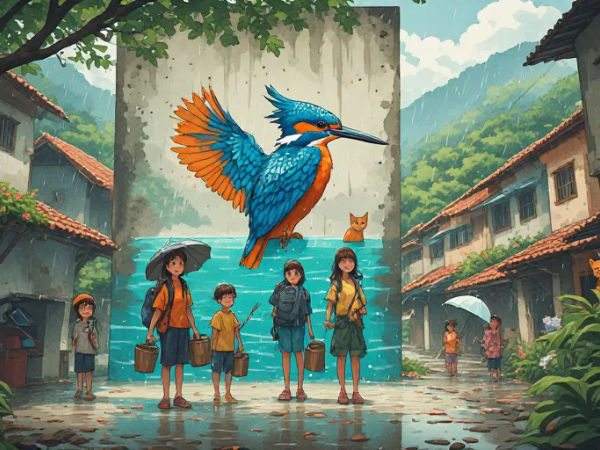
It came down like the sky had overturned an enormous bucket.
Aiman stood beneath the porch, staring at the village field.
Water rushed along the edges.
The decorations were soaked.
The paper signs sagged.
Several chairs had blown over.
And the giant lantern was lying on its side.
“Oh no.”
Faris arrived wearing a raincoat two sizes too big.
“Bad news.”
Aiman looked at him.
“I can see that.”
“The food tent collapsed.”
Aiman closed his eyes.
“What else?”
“The small stage is leaking.”
“Anything else?”
“The cat stole one of the ribbons.”
“That doesn’t count.”
“The cat thinks it counts.”
Mei Lin came running through the rain.
“Aiman!”
“What?”
“The river is rising.”
Everyone became quiet.
The field was beside the river.
If the rain continued, the celebration might have to be cancelled.
Aiman looked at the dark clouds.
“But tomorrow is Merdeka.”
“I know.”
“What are we going to do?”
Nobody answered.
Then Tok Wan appeared behind them.
She was carrying the old wooden trunk.
Aiman blinked.
“Tok Wan?”
She placed the trunk on the porch.
“Your grandfather used to say something whenever plans went wrong.”
“What?”
She smiled.
“Then make a new plan.”
Aiman looked at the trunk.
“What’s inside?”
“Maybe your answer.”
They opened it.
Inside were old notebooks.
Aiman picked one up.
It contained handwritten notes about past village celebrations.
There were drawings.
Lists.
Little maps.
Recipes.
Even sketches of decorations.
Then Aiman saw something.
A small map of the community field.
His grandfather had drawn the river, the hall, the trees and the old storage shed.
Beside the field he had written:
If rain comes, move everything here.
Aiman’s eyes widened.
“The community hall!”
Mei Lin understood.
“We can move the celebration inside.”
Faris pointed at the tiny hall.
“For everyone?”
“Not everyone,” Aiman said.
“Then where?”
Aiman studied the map.
“The covered walkway.”
Mei Lin’s eyes brightened.
“And the food tables can go under the awning.”
Faris nodded.
“Games can go in the hall.”
“And the storytelling corner near the windows,” Aiman added.
The three friends looked at each other.
The celebration wasn’t cancelled.
It was changing.
They just needed to move fast.
Chapter 4: Everybody Helps
The message spread through the village.
CHANGE OF PLAN.
Within an hour, people were carrying tables.
Children rescued decorations.
Adults moved chairs.
Someone brought extra mats.
Someone else brought plastic sheets.
The aunties reorganised the food.
The uncles fixed the leaking stage.
Nobody complained.
Not even Faris.
Well, almost nobody.
“I am carrying twelve chairs,” he announced.
“You’re carrying four,” Mei Lin said.
“Emotionally, twelve.”
Aiman laughed.
Then he noticed Tok Wan sitting at the side of the hall.
She was holding one of Grandpa’s old notebooks.
Aiman sat beside her.
“You okay?”
She nodded.
“I was remembering.”
“Grandpa?”
“Yes.”
“What was he like when he was twelve?”
Tok Wan laughed.
“Troublesome.”
Aiman grinned.
“Really?”
“Very.”
“What did he do?”
“He once climbed onto the roof because he wanted to retrieve a kite.”
“Did he get it?”
“No.”
“Then why did he climb up?”
“He said the kite looked lonely.”
Aiman burst out laughing.
Tok Wan laughed too.
For a moment, the sadness in her face disappeared.
Aiman leaned against her shoulder.
“Tok Wan?”
“Yes?”
“Will you tell Grandpa’s story tomorrow?”
She became quiet.
“I’m not sure.”
“You don’t have to tell everything.”
“What should I tell?”
Aiman thought.
“Tell us what made him happy.”
Tok Wan looked at the old lantern.
Then she nodded.
“Maybe I can do that.”
That evening, something unexpected happened.
The rain stopped.
The clouds opened.
And a pale golden sunset appeared above the village.
Everyone stepped outside.
The wet roads reflected the light.
Leaves glittered.
Water dripped from rooftops.
The whole kampung smelled of rain and fresh earth.
Faris stood in the middle of the field.
“Look!”
A faint rainbow appeared above the trees.
Mei Lin smiled.
“Maybe that’s a good sign.”
Aiman looked at the ruined decorations.
The bent lantern.
The wet cardboard.
The muddy field.
Then he smiled.
“Tomorrow will still be our best Merdeka.”
Faris nodded.
“Even if everything is inside?”
“Especially if everything is inside.”
Chapter 5: Merdeka Eve
On the evening of 31 August, Kampung Kuantan was glowing.
Not perfectly.
But beautifully.
The community hall was decorated with handmade paper flowers.
Old photographs hung along one wall.
The giant lantern had been repaired.
It was slightly crooked.
Everyone agreed that made it better.
Children played simple traditional games.
There were bowls of snacks.
Plates of homemade kuih.
Warm drinks.
Fried noodles.
Rice cakes.
Fruit.
Everything seemed to come from someone’s kitchen.
People laughed.
Neighbours who rarely spoke for more than five minutes were suddenly sitting together for an hour.
The children performed a short play.
Faris forgot his line.
Then made up a completely ridiculous one.
Everyone laughed.
Mei Lin nearly fell off the stage because she was trying not to laugh.
Aiman covered his face.
“This is terrible.”
“No,” Tok Wan said beside him.
“It’s wonderful.”
Aiman looked at her.
She was smiling.
Really smiling.
Then came the storytelling.
Tok Wan walked to the front.
Aiman suddenly felt nervous for her.
The hall became quiet.
Tok Wan held Grandpa’s old lantern.
“This belonged to my husband,” she began.
She paused.
“He made it when he was young.”
The children leaned forward.
“He wasn’t very good at making lanterns.”
Everyone laughed.
Aiman whispered to Faris, “I knew it.”
Tok Wan continued.
“He believed celebrations were important because they reminded people that they belonged to one another.”
She looked around the room.
“At that time, the village was smaller. The houses were different. The roads were different.”
She smiled.
“But the laughter was the same.”
Aiman listened carefully.
Tok Wan told stories about children running through the rain.
About neighbours sharing food.
About handmade decorations.
About Grandpa trying to organise a game and accidentally becoming more confused than the children.
Everyone laughed.
Then she held up the lantern.
“He wrote something inside it.”
Aiman looked surprised.
“What?”
Tok Wan turned the lantern around.
Inside was a small handwritten note.
She read it aloud.
“To whoever finds this: Don’t wait for a perfect day. Make the day worth remembering.”
The hall became silent.
Aiman felt something warm in his chest.
He finally understood.
That was why the day felt special.
Not because everything had gone right.
Everything had gone wrong.
The rain had ruined the field.
The decorations had fallen.
The plans had changed.
But people had stayed.
They had helped.
They had laughed.
They had carried chairs and food and lanterns.
They had remembered one another.
That was the celebration.
Chapter 6: The Light
Later that night, the children gathered outside.
The rain had left the sky clear.
Stars appeared between the clouds.
The giant lantern hung above the entrance to the hall.
Its light spilled across the wet ground.
Aiman stood beside Faris and Mei Lin.
Faris looked up.
“You know what?”
“What?”
“This really is the best Merdeka ever.”
Aiman smiled.
“You said that when we finished the lantern.”
“I was wrong then.”
Mei Lin nodded.
“This one is better.”
Aiman looked toward Tok Wan.
She stood near the doorway, speaking with the neighbours.
She was holding Grandpa’s old notebook.
For the first time in a long while, she didn’t look like someone waiting for yesterday to return.
She looked like someone ready to remember it—and keep going.
Aiman felt a lump in his throat.
He quietly took the cardboard sign they had rescued from the rain.
It was wrinkled.
The writing had run.
But the words could still be read.
OUR BEST MERDEKA EVER
He carried it to the wall.
Then he added something underneath.
Because we made it together.
Faris read it.
“That’s cheesy.”
Aiman nodded.
“Very.”
Mei Lin smiled.
“Leave it.”
They did.
Chapter 7: One More Surprise
The next morning, Aiman woke early.
He went outside expecting the village to be quiet.
Instead, he found Tok Wan sitting beneath the mango tree.
Beside her was the wooden trunk.
Aiman sat down.
“You’re awake early.”
“So are you.”
“What are you doing?”
“Writing.”
She handed him a notebook.
On the first page she had written:
Kampung Kuantan — Merdeka
Below it was a list.
The rainy-day rescue.
The broken lantern.
The children’s performance.
Faris forgetting his lines.
Mei Lin nearly falling off the stage.
The food.
The stories.
The rainbow.
The giant lantern.
And at the bottom:
Aiman helped me remember that memories don’t have to stay in the past.
Aiman stared at the sentence.
“Tok Wan…”
She squeezed his hand.
“Your grandfather would have been proud.”
Aiman looked away quickly.
He didn’t want her to see his eyes becoming watery.
But Tok Wan noticed anyway.
She didn’t tease him.
She simply leaned closer.
After a moment, Faris appeared at the gate.
“Oi! Aiman!”
Aiman wiped his eyes.
“What?”
“We need to return the chairs.”
Aiman groaned.
“How many?”
Faris sighed.
“Emotionally, about one hundred.”
Mei Lin appeared behind him.
“You’re carrying four.”
“I know.”
Aiman laughed.
The three friends walked toward the community hall.
Behind them, the old lantern swayed gently beneath the mango tree.
The village was quiet again.
But something had changed.
Aiman understood now that celebrations were not really about perfect decorations, grand plans, or beautiful photographs.
They were about the people who stayed when the rain came.
The neighbours who carried tables.
The children who shared snacks.
The grandparents who told stories.
The friends who made ridiculous lanterns and chased runaway chickens.
And the families who kept old memories alive by creating new ones.
Years later, Aiman would probably forget exactly what food they ate that night.
He might forget which songs they sang.
He might forget who won the games.
But he would remember the rain.
He would remember everyone rushing through the village.
He would remember Tok Wan laughing beneath the hall lights.
He would remember Grandpa’s lantern.
And most of all, he would remember that sometimes the best days are not the days that go according to plan.
They are the days when everyone looks at a disaster and says:
“Okay. Then let’s make a new plan.”
Aiman glanced back at the village.
The morning sunlight had begun touching the rooftops.
The giant lantern was still hanging there.
A little crooked.
A little battered.
Still shining.
And somehow, that made it perfect.
Kampung Kuantan’s Merdeka had not been perfect.
It had been better.
It had been theirs.
And that was why, in the years to come, whenever someone asked Aiman about his favourite Merdeka celebration, he never mentioned the decorations or the games or the food.
He always told them about the rain.
Then he smiled.
And said:
“That was the year we learned how to celebrate together.”
The End…