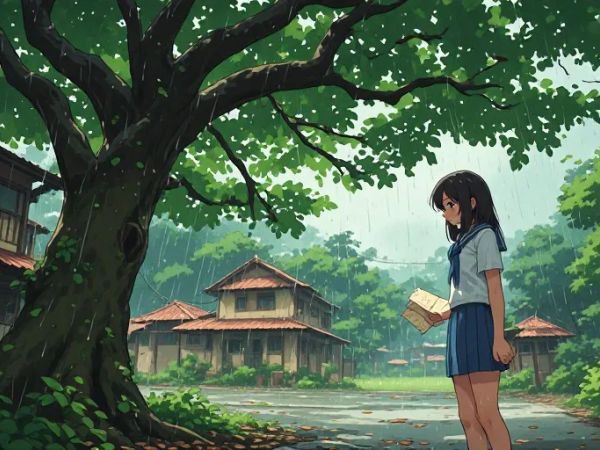
Chapter 1: The Girl with the Sketchbook and the Worn Teddy Bear
In the small, sun-kissed town of Kamunting, where the air smelled of honey-sweetened breezes and blooming roses, lived a little girl named Maisie. At just nine years old, Maisie was an old soul trapped in a child’s body, often found sitting with her sketchbook on the porch, drawing the laughter of her family. But beneath her cheerful exterior, Maisie wore a heavy heart, like the worn-out teddy bear she cherished.
Her teddy bear was called Button.
Button had one floppy ear, a crooked smile, and a belly that had been patched so many times that Maisie had stopped counting. He had belonged to her since she was little enough to believe every stuffed animal had secret conversations while children slept.
These days, Maisie wasn’t so sure.
Still, she kept Button tucked beside her pillow every night.
On Saturday mornings, Maisie liked to sit on the wooden porch outside her family’s little house with her sketchbook balanced on her knees.
The town woke slowly around her.
Motorbikes buzzed down the road. A rooster somewhere nearby announced the morning as if he had personally invented it. From the kitchen came the clink-clink of spoons against cups, followed by the warm smell of coffee drifting through the open windows.
Maisie drew everything.
She drew Uncle Jalen’s enormous slippers.
She drew Auntie Suri trying to catch a runaway clothes peg.
She drew her little cousin Milo making a face whenever he ate something sour.
But most of all, she drew people laughing.
She had discovered that laughter was surprisingly difficult to draw.
You couldn’t simply draw an open mouth and two rows of teeth.
Real laughter lived in the eyes.
It made shoulders shake.
It made people lean toward each other.
It made hands slap tables and feet shuffle beneath chairs.
So Maisie watched carefully.
She wanted to remember every laugh.
Especially lately.
Chapter 2: The Coffee Spill and the Hidden Message
That morning, she was drawing her grandmother, Nana Elsie, who sat at the kitchen table with her favorite cup of coffee.
Nana Elsie had silver hair that curled around her ears and spectacles that always seemed to slide down her nose whenever she was concentrating.
Maisie carefully drew the tiny wrinkles beside Nana’s eyes.
“Why are you making me look so old?” Nana asked.
Maisie looked up.
“Because you are old.”
Nana gasped dramatically.
“Cheeky!”
Maisie giggled.
Nana laughed too.
And Maisie quickly added the laugh lines to her drawing.
Then something happened.
A sudden breeze swept across the porch.
Maisie’s sketchbook fluttered.
She grabbed for it.
At exactly the same moment, Milo came racing out of the kitchen.
“Maisie! Look!”
He held up a spoon.
“I can balance it on my nose!”
“Milo, don’t—”
Too late.
Milo bumped the table.
Nana’s coffee jumped out of its cup.
Splash!
Brown coffee scattered across the porch.
A few drops landed on Maisie’s sketchbook.
One large stain spread across the page.
Maisie froze.
The laughter disappeared from her face.
“Oh.”
Milo’s eyes widened.
“I’m sorry.”
Maisie slowly lifted the page.
The coffee had soaked through her drawing.
Nana’s face was blurred.
Her spectacles were a brown smudge.
The carefully drawn laugh lines had disappeared beneath a spreading stain.
For a moment, Maisie couldn’t speak.
Then she closed the sketchbook.
“It’s okay.”
Nana reached for her.
“Maisie—”
“It’s okay.”
She stood.
“I’m just going inside.”
She carried the sketchbook into her room and shut the door.
Button sat on her bed.
Maisie dropped beside him.
“Everything gets ruined,” she whispered.
Button, as usual, said nothing.
Maisie opened the sketchbook again.
The page was awful.
She wanted to tear it out.
She even put her fingers around the corner.
But then she stopped.
Underneath the coffee stain, something strange had appeared.
A faint blue line.
Maisie frowned.
She tilted the page toward the window.
The sunlight shone through the damp paper.
There was another drawing underneath.
She hadn’t drawn it.
Slowly, Maisie turned the page.
The sheet behind it had a faint outline of a little girl sitting on a porch.
The girl had a teddy bear beside her.
Maisie’s heart gave a funny little thump.
She turned another page.
More faint marks.
A tiny house.
A wooden table.
A woman with silver hair.
And beneath the drawing were three words written in faded pencil:
Keep the ordinary things.
Maisie stared.
She knew that handwriting.
It belonged to her mother.
Her mother had written those words years ago, back when Maisie was still small enough to need help tying her shoes.
Maisie sat perfectly still.
She had almost forgotten that page existed.
Her mother had once told her that ordinary days were often the ones worth remembering most.
Maisie had laughed at the time.
She’d thought important memories were supposed to involve fireworks, giant birthday cakes, or exciting adventures.
But now she understood what her mother meant.
A cup of coffee.
A crooked teddy bear.
A family laughing around a table.
A Saturday morning.
Ordinary things.
Maisie traced the words with her fingertip.
Then she noticed something else.
At the bottom of the page was a tiny drawing of a coffee cup.
Beside it, another message:
Make room for the mess.
Maisie smiled despite herself.
“Really, Mum?”
She looked at the coffee stain.
It wasn’t pretty.
It wasn’t perfect.
But it had uncovered something she had forgotten.
Maybe the stain hadn’t ruined the picture.
Maybe it had changed it.
That afternoon, Maisie took her sketchbook outside.
Milo was sitting on the front step, looking miserable.
“I’m sorry,” he said.
Maisie sat beside him.
“I know.”
“I ruined your drawing.”
“You spilled coffee.”
“That’s the same thing.”
Maisie shook her head.
“No. I think the drawing was waiting for you.”
Milo frowned.
“What?”
Maisie showed him the hidden picture.
His mouth dropped open.
“Whoa.”
“I know.”
“Did the coffee make that?”
“Sort of.”
Milo leaned closer.
“Can we make another?”
Maisie smiled.
“Maybe.”
Chapter 3: The Community Project and the Great Water Spill
By Monday, Maisie had an idea.
Her school was preparing for a small community open day. Every class had been asked to create something showing what made their neighborhood special.
Maisie’s teacher, Miss Rina, suggested paintings.
Some children wanted to paint flowers.
Others wanted to paint houses.
Milo, who wasn’t even in Maisie’s class, suggested painting himself eating noodles.
Nobody chose that idea.
Maisie wanted something different.
She stood in front of the blank classroom board.
“What if we make a giant picture of ordinary things?”
Her classmates stared.
“Like what?” asked Farah.
“Breakfast tables. Shoes outside doors. Umbrellas. Bicycles. People laughing. Cups. Dogs sleeping under benches.”
“And coffee stains?” someone asked.
Maisie grinned.
“Especially coffee stains.”
The class laughed.
Over the next few days, everyone brought something.
A pressed leaf.
A receipt from a little shop.
A scrap of wrapping paper.
A pencil rubbing of the school gate.
A tiny drawing of a grandmother watering plants.
Maisie painted in the middle.
At first, she tried to make everything neat.
Then she remembered the message.
Make room for the mess.
So she stopped.
She let paint drip.
She let pencil lines wander.
She let one corner become too crowded.
And something wonderful happened.
The picture began to feel alive.
It looked like their town.
Not the perfect version.
The real version.
A little messy.
A little noisy.
Warm.
On Thursday afternoon, disaster struck again.
The class had almost finished.
The giant artwork was spread across several tables.
Everyone was proud of it.
Then a bucket of rinse water tipped over.
Water rushed across the paper.
Paint ran.
Blue became green.
Green became gray.
A yellow sun dissolved into a muddy puddle.
Someone gasped.
“Oh no.”
Maisie stared.
Her stomach tightened.
Not again.
She wanted to shout.
She wanted to grab the paper and run.
She wanted everything to stop changing.
Miss Rina hurried over.
“Everyone, step back.”
The room became silent.
Maisie looked at the ruined artwork.
Then she looked at her classmates.
Farah was biting her lip.
Juno looked ready to cry.
Even the loudest children had gone quiet.
Maisie took a breath.
“It isn’t ruined.”
Everyone looked at her.
She wasn’t completely sure she believed herself.
But she remembered Nana’s coffee.
She remembered the hidden drawing.
She remembered the words.
Make room for the mess.
Maisie walked to the table.
“What if we don’t fix the water marks?”
Farah blinked.
“What do you mean?”
“We use them.”
“How?”
Maisie picked up a thick pencil.
She studied the spreading gray shapes.
“They look like clouds.”
Juno leaned closer.
“They do.”
“And this one looks like a river.”
“It really does!”
Soon everyone was moving.
The gray water stain became a cloudy sky.
A green paint smear became a hill.
A yellow streak became sunlight.
Someone added tiny paper boats.
Someone else drew bicycles.
Farah painted flowers around the edges.
Juno added little people holding hands.
Maisie drew a coffee cup in the corner.
Inside it, she drew a tiny heart.
Then she added Button.
Not the real Button.
A little painted version.
One floppy ear.
One crooked smile.
When the artwork was finally finished, everyone stood around it.
Nobody spoke for several seconds.
Then Miss Rina smiled.
“It’s beautiful.”
Maisie looked at the picture.
It wasn’t perfect.
There were uneven lines.
Smudges.
Water marks.
Paint drips.
Little mistakes everywhere.
But the picture seemed to breathe.
It told a story.
Their story.
The story of a place where people spilled drinks, dropped things, laughed too loudly, hurried through rain, forgot umbrellas, shared snacks, and somehow kept going.
Chapter 4: The Open Day and the Beauty of Memories
Maisie felt something loosen inside her chest.
For weeks, she had been trying to hold everything still.
She had been drawing every smile because she was afraid she might forget it.
She had been keeping little moments because she thought memories disappeared if you didn’t capture them perfectly.
But perhaps memories weren’t glass jars.
Perhaps they were more like gardens.
They changed.
They grew.
Sometimes the rain knocked things sideways.
Sometimes a coffee stain appeared.
And sometimes something beautiful grew from it.
On the morning of the open day, the school grounds filled with families.
Children ran between tables.
Adults carried plates of food.
Someone’s speaker played cheerful music.
The air smelled of flowers, warm bread, and coffee.
Maisie’s family arrived together.
Nana Elsie walked slowly beside Uncle Jalen.
Milo raced ahead.
“There! There! Come see Maisie’s picture!”
Maisie stood beside the artwork.
Her hands were cold.
She suddenly felt nervous.
What if everyone thought it looked messy?
What if they didn’t understand?
Nana stepped closer.
She studied the painting.
Then she noticed the coffee cup.
Her eyes softened.
“You remembered.”
Maisie nodded.
“I found your coffee stain.”
Nana laughed.
“That was quite a coffee stain.”
“It wasn’t just a stain.”
“No?”
Maisie shook her head.
“It helped me find something.”
Nana waited.
Maisie touched the edge of the painting.
“I think I was trying too hard to keep everything perfect.”
Nana smiled.
“And now?”
Maisie looked at her family.
Milo had paint on his sleeve.
Uncle Jalen’s shoelace was untied.
Nana’s coffee cup was already half empty.
“Now I think messy things can be memories too.”
Nana squeezed her hand.
“That’s a very wise thought for a nine-year-old.”
Maisie grinned.
“I told you I’m old.”
Nana laughed.
“There she goes again.”
Maisie laughed too.
And this time, she didn’t rush to draw it.
She simply listened.
The sound filled her like warm sunlight.
Later that day, Maisie’s teacher announced that their class had received a special award for the most imaginative project.
Everyone cheered.
Maisie didn’t care much about the award.
What mattered was the little crowd around their painting.
Children were pointing at different parts.
Parents were laughing at the tiny drawings.
One woman spotted the painted coffee cup.
“What’s that?”
Maisie smiled.
“A reminder.”
“Of what?”
Maisie thought for a moment.
“That things don’t have to stay perfect to stay special.”
The woman nodded.
“That’s a good reminder.”
Chapter 5: A Heart That Can Make Room for Joy
That evening, the family returned home tired and happy.
Nana made coffee.
Milo tried to balance a spoon on his nose again.
Maisie opened her sketchbook.
She began a new drawing.
This time, she didn’t draw the laughter perfectly.
She drew Nana’s cup.
Milo’s ridiculous spoon trick.
Uncle Jalen’s slippers.
The sunlight across the table.
And Button sitting on a chair.
Then she deliberately let one brown pencil line wander outside the picture.
She smiled.
It looked better that way.
When she finished, she wrote beneath the drawing:
Saturday morning. Coffee stain. Everybody laughing.
Then she closed the sketchbook.
For the first time in a long while, Maisie didn’t feel afraid of forgetting.
She knew she couldn’t keep every moment.
Nobody could.
Days would change.
People would grow.
Pictures would fade.
Cups would crack.
Teddy bears would lose their stuffing.
Paint would run.
Coffee would spill.
And hearts, sometimes, would feel heavy.
But heavy didn’t mean broken.
A heart could carry sadness and still make room for joy.
It could hold old memories and new ones at the same time.
Maisie looked toward the kitchen.
Nana was telling a story.
Milo was laughing so hard he could barely breathe.
Uncle Jalen was pretending not to listen.
The house felt warm.
Ordinary.
Wonderful.
Maisie picked up her pencil.
Then she stopped.
She didn’t draw.
She simply listened to the sound of everyone she loved laughing together.
And somewhere beneath that laughter, she could hear her own heartbeat.
Soft.
Steady.
There.
Maisie smiled.
Some memories needed pictures.
Some needed words.
And some were meant to be lived.
So she put down her pencil, tucked Button beneath her arm, and went to join the others.
Behind her, on the table, the sketchbook remained open.
Across the page was one little coffee stain.
And this time, Maisie thought it was beautiful.
The End…